"Who Would Believe It?"
Opinions Divided Over Disclosure of Advisory Documents
"Legalization of Confidentiality Rights Needed
to Guarantee Defense Counsel Assistance Rights"
"Lawyer, please prepare a response letter for the Financial Supervisory Service investigation" (In-house lawyer at Kakao)
"Yes, you mean a general response, right?" (Lawyer at a major law firm)
On the 29th of last month, a KakaoTalk conversation between Kakao and a law firm lawyer was disclosed in the courtroom of the Seoul Southern District Court, revealing Kakao's internal situation ahead of the Financial Supervisory Service’s special investigation. In the trial related to former Kakao Chief Investment Officer Bae Jaehyun’s alleged market manipulation of SM Entertainment, the prosecution revealed this conversation, arguing that it appeared Kakao was fabricating circumstances in preparation for the investigation after already committing market manipulation. As searches of lawyers’ offices have expanded beyond criminal cases into advisory areas, concerns are rising that clients’ fear of consultation content leaks may ultimately restrict their ‘right to receive legal assistance.’
Disclosure of Advisory Documents Between ‘Law Firm and Client’
During the trial, multiple major law firms contacted by Kakao were named, and documents received from each were disclosed. The prosecution showed an advisory document Kakao received from Law Firm B, claiming, “They discuss boosting the stock price through on-market purchases as a way to induce the failure of Hive’s (SM Entertainment stock) public tender offer,” arguing that the market manipulation was planned.
In response, the defense revealed emails among lawyers at Law Firm B. The lead lawyer at Law Firm B instructed other lawyers, “It seems Law Firm C represents both SM and Hive. Law Firm D represents SM, Law Firm E represents Lee Soo-man, and Law Firm F appears to be assisting Kakao. Come up with ideas on how to leverage this structure most favorably for us.”
Bae’s defense lawyer disclosed the email, stating, “This shows the background of Law Firm B advising on matters related to SM Entertainment’s on-market stock accumulation without Kakao’s request,” and argued, “Kakao did not even view the presentation proposing this engagement.” They claimed it was merely a law firm’s advisory opinion, and Kakao never requested or planned Hive’s public tender offer failure inducement.
Concerns Over Advisory Retraction: ‘Who Would Trust to Speak?’
Legal circles are divided over the advisory documents disclosed in this trial. Some argue that to uncover the substantive truth, even lawyer-related content can be introduced as evidence in court. Others contend that advisory documents and work-related communications between client and lawyer should be protected.
While law enforcement agencies have occasionally searched law firms or lawyers’ offices, it is rare for lawyers’ advisory documents and KakaoTalk conversations to be admitted as evidence and disclosed in court as in this case. A criminal lawyer at a major law firm said, “If the defense objects to the admission of evidence submitted by the prosecution during the trial, it may give the court the impression that facts are being concealed, which can be disadvantageous. Therefore, no matter how much the advisory documents were exchanged with the lawyer, the defense often has no choice but to agree to their admission. This situation undermines the right to legal assistance.”
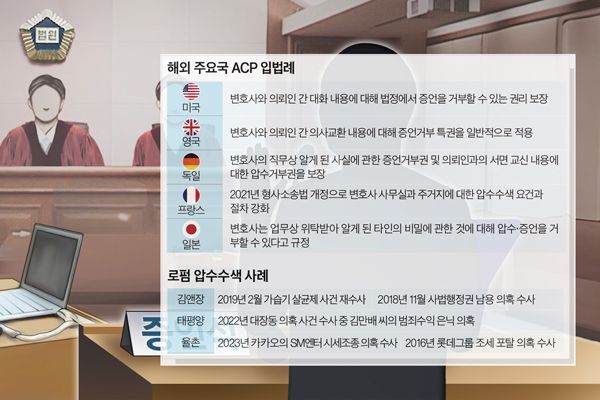
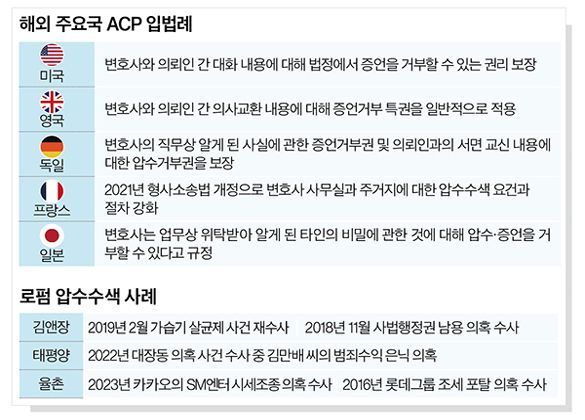
Within the legal profession, there has been a consistent call for the establishment of ‘Attorney-Client Privilege (ACP)’ to effectively guarantee the right to legal assistance. The current Attorney-at-Law Act only stipulates lawyers’ duty of confidentiality (Article 26), prohibiting current and former lawyers from disclosing secrets learned in the course of their duties, but it does not grant lawyers the right to refuse disclosure of conversations or materials exchanged with clients. In contrast, countries such as the United States, the United Kingdom, and Germany have legislated ACP.
Precedent Recognizing the Right to Keep Legal Advice Confidential Emerges
Recently, a lower court ruling recognizing the ACP right has attracted attention.
Last month, the Seoul Southern District Court accepted a petition for provisional relief filed by Jang Ha-won, former CEO of Discovery Asset Management, against a search and seizure order, stating, “To receive sufficient legal assistance, trust based on confidentiality must be guaranteed, and lawyers may refuse to disclose communications made for the purpose of legal advice.” The court ruled, “Messages or emails sent or received by lawyers affiliated with a law firm, or documents prepared by lawyers among the seized items, violate the constitutional right to legal assistance and are unlawful.”
A criminal lawyer in Seocho-dong said, “If additional costs arise from security measures such as storing materials on external servers, these costs may ultimately be passed on to the client.”
Reporter Lim Hyunkyung, Legal Times
※This article is based on content supplied by Law Times.
© The Asia Business Daily(www.asiae.co.kr). All rights reserved.


















