Ali, Temu, and Others See Rapid Increase in Domestic Users of Chinese E-commerce
Merchants Say "Competition at a Different Level from Existing Online Market"
"16-color eyeshadow palette 1,800 won, wireless Bluetooth headphones 1,800 won."

Not only are these prices unprecedentedly low in Korea, but this site also offers free shipping and free returns for 7 days. This is the AliExpress website, often called the "Coupang of China." Recently, the so-called "Ali-Te-Shi," referring to Chinese e-commerce companies AliExpress, Temu, and Shein, have been aggressively marketing to Korean users to encourage sign-ups.
After Coupang, AliExpress... Rapid Increase in 'Chinese Direct Purchase' Users
As the once complicated and difficult "overseas direct purchase" becomes more convenient and accessible, the number of domestic users is rapidly increasing. According to app analysis service companies WiseApp, Retail, and Goods, as of January, the most used comprehensive online shopping mall app by Koreans was Coupang, followed by AliExpress, 11st, and Temu. The number of AliExpress app users reached 8.18 million as of February, a 130% increase compared to February last year; Temu had 5.81 million users, and Shein had 680,000 users.
AliExpress user Lee Kyung-hee (22) said, "When buying clothes or cosmetics, I first look for YouTube reviews and then quickly search and purchase online. Although I feel a bit uneasy because it’s a Chinese site, I joined because the prices are much cheaper."
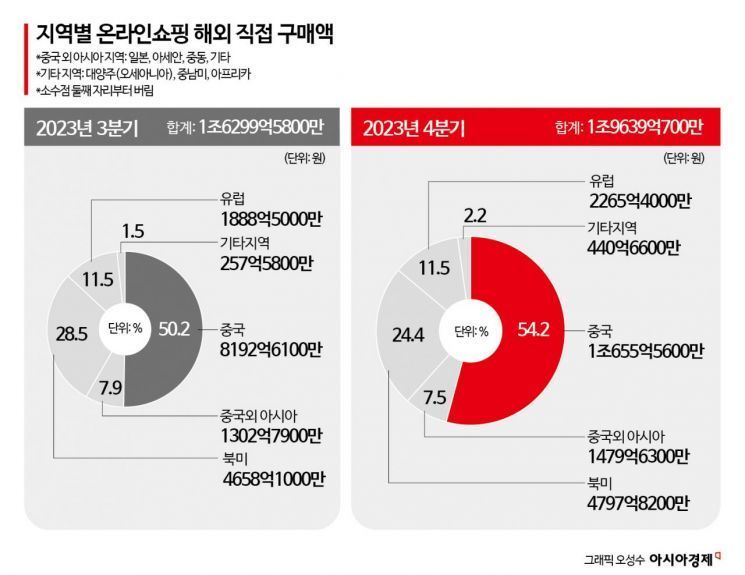
According to Statistics Korea's "Online Shopping Overseas Direct Purchase Amount by Region and Product Group," the total global direct purchase amount in the fourth quarter of last year was about 1,963.97 billion won, of which China accounted for about 1,065.56 billion won, approximately 54% of the total.
Deepening Worries of Small Business Owners Due to Price Competition from China
Domestic merchants unanimously described the aggressive marketing by Chinese e-commerce as "competition unlike anything before." Jeong, who has operated a mobile phone case store in Seodaemun-gu, Seoul for six years, said, "Domestic e-commerce sellers have been importing goods from China and selling them with a markup, so offline store operators could compete by providing better service to customers or accepting lower margins. But now that middlemen are gone, competition with Chinese e-commerce sellers like us is impossible." When comparing the price of a transparent silicone smartphone case, AliExpress sells it for under 1,500 won, which is much cheaper than 2,000 won on Naver Shopping and 3,000 won in offline stores.
Kim, a clothing store merchant in Dongdaemun-gu, Seoul, also sighed, "Domestic companies pay customs duties when importing from China and taxes on all domestic sales, so the product prices go up. Consumers easily buy products online just by looking at prices, so how can we beat Chinese prices?"
Small business owners are expected to face even greater difficulties as domestic e-commerce grows and the global e-commerce market joins in. In December last year, Ray Zhang, head of AliExpress Korea, stated, "We are keeping all possibilities open to achieve our goals," and mentioned that they are considering opening a logistics center locally in Korea next year. Coupang also announced last month that it will invest over 3 trillion won to expand Rocket Delivery nationwide by 2027.
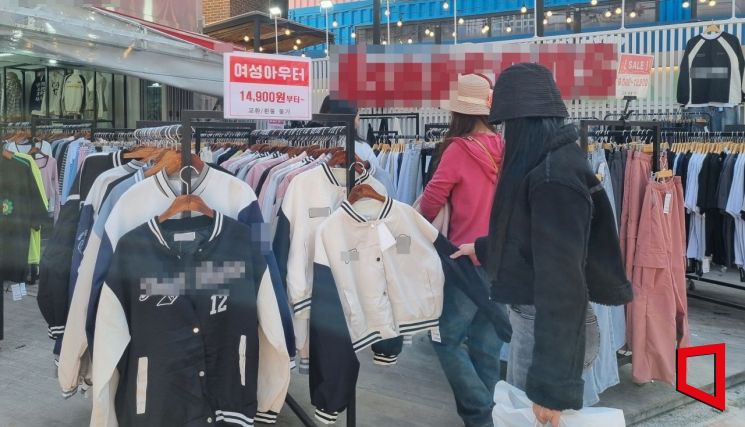 Citizens are looking at clothes in front of a clothing store in Seogyo-dong, Mapo-gu, Seoul.
 Photo by Shim Seong-a
Offline store operators cannot help but worry deeply. Kang Da-hee (31), who has run a clothing store in Seogyo-dong, Mapo-gu, Seoul for four years, said, "These days, clothing designs are all very similar, and many customers try on clothes in the store but then search online to purchase. Thinking that this trend will worsen and hurt sales is daunting," she expressed her concerns.
Experts advise accepting the intensifying global competition and developing each one's unique strengths. Professor Park Jeong-eun of Ewha Womans University’s Department of Business Administration said, "Economically, not only superior products sell; there is demand for lower-quality products as well. It is important for small business owners to explore differentiating factors and focus on products where they have a competitive advantage." She added, "The government needs to ease regulations to create an environment where domestic merchants and companies can freely compete with global e-commerce."
Professor Choi Cheol of Sookmyung Women's University’s Department of Consumer Economics also said, "Comparing the distribution structures of large e-commerce and small merchants, it is naturally difficult to compete. They must continuously strive to find ways to be chosen by consumers." However, Professor Choi also noted, "While consumers freely choose sellers, it is necessary to be aware of the market structure changes when foreign companies dominate the domestic distribution system. If such social discussions increase, consumers will make decisions based on their own ethics and thoughts."
© The Asia Business Daily(www.asiae.co.kr). All rights reserved.



















