Minister Lee Sang-min at the Central Disaster and Safety Countermeasures Headquarters Meeting: "Government Policy Is Open"
Flexible Stance on Medical School Expansion, President Also Urges Dialogue
Residents Remain Firm... Court Sides with Government
The government stated that if better opinions and rational grounds are presented regarding the increase in medical school quotas, the policy could change in a better direction. It reiterated a flexible stance on the increase in medical school quotas and emphasized President Yoon Seok-yeol's willingness to meet with residents.
On the 3rd, Lee Sang-min, Minister of the Ministry of the Interior and Safety (Deputy Head of the Central Disaster and Safety Countermeasures Headquarters), said before the Central Disaster and Safety Countermeasures Headquarters meeting, "The government's medical reform and normalization tasks are to protect the lives and health of the people."
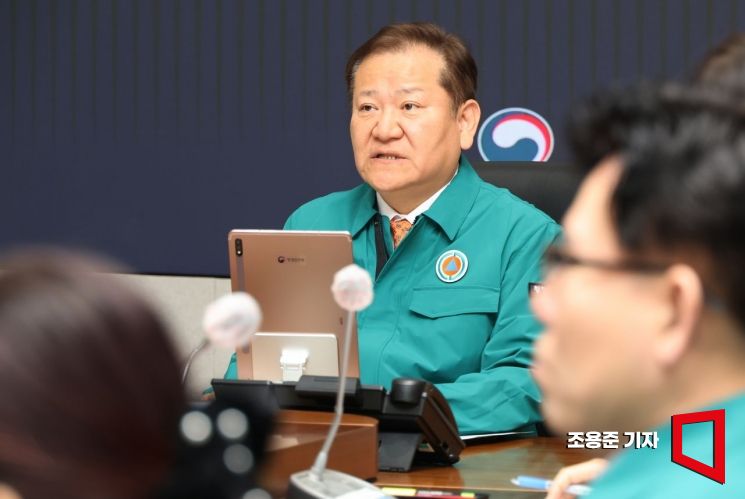
In particular, Minister Lee urged dialogue, saying, "The government's policy is always open." He added, "Yesterday, the President said he would meet directly with the residents, who are the parties involved in the collective action, to hear their stories." He urged the residents to return to hospitals as soon as possible, saying, "When you return to the bedside of patients and fulfill your duties, your opinions and voices will be louder and heavier."
He also promised support for the medical community. Minister Lee said, "The scale of medical school faculty increases by university for next year will be reviewed comprehensively based on the demands submitted by each university by April 8, considering the scale of student increases and regional essential medical needs." He added, "The procedures for increasing 1,000 full-time medical school professors over three years until 2027 are also being carried out without delay." He further stated, "We plan to sufficiently secure the necessary resources for medical reform, including expanding the number of doctors, fostering medical institutions for regional and essential medical care, training medical personnel such as residents, compensation to maintain essential medical services, and establishing a safety net for medical accidents."
The government has already expressed a flexible stance on increasing medical school quotas. In a statement on the 1st, President Yoon said, "If a more reasonable and rational plan is brought forward, it can be discussed at any time," emphasizing, "If the medical community insists that the increase should be reduced from 2,000, they should present a unified plan with clear scientific evidence to the government, not engage in collective action."
This message came amid a tense standoff between the government and the medical community over the '2,000 increase,' indicating that if a rational and scientific 'single plan' is presented, the scale itself will be discussed.
The day before, the Presidential Office also released a statement saying, "President Yoon wants to meet with residents and hear their stories directly," and Prime Minister Han Duck-soo appeared on a broadcast to reiterate President Yoon's intention to meet and talk with residents who left hospitals in opposition to the increase in medical school quotas. Prime Minister Han urged, "I hope those around the residents, such as their parents and professors, actively persuade them so that dialogue can take place," and also mentioned plans to form a social consultative body. The government envisions a body including the government, medical community, and the public, with patients as beneficiaries of medical services also included.
Some analyses suggest that residents are becoming more hardline due to the government's flexible attitude. In an online poll conducted the day before, 96% of residents and medical students opposing the government's policy to increase medical school quotas believed that the medical school admission quota should be 'reduced or maintained as is.' This stance still opposes the government's estimate that 15,000 doctors will be lacking in 10 years.
However, the government took the lead legally. The day before, the court dismissed the medical community's injunction request to cancel the government's decision to increase medical school admission quotas by 2,000. The court ruled that the counterpart to the policy of expanding medical school quotas is the 'head of the university,' not the professors. Even if the quota increase makes it difficult to provide quality education as the professors claim, it is a problem each university must solve. The court also pointed out that the economic damage to doctors caused by the increase in the number of doctors is not a consideration.
© The Asia Business Daily(www.asiae.co.kr). All rights reserved.
![Clutching a Stolen Dior Bag, Saying "I Hate Being Poor but Real"... The Grotesque Con of a "Human Knockoff" [Slate]](https://cwcontent.asiae.co.kr/asiaresize/183/2026021902243444107_1771435474.jpg)
















