Biden Manages US-China Relations Ahead of November Election
Biden: "Blocking Advanced Technology Threats to National Security"... Xi: "Will Not Stand Idly By"
U.S. President Joe Biden spoke with Chinese President Xi Jinping on the 2nd (local time), conveying concerns regarding the denuclearization of the Korean Peninsula, peace and stability in the Taiwan Strait, and China’s military support for Russia related to the Ukraine war. This is interpreted as an attempt to narrow differences on international issues and seek the maintenance and stabilization of bilateral relations ahead of the U.S. presidential election in November. The U.S. daily The Washington Post (WP) evaluated, "This call is part of a series of diplomatic efforts both sides have been conducting since late last year to advance cooperation amid tense relations." However, the two leaders confirmed clear differences in positions, running parallel on issues related to U.S.-China technological competition and the Taiwan matter.
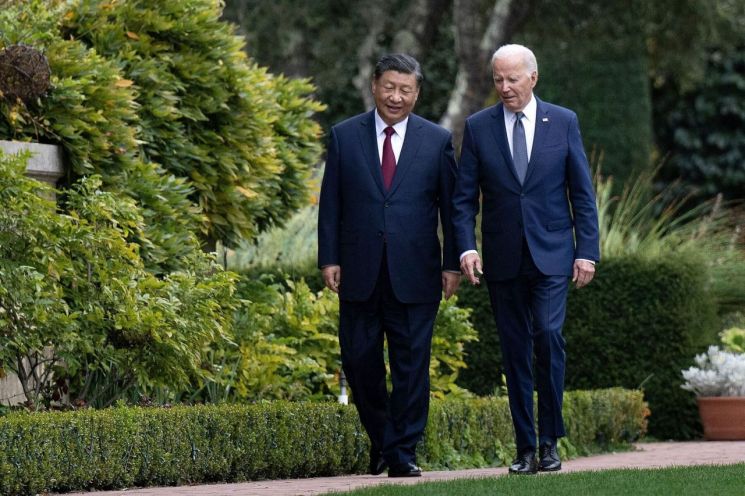
President Biden had a 1 hour and 45 minutes phone call with President Xi on the day. It was about five months since the two leaders last communicated directly after their in-person summit in San Francisco in November last year.
They discussed artificial intelligence (AI), military cooperation, climate change, and efforts to combat drug trafficking. They also exchanged views on resuming high-level exchanges between the two countries and fully restoring military communications. Additionally, they agreed to hold a Maritime Military Security Consultative Agreement (MMCA) meeting this month in Hawaii to discuss measures to prevent maritime collisions between the two countries.
According to the U.S. summary of the call, President Biden expressed concerns about China’s support for Russia’s defense industry. He also emphasized the importance of maintaining peace and stability in the Taiwan Strait and the rule of law and freedom of navigation in the South China Sea. Ahead of Lai Ching-te’s inauguration as Taiwan’s new president next month, the message was to avoid escalating tensions in the Taiwan Strait. Discussions were also held on progress toward denuclearization of the Korean Peninsula. The U.S. requested China’s role in preventing conflicts from spreading in regions already at war or at risk of accidental clashes.
Regarding this, President Xi stated, "The Taiwan issue is the first red line that must not be crossed in China-U.S. relations," adding, "We will not tolerate separatist activities by Taiwan independence forces or external connivance and support."
The U.S. and Chinese leaders also showed stark differences in trade and technological competition.
President Biden pointed out "unfair trade policies and anti-market economic practices," hinting at imminent tariffs on China. He also said, "The U.S. will continue to take necessary measures to prevent American advanced technologies from being used to threaten national security," signaling continued restrictions on semiconductors, AI, and other advanced technologies toward China.
In response, President Xi said, "The U.S. has taken endless economic, trade, and technological suppression measures against China, and the list of sanctions on Chinese companies is growing longer," adding, "If the U.S. tries to suppress China’s advanced technology development and deprive China of its legitimate right to development, we will not stand idly by."
Amid this atmosphere, U.S. Treasury Secretary Janet Yellen will visit China on the 3rd. As previously announced, Secretary Yellen is expected to focus on criticizing the Chinese government’s massive subsidies in solar power, electric vehicles, and other sectors, which are inducing global overproduction. China’s overproduction is said to distort companies in other countries and the global economy. She also plans to demand fair treatment for American workers and companies. Secretary of State Antony Blinken is also scheduled to visit China soon.
The call between the two leaders on this day is interpreted as reflecting President Biden’s intention to prevent U.S.-China clashes and manage bilateral relations stably ahead of the U.S. presidential election in November. China, facing internal issues such as a real estate market downturn and youth unemployment, is also seen as seeking to avoid conflict with the U.S. and blunt the U.S.’s containment measures to overcome its economic slowdown.
The New York Times (NYT) reported, "Since last summer, President Biden and President Xi have been working to prevent disputes between the two countries," adding, "President Biden is focusing on a fierce competition for re-election this year, while President Xi is grappling with numerous domestic issues such as economic difficulties and corruption among senior military officials." The WP, citing senior officials, evaluated, "Both sides have realized the importance of managing the relationship in a more responsible manner."
© The Asia Business Daily(www.asiae.co.kr). All rights reserved.

















