KAIST Research Team Develops MRI-Based Diagnosis and Monitoring Technology for Non-Alcoholic Steatohepatitis
A technology that can detect non-alcoholic fatty liver disease using magnetic resonance imaging (MRI) instead of tissue biopsy has been developed for the first time in the world.
KAIST (President Kwang Hyung Lee) announced on the 2nd that a joint research team led by Professor Sang-Yong Jeon of the Department of Biological Sciences and Professor Sung-Hong Park of the Department of Bio and Brain Engineering has developed a technology that easily monitors and diagnoses the progression of non-alcoholic steatohepatitis through MRI scanning for the first time worldwide.
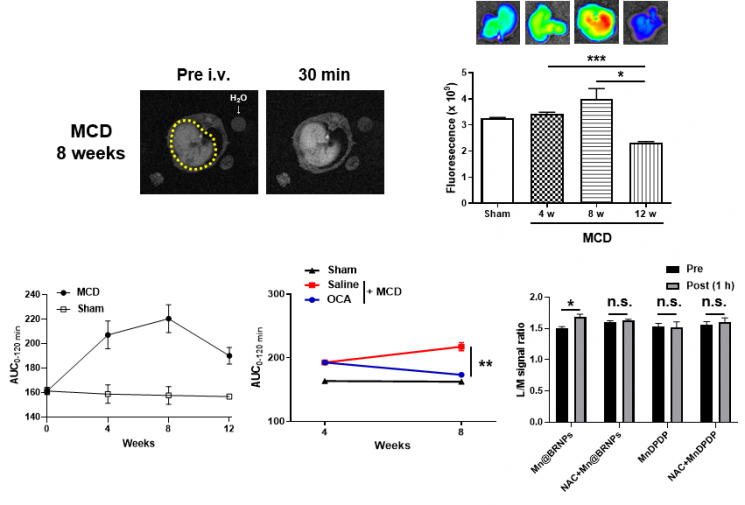 Experimental results confirming the monitoring of non-alcoholic steatohepatitis progression using manganese ion-bonded bilirubin nanoparticles.
Non-alcoholic steatohepatitis is a disease that can progress to liver cell damage, inflammation, and even cirrhosis, but it usually requires diagnosis through liver biopsy, which involves inserting a needle to collect liver tissue, posing significant risks to patients and making it difficult for medical staff to track the disease progression stages.
The research team identified a close relationship between increased levels of reactive oxygen species in the liver and non-alcoholic steatohepatitis. They developed manganese ion-bound bilirubin nanoparticles that can enhance MRI signals in response to changes in reactive oxygen species levels in the liver, and studied a technology that can precisely track the progression of non-alcoholic steatohepatitis using these nanoparticles.
Through various experiments, the research team confirmed that manganese ion-bound bilirubin nanoparticles sensitively respond to changes in reactive oxygen species levels in liver disease model mice, adjusting the intensity of MRI signals. Using these nanoparticles, they were able to determine the progression level of non-alcoholic steatohepatitis through MRI scanning.
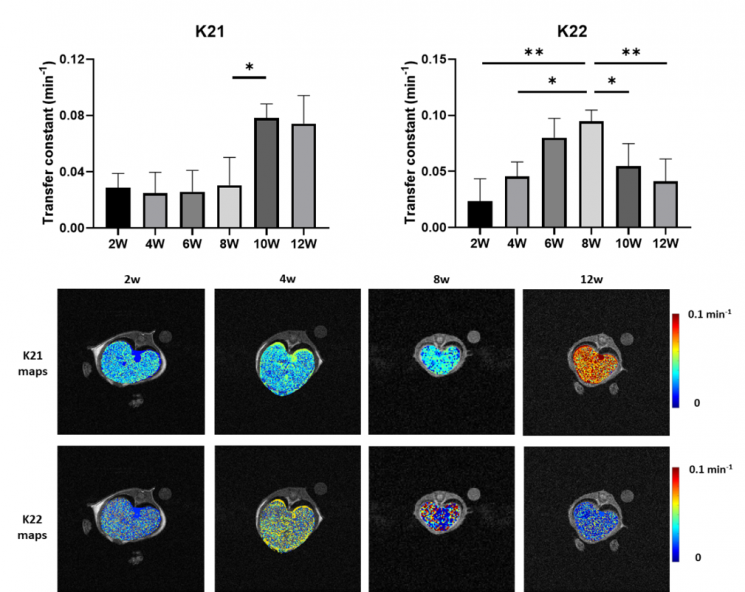 Monitoring Results of Non-Alcoholic Steatohepatitis Progression Using a Dual-Input Similar 3-Compartment Model
The research team expects that the results of this study will greatly contribute to establishing patient-tailored treatment strategies, significantly reduce patient burden, and improve the efficiency of liver disease management and treatment.
Professor Sang-Yong Jeon said, “By using the new MRI contrast agent and imaging analysis model developed through this research, it is expected to replace liver biopsies, which are risky for patients and have been used as the standard diagnosis,” adding, “It is also expected to contribute to the development of effective treatments for steatohepatitis.”
Dr. Won-Sik Jung of the Department of Biological Sciences at KAIST and Dr. Muhammad Asaduddin of the Department of Bio and Brain Engineering participated as co-first authors in this study, which was published online on March 9 in the top-tier materials science journal Advanced Materials (ISSN: 0935-9648 print, 1521-4095 online, Impact Factor: 32).
© The Asia Business Daily(www.asiae.co.kr). All rights reserved.
![Clutching a Stolen Dior Bag, Saying "I Hate Being Poor but Real"... The Grotesque Con of a "Human Knockoff" [Slate]](https://cwcontent.asiae.co.kr/asiaresize/183/2026021902243444107_1771435474.jpg)

















