March Consumer Price Trends
Bread Soars 87.8%...Largest Increase Since 1975
Oil Products Also Rise 1.2% Amid Oil Price Instability
As agricultural product prices continue to soar and oil price instability adds to the pressure, the consumer price inflation rate has recorded over 3% for two consecutive months. In particular, apples and pears saw price increases of nearly 90% compared to the same month last year, marking the highest price surge since related statistics began.
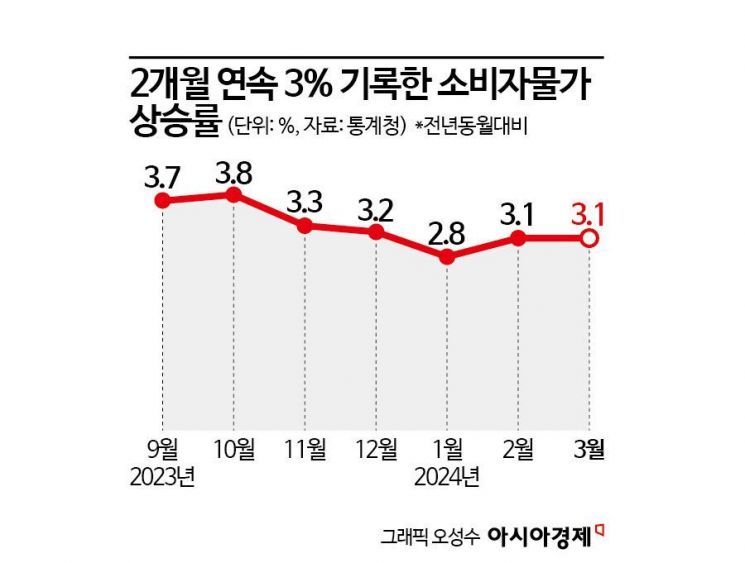
According to the 'March Consumer Price Trends' released by Statistics Korea on the 2nd, consumer prices last month rose 3.1% compared to the same month last year. The consumer price inflation rate fell to 2.8% in January but rose to 3.1% in February, maintaining a level above 3% for two consecutive months.
Agricultural, livestock, and fishery products led the overall price increase with an 11.7% rise. These products had already increased by 11.4% in February, and the rate of increase expanded further in March. In particular, agricultural products rose 20.5% in March following a 20.9% increase in February, marking over 20% growth for two consecutive months and pushing the overall inflation rate up by 0.79 percentage points. This is the highest increase in 35 months since a 13.2% rise in April 2021. Gong Mi-sook, Director of Economic Trend Statistics at Statistics Korea, explained, “(For apples and pears) there is also a base effect due to last year’s prices being very low,” adding, “Without the government’s focused support such as agricultural, livestock, and fishery product price discounts, prices would have risen even more.”
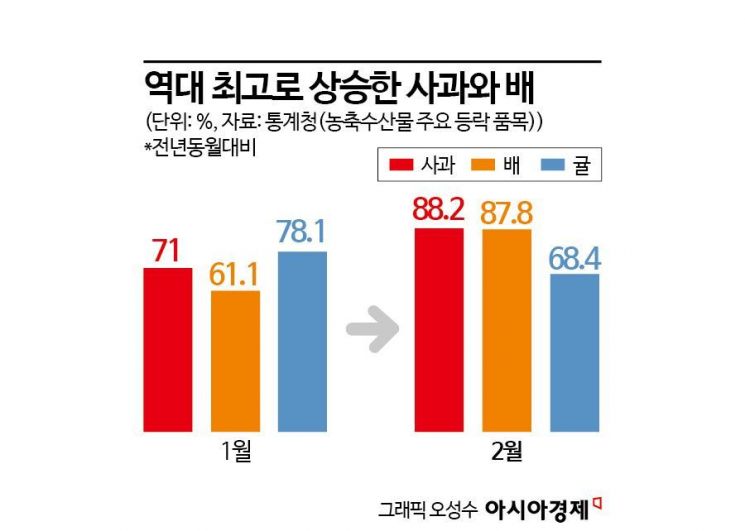
In particular, apple prices surged 88.2%, the largest increase since price statistics began in January 1980. Pear prices also jumped 87.8%, the highest increase since related surveys started in January 1975. Tangerine prices rose 68.4%. Compared to the previous month, apple and pear prices increased by 7.8% and 12.6%, respectively.
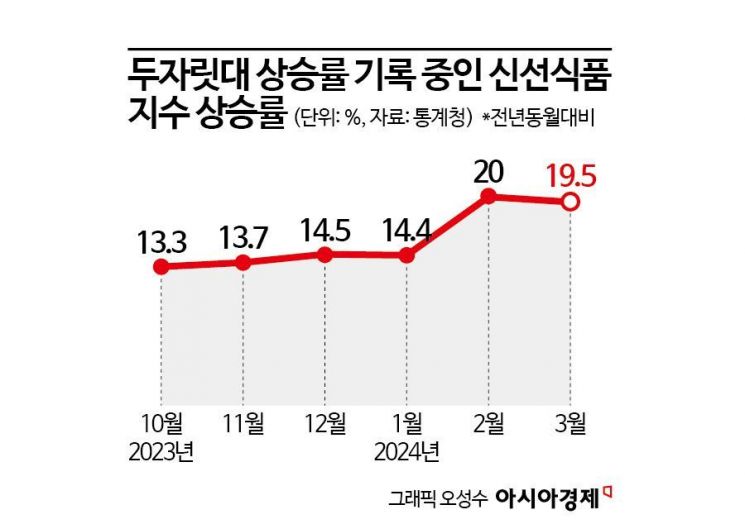
Accordingly, the fresh food index continued its sharp rise, increasing 19.5% in March following a 20.0% rise in February. The fresh food index reflects the prices of 55 items such as fish, seafood, vegetables, and fruits, which are highly sensitive to weather conditions and seasonal changes. The fresh food index has recorded double-digit growth for six consecutive months since October last year. Fresh fruits, excluding almonds, rose 40.9% year-on-year, while fresh vegetables increased by 11.0%.
Adding to the instability in oil prices, petroleum products rose 1.2%, influencing overall inflation. Petroleum prices had been declining since February after a 4.1% increase in January last year but shifted to an upward trend after 14 months. The Ministry of Economy and Finance explained that the rise in international oil prices in February was reflected with a time lag. International oil prices based on Dubai crude continued to rise from an average of $78.9 in January to $80.9 in February and $83.9 in March. Due to escalating tensions in the Middle East, West Texas Intermediate (WTI) crude oil futures closed at $83.71 on the 1st (local time), the highest level in five months since October last year.
Director Gong explained, “The rise in petroleum prices is due to the increase in international oil prices,” adding, “While the overall inflation trend was similar to last month, the contribution of petroleum products increased, which is the difference.” The contribution of petroleum products to overall inflation shifted from -0.06 percentage points in February to 0.05 percentage points. Core inflation (excluding food and energy), which shows the underlying inflation trend, rose 2.4%. The living cost index, which reflects prices of frequently purchased household items and is close to perceived inflation, rose 3.8% due to the impact of rising oil prices.
The government acknowledged concerns that inflation could accelerate due to rising international oil prices but evaluated that the “inflation reins have been tightened” thanks to measures such as the ‘Emergency Agricultural and Livestock Product Price Stabilization Policy’ launched last month. On the 18th of last month, the government announced a support plan for the ‘Emergency Agricultural and Livestock Product Price Stabilization Fund’ and is implementing policies including delivery price support and discount support with a budget of 150 billion won.
A Ministry of Economy and Finance official stated, “Statistics Korea conducts surveys three times a month?early, mid, and late?and it appears that the upward price trend has eased toward the end of the month,” adding, “We see this as a sign that the policy effects are taking hold.” The official further noted, “So far, government support has focused on large supermarkets, but if support expands to small and medium-sized supermarkets and traditional markets included in Statistics Korea’s survey, it will be meaningfully reflected in the statistics.”
However, prices of apples, which have surged nearly 90%, are unlikely to stabilize in the short term. This is because it is difficult to increase supply until the new apple harvest arrives at the end of July. A Ministry of Agriculture, Food and Rural Affairs official also predicted, “Apple prices are expected to stabilize around the end of July when new apples become available.”
Choi Sang-mok, Deputy Prime Minister and Minister of Economy and Finance, forecasted that prices would stabilize from April as weather conditions improve. At a price-related ministers’ meeting held at the Government Complex Sejong on the 2nd, Minister Choi said, “Unless additional unusual factors occur, inflation will peak in March and stabilize rapidly in the second half of the year,” emphasizing, “However, since the inflation level is not absolutely low, we will make every effort to quickly stabilize inflation at around 2%.”
© The Asia Business Daily(www.asiae.co.kr). All rights reserved.
![From Hostess to Organ Seller to High Society... The Grotesque Scam of a "Human Counterfeit" Shaking the Korean Psyche [Slate]](https://cwcontent.asiae.co.kr/asiaresize/183/2026021902243444107_1771435474.jpg)


















