Won-Dollar Exchange Rate Surpasses 1350 Won
Highest Level in 5 Months Since Late October Last Year
Dollar Strength Continues Amid US Economic Recovery
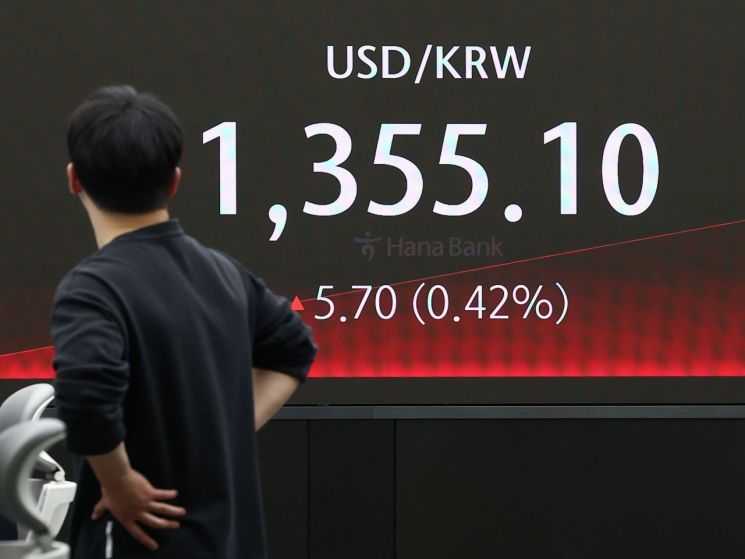 On the morning of the 2nd, KOSPI opened at 2,744.15, down 3.71 points (0.14%) from the previous day, as a dealer was working in the dealing room at the Hana Bank headquarters in Jung-gu, Seoul. On the same day, the won/dollar exchange rate rose by 5.3 won to 1,354.7 won, and KOSDAQ opened down 0.38 points (0.04%) at 912.07. 2024.4.2 [Image source=Yonhap News]
The won-dollar exchange rate hit its highest level in five months. This was largely due to the continued strength of the dollar, driven by better-than-expected U.S. economic performance. The won is also showing weakness in tandem with major Asian currencies such as the yen and yuan. As the won's depreciation is expected to persist through April, import prices are rising, raising concerns about increased consumer inflation.
On the 2nd, in the Seoul foreign exchange market, the won-dollar exchange rate opened at 1,354.7 won, up 5.3 won from the previous trading day. This is the highest level in five months since October 30 last year (1,356.7 won) based on the opening price.
The main cause of the rise in the won-dollar exchange rate is the continued strength of the dollar. The dollar has been strong as the U.S. economy performed better than expected, leading to speculation that the Federal Reserve will delay cutting interest rates.
On the 1st (local time), the Institute for Supply Management (ISM) released the March Manufacturing Purchasing Managers' Index (PMI), which stood at 50.3, significantly higher than February's 47.8. An ISM manufacturing index above 50 indicates economic expansion, and this is the first time in a year and a half since September 2022 that it has surpassed 50. With the U.S. economy showing improvement, the Federal Reserve Bank of Atlanta's 'GDP Now' model sharply revised up the estimated annualized GDP growth rate for the first quarter of this year from 2.3% to 2.8%.
In the federal funds (FF) futures market, the probability that the U.S. Federal Reserve (Fed) will cut the benchmark interest rate in June has dropped to 58.1% from 70% last week. The increased likelihood of a delayed Fed rate cut is contributing to the dollar's strength. The dollar index, which reflects the value of the dollar against six major currencies, closed at 105.02, the highest since November 13 last year.
Oh Hyun-hee, a researcher at Hana Financial Management Research Institute, stated, "Despite the dovish FOMC results, the relatively strong U.S. growth and hawkish remarks from key Fed officials have sustained the dollar's strength."
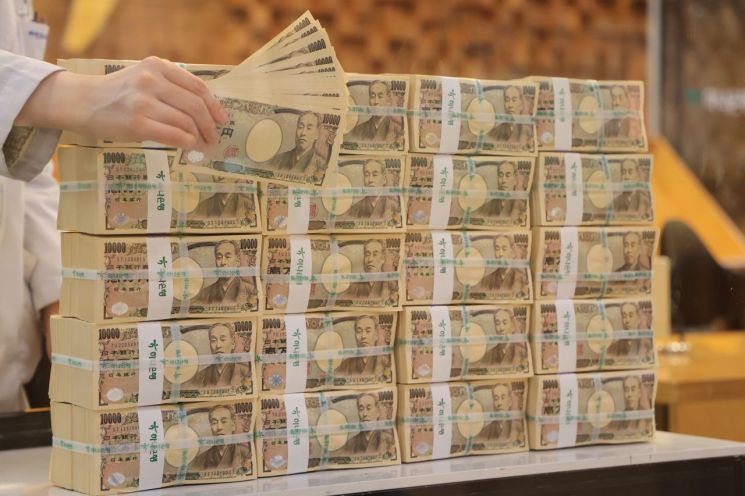 An employee is holding Japanese yen at the Counterfeit Response Center of Hana Bank Headquarters in Jung-gu, Seoul.
 [Photo by Yonhap News]
Simultaneous Weakness of Won, Yen, and Yuan; Won Depreciation May Persist Throughout the First Half of the Year
The simultaneous weakness of the Japanese yen and Chinese yuan is also a factor lowering the won's value. Although the Bank of Japan ended its negative interest rate policy, the yen-dollar exchange rate has surpassed 150 yen for the first time in 34 years, showing a continued weakening trend. The market expects that further rate hikes by the Bank of Japan will be difficult, so the yen's weakness is likely to persist for the time being. The yuan has also continued to weaken amid ongoing uncertainties surrounding the Chinese economy, with remarks from the People's Bank of China’s deputy governor hinting at further reserve requirement ratio cuts and official devaluation announcements.
With multiple factors overlapping, the won's depreciation is expected to continue for the foreseeable future. In April, the dividend season will coincide, increasing foreign demand for dollars, which is also expected to push up the won-dollar exchange rate. Researcher Oh said, "The external factors that triggered the recent won depreciation are unlikely to be resolved quickly, and the increased foreign demand for dollars during the April dividend season will also act as upward pressure on the exchange rate."
Moon Da-woon, a researcher at Korea Investment & Securities, said, "Due to the robust U.S. economy and the resulting reduced expectations for Fed rate cuts, the shift to a weaker dollar is expected to be delayed more than anticipated," adding, "There is a possibility that strong dollar pressure will prevail throughout the first half of the year." Choi Ye-chan, a researcher at Sangsangin Securities, also said, "Since South Korea is highly dependent on exports, the won-dollar exchange rate can only fall if the export economy improves. However, export growth is expected to be difficult in the near term, and the dollar is likely to remain stronger than expected, making it hard for the rate to fall below 1,300 won."
Concerns Grow Over Inflation Pressure Due to Won Depreciation
The continued depreciation of the won raises concerns about inflationary pressure. When the won-dollar exchange rate rises, the cost of imported raw materials increases, pushing up import prices, which may eventually lead to higher consumer prices with a time lag. Rapid exchange rate increases raise uncertainty in inflation forecasts through various channels and can also affect financial stability, prompting close monitoring by foreign exchange authorities such as the Ministry of Economy and Finance and the Bank of Korea.
Recently, rising international oil prices have further heightened concerns about price stability. On the 1st (local time), the closing price of May delivery West Texas Intermediate (WTI) crude oil futures on the New York Mercantile Exchange was $83.71 per barrel, the highest level in five months since October 27 last year ($85.54). Rising consumer prices could also delay South Korea's benchmark interest rate cuts.
Kim Woong, Deputy Governor of the Bank of Korea, said at a price situation review meeting held at the Bank of Korea headquarters that morning, "While the consumer price inflation rate is expected to show a gradual slowdown trend, depending on movements in oil and agricultural product prices, it may show a bumpy trend for some time. Living costs continue to rise sharply, and there remains significant uncertainty in the inflation outlook."
© The Asia Business Daily(www.asiae.co.kr). All rights reserved.


















