'VAT Card for General Election' Played Again After 4 Days
Democratic Party Criticized '250,000 Won' but...
Still Stimulating Consumer Sentiment
Last year, national tax revenue fell short by 56 trillion won, yet the People Power Party is instead pulling out tax cut cards by pushing for a temporary reduction in the value-added tax (VAT) rate and expanding the scope of simplified taxation. This is why critics say these are election pledges.
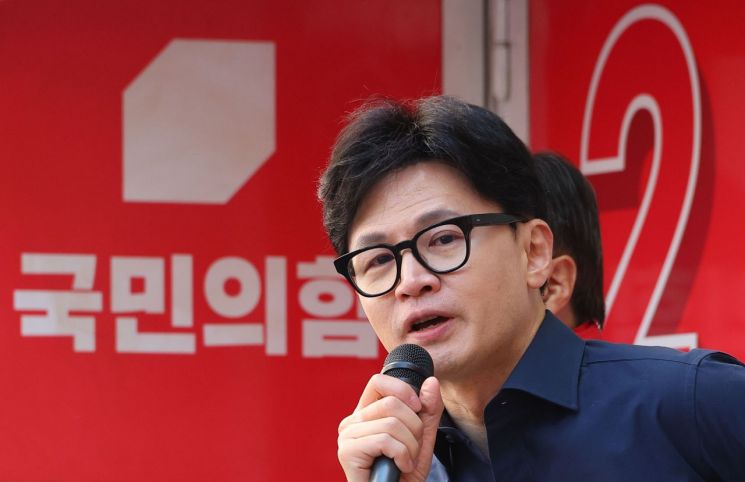
On the 1st, Han Dong-hoon, the emergency committee chairman of the People Power Party, visited Sasang District in Busan and said, "Politics must help more boldly for small business owners and fellow citizens," adding, "We will raise the VAT simplified taxation application threshold from an annual sales of 80 million won to 200 million won." Simply put, the simplified tax benefits previously given only to small business owners with annual sales of 80 million won will be expanded to those with annual sales of 200 million won. Generally, VAT is taxed at 10%, but when simplified taxation applies, a lower tax rate of 1.5% to 4% is applied.
Chairman Han also said at a campaign event at Hoegi Station intersection in Dongdaemun District, Seoul, on the 28th of last month, "The People Power Party strongly demanded the government temporarily cut VAT from 10% to 5%?half off?on areas closely related to the daily lives of ordinary people, such as childbirth and childcare products, processed foods like ramen, instant rice, canned goods, and food ingredients like sugar and flour," adding, "If necessary, we will push for legal revisions." He pulled out an additional tax cut card just four days later.
The problem lies in the scale of last year's tax revenue shortfall. Last year, national tax revenue was 344.1 trillion won, down 51.9 trillion won from the previous year. Compared to the 2023 original budget forecast of 400.5 trillion won, this is a shortfall of 56.4 trillion won. Among this, last year's VAT revenue was 74 trillion won, accounting for 21.4% of total national tax revenue.
The government hasn't even implemented it yet...
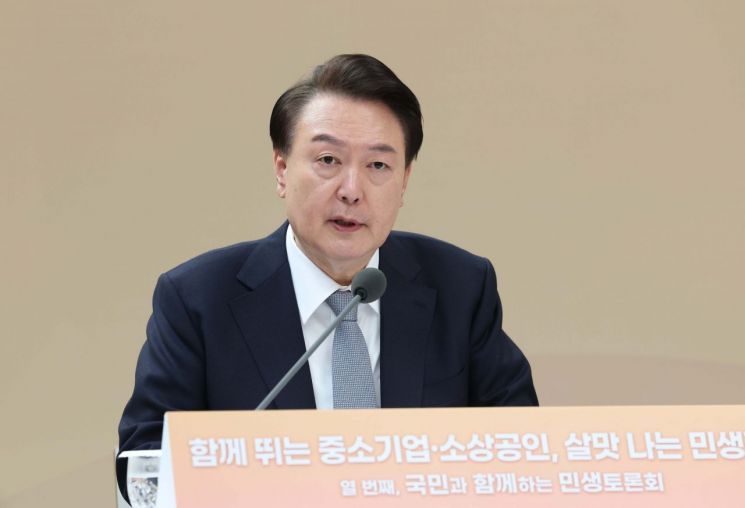
The expansion of simplified taxation targets is a policy the government has already proposed. President Yoon Suk-yeol said at a public discussion on supporting small and medium enterprises and small business owners held in February at the complex cultural space 'Layer 57' in Seongsu-dong, Seoul, "We will raise the simplified taxpayer threshold from an annual sales of 80 million won to 104 million won to reduce the tax burden." The difference between Chairman Han's and President Yoon's policies lies in whether legal revision is necessary. Raising the simplified taxpayer threshold to 104 million won can be done by revising enforcement ordinances without legal amendments. The enforcement ordinance revision has already been completed, and the changed criteria were scheduled to be applied from July. However, Chairman Han decided to further expand the target threshold before the effects of the changed criteria were even verified.
Professor Ryu Deok-hyun of the Department of Economics at Chung-Ang University said in a phone interview with Asia Economy, "Just because it's an election pledge, they are proposing something the president already announced before the ink has even dried," adding, "It seems excessive." He also emphasized, "The government and ruling party said fiscal soundness is the most important national policy goal," warning, "If tax cut bills continue to be introduced like this, the problem could become serious."
Temporary VAT reduction... could actually raise prices

Chairman Han pulled out the temporary VAT rate reduction card to ease the price burden on ordinary people, but there are criticisms that lowering the VAT rate could stimulate consumer sentiment and actually push prices up. Professor Kang Sung-jin of the Department of Economics at Korea University, when asked if lowering the VAT rate would be effective in controlling prices, said, "It is not. It's because it's election time," and explained, "Lowering the VAT rate increases consumption, so it raises prices rather than lowers them." He added, "Korea's VAT rate is already very low," and said, "Lowering the VAT rate when tax revenue is insufficient is not desirable."
After a Central Election Committee meeting at Hanyang University in Seoul on the 25th of last month, Chairman Han told reporters, "(The 250,000 won payment) is money being distributed to help those suffering from inflation," and questioned, "If money is distributed, do you think prices will go up or down? Isn't that a very simple calculation?" While criticizing Lee Jae-myung, the leader of the Democratic Party, and his party's cash payment pledge as something that would raise prices, he and his party have proposed tax cut policies that could stimulate consumer sentiment.
© The Asia Business Daily(www.asiae.co.kr). All rights reserved.



















