Extension of PRS Contract for 5 Years Without Repurchase or Third-Party Sale
Maintaining Business as Is but No Burden of Purchase Funds
SK Gas has signed a contract to re-lease 43 liquefied petroleum gas (LPG) filling stations. As the existing contract expiration approached, possibilities such as selling the filling stations as a package to a third party or directly repurchasing them were discussed, but it was decided to extend the existing contract for a long term. The price return swap (PRS) contract between SK Gas and the asset management company owning the filling stations was also extended.
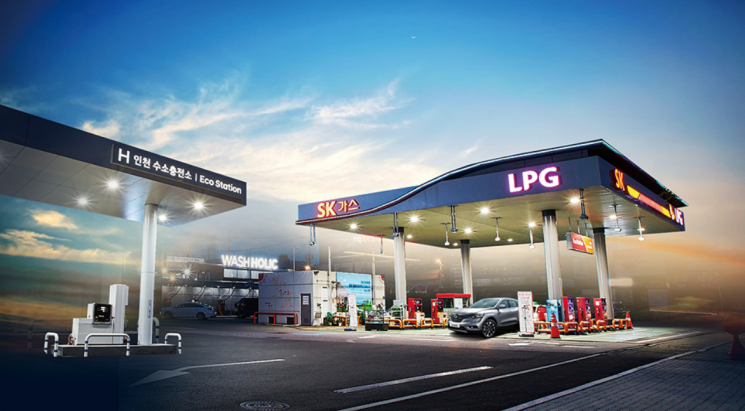
According to the investment banking (IB) industry on the 2nd, SK Gas signed a contract to lease LPG filling stations owned by ‘Finestreet Filling Station General Private Investment Trust (Finestreet Fund),’ an alternative investment private fund set up by Finestreet Asset Management, for the next five years. SK Gas will lease and operate 43 filling stations scattered across the country and regularly pay rent (lease fees) to the Finestreet Fund, the owner of the filling stations.
SK Gas signed a PRS contract with the fund simultaneously with the re-lease contract. The contract stipulates that if the market value of the filling stations rises, SK Gas will take the profit, and if the value falls, SK Gas will compensate for the fund’s losses accordingly. All profits and losses of the assets accrue to SK Gas. From the fund’s perspective, it is an investment that receives stable long-term lease fees from SK Gas without bearing the risk of price fluctuations of the purchased filling station assets.
If SK Gas agrees with the investors, it can terminate this contract and promote the sale of the filling stations even before maturity. If SK Gas neither repurchases nor sells the filling stations to a third party before maturity, the fund can initiate the sale process of the filling stations at its discretion after four years. If investors decide on a forced sale of the fund’s filling stations, SK Gas will have the right of first refusal (call option) to purchase them first.
This contract initially started when SK Networks transferred the LPG filling station business rights to SK Gas during the restructuring of the business structure within the SK Group. SK Networks transferred the filling stations to the fund for about 300 billion KRW, and SK Gas leased and operated them, marking the starting point. After seven years, the fund matured, and this time the contract was extended for another five years.
During the contract extension process, the Finestreet Fund transferred the fund beneficiary certificates to a special purpose company (SPC), then received asset-backed loans (ABL) using them as underlying assets (a kind of collateral) and issued asset-backed securities. When SK Gas pays lease fees to the fund, institutional investors who invested in the ABL and asset-backed securities share the fund dividends at a predetermined interest rate.
However, if SK Gas’s credit rating deteriorates, all contracts must be settled early. This applies if SK Gas faces bankruptcy (default) or fails to properly fulfill the PRS contract. If SK Gas’s credit rating falls below A-, early settlement before maturity can be requested. Currently, SK Gas’s credit rating is AA-, and if it falls by three grades, an early repayment trigger will be activated.
The reason SK Gas extended the filling station lease contract is that it continues to generate cash flow from the LPG filling station business and does not have sufficient financial conditions to repurchase the filling stations.
SK Gas’s financial burden has not decreased over a long period due to successive investments. Annual capital expenditures (CAPEX) of 200 to 300 billion KRW have consistently occurred due to investments in the Ulsan gas combined power plant (Ulsan GPS), hydrogen complex (Ulsan CEC), and LPG and liquefied natural gas (LNG) infrastructure. This year, CAPEX is expected to increase to around 500 billion KRW due to the CEC project and equity investments in investee companies.
SK Gas is increasing borrowings to respond to debt maturities and secure operating funds. In February, it issued 100 billion KRW worth of corporate bonds to repay maturing bonds. Recently, it decided to increase short-term borrowings by issuing 500 billion KRW worth of commercial paper (CP) to secure operating funds. This amount is close to 20% of its equity capital.
An IB industry official explained, "It will be difficult to purchase LPG filling stations, which are business assets, amid increasing financial burdens due to new business investments such as LNG terminals and hydrogen. The sale-and-leaseback operation of LPG filling stations is an efficient strategy that can generate a certain level of cash flow without increasing financial burdens."
© The Asia Business Daily(www.asiae.co.kr). All rights reserved.

















