Public Pension's 'Mother's Side' Support Reverses the Situation, Sparking 'Backlash'
"An Institution Operated with Public Funds Opposes Individual Shareholders"
After Public Pension's Decision, 'Brother's Side' Consolidates Voting Rights at the Last Minute
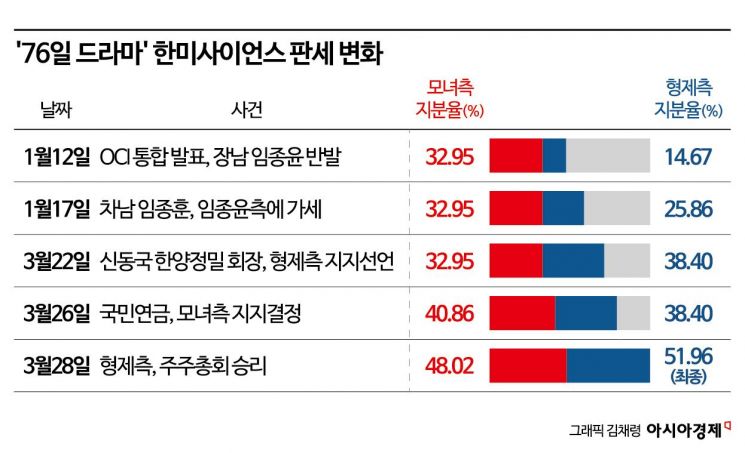
Lee Sang-mok, CEO of Conduit, which operates the proxy voting platform 'Act,' said this on the 2nd while reflecting on the results of the HanmiScience shareholders' meeting (March 28). He explained that two days before the meeting, when the major shareholder National Pension Service's support for the mother-daughter side (Chairman Song Young-sook and Vice Chairman Lim Ju-hyun, supporters of OCI integration) flipped the situation, minority shareholders rallied behind the brothers' side (Presidents Lim Jong-yoon and Jong-hoon, opponents of OCI integration). Lee witnessed the behind-the-scenes of the minority shareholders during the dramatic 76-day HanmiScience management rights dispute. He said, "The accessible minority shareholders accounted for about 7% of the total shares," adding, "Including the mid-1% shares gathered through Act, and the collection of proxy votes both online and offline, the votes cast for the brothers' side exceeded 5%, while the opposition (mother-daughter side) was less than 1%." According to his explanation, about 80% of minority shareholders sided with the brothers.
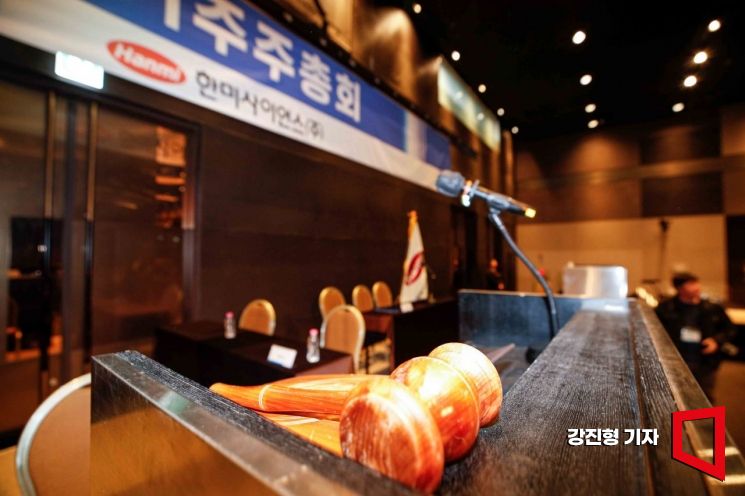 The '51st Annual Shareholders Meeting of Hanmi Science' held at Syntex in Hwaseong-si, Gyeonggi Photo by Jinhyung Kang aymsdream@
At first, they gathered to share opinions... "Later, not a single minority shareholder supported the mother-daughter side"
Act is a platform that provides a public forum for minority shareholders, who are difficult to unite, to gather opinions and enables proxy voting through electronic ballots. According to Lee, minority shareholders of Hanmi did not initially gather in support of the 'brothers' side.' When news of integration with OCI Group surfaced, they gathered on Act to discuss whether the integration would be beneficial or detrimental to minority shareholders. Lee said, "As opinions converged against the integration, it naturally flowed toward supporting the brothers' side, who opposed the integration."
The primary concern of minority shareholders was the 'stock price.' There was growing worry that if HanmiScience became an 'intermediate holding company' through OCI integration, the stock price could be 'cut in half,' based on past cases. Moreover, when it became known that there was no 'management premium' in the share transfer conditions, backlash grew, labeling it a 'hasty sale.' Dissatisfaction with management and doubts about their expertise also intensified. There were even remarks like, "Can someone who ran a museum and a music major lead the challenging pharmaceutical industry?" This targeted Chairman Song Young-sook, who took center stage in management after the founder's passing in 2020 while running the Hanmi Photo Art Museum, and Vice Chairman Lim Ju-hyun, who majored in music. On the other hand, favorable public opinion grew toward former President Lim Jong-yoon, who majored in biochemistry and led Beijing Hanmi. As time passed, it is said that not a single minority shareholder remained supporting the mother-daughter side. After the meeting results were announced on-site, one minority shareholder said, "It made me cry, thinking that if we unite, we can achieve something."
"An institution operated with the people's money made a decision contrary to the people"
Backed by the unanimous minority shareholder votes, the brothers' side succeeded in controlling the board with about 52% of the approval votes. It is also known that some rebel votes came from friendly shares classified as special relations to the mother-daughter side. Judging by the results alone, the National Pension Service and minority shareholders had differing opinions. Considering that the largest individual shareholder, Shin Dong-guk, chairman of Hanyang Precision, also supported the brothers' side, all shareholders except special relations united behind the brothers' side. This has sparked whispers questioning whether it was appropriate for the National Pension Service, operated with the people's money, to make a decision opposing the people (individual shareholders).
From the National Pension Service's standpoint, their justification was not different from that of minority shareholders. At the time of the decision, they explained that "the current board (mother-daughter side) better aligns with long-term value enhancement." However, no detailed explanation was provided. The National Pension Service typically explains the background of proxy voting decisions in about one sentence. This time was no different. Park Joo-geun, CEO of Leaders Index, a corporate analysis research institute, pointed out, "The National Pension Service has mechanically supported the current management when it holds the 'casting vote.' Compared to minority shareholders who made a well-considered judgment over two months for shareholder value, it superficially appears to be a careless stance. At the very least, for decisions with such significant social issues and impact, detailed explanations for proxy voting decisions should be provided."
© The Asia Business Daily(www.asiae.co.kr). All rights reserved.
![Clutching a Stolen Dior Bag, Saying "I Hate Being Poor but Real"... The Grotesque Con of a "Human Knockoff" [Slate]](https://cwcontent.asiae.co.kr/asiaresize/183/2026021902243444107_1771435474.jpg)


















