Digital Economy Alliance Composed of ICT Associations
Publishes 'Policy Proposal' Ahead of the 22nd General Election
Eyewear Industry Opposes... Bill Remains Pending
Naver, Coupang, Kakao, and other internet companies have formally requested the ruling and opposition parties to allow the online sale of glasses and contact lenses. Currently, glasses and lenses can only be sold through offline optical stores, but they are asking for deregulation to permit sales to consumers online as well. This is seen as a potential new point of contention between the eyewear distribution industry and online companies, amid ongoing conflicts between new and old businesses in areas such as law, tax services, and car sharing.
 The Digital Economy Alliance has requested both ruling and opposition parties to allow the online sale of glasses and contact lenses ahead of the 22nd general election. [Image=Adobe Generative AI Firefly]
According to related industries on the 2nd, the Digital Economy Alliance, composed of seven cooperative organizations including the Korea Internet Corporations Association, recently appealed in their ‘22nd General Election Policy Proposal’ to ease regulations related to eyewear distribution. This is the first election policy proposal issued by the organization, which was launched in 2021, and it raised the deregulation of eyewear distribution as a major agenda. The proposal contains over 60 policy suggestions necessary for domestic companies to grow into global enterprises, in addition to eyewear. The total number of member companies included in the Digital Economy Alliance reaches about 22,000.
"Online and Offline Competition Will Lower Glasses Prices"
The internet industry is focusing on eyewear distribution because online sales are allowed in major countries such as the United States, Japan, and China. In South Korea, glasses can only be purchased at offline optical stores staffed by opticians who have passed national qualification exams.
The regulation banning online sales of glasses and contact lenses is based on the ‘Medical Technicians Act.’ Article 12 of this law states that ▲only licensed opticians can sell glasses and contact lenses, ▲glasses and contact lenses must be sold only at offline optical stores, and ▲opticians must provide instructions on usage and side effects when selling contact lenses.
However, in island and mountainous areas without optical stores, consumers have to travel long distances just to buy reading glasses. Consumers also have no way to check prices online. This contrasts with countries like the U.S., where Amazon sells glasses and contact lenses online, as well as Japan’s Rakuten and China’s Tmall.

Controversy Repeated for Years
The debate over allowing online sales of glasses and contact lenses has continued for years. In 2021, the government tried to resolve this issue by applying the ‘One Step Model,’ which aims to reach consensus among stakeholders in fields where conflicts arise during the introduction of new businesses. However, no significant agreement was reached.
Last month, the ICT Regulatory Sandbox Deliberation Committee designated the ‘Optical Store Contact Lens Resale Brokerage Platform’ as a demonstration exemption. Only one approved company (Pixelro) is conducting a pilot project, allowing ▲consumers with purchase history ▲to reorder from the same optical store with the same prescription ▲through a specific platform online.
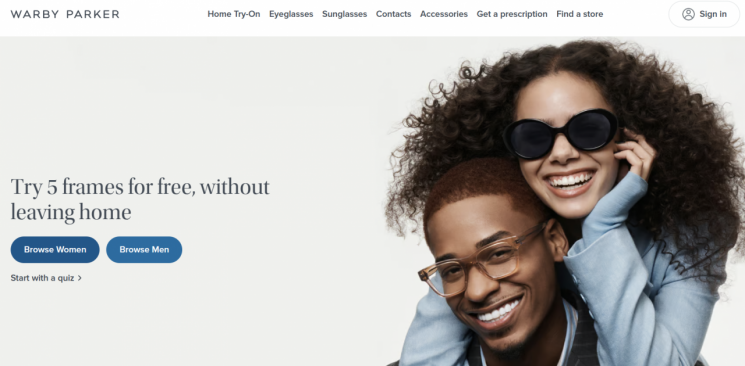 The American company 'Warby Parker' operates an online sales service where consumers upload their eyeglass prescriptions and select five frames, which are then delivered to their homes for free. Virtual try-on is also available through a smartphone app. Warby Parker disrupted the monopoly market of the American eyewear industry and was listed on the New York Stock Exchange just 11 years after its founding.
 [Photo by Warby Parker website]
However, there has been no progress on the online sale of glasses without special reasons. In July 2020, the government submitted a revision bill to the Medical Technicians Act after a research project. The bill included provisions to allow online sales of ‘prescription swimming goggles’ and ‘low-prescription reading glasses.’ However, as the 21st National Assembly is ending, the bill has not even been properly discussed in the National Assembly’s Health and Welfare Committee.
The Ministry of Health and Welfare submitted an opinion on the bill requesting, "To expand purchasing methods and improve convenience, allow online sales of prescription swimming goggles and some reading glasses within the minimum range that does not pose a risk to eye health." In response, the Korean Opticians Association argued, "It is a dangerous idea that risks the public’s eyesight," and warned, "It will lead to indiscriminate distribution of low-priced overseas products."
Successful Cases of Online Sales Overseas
Overseas, there is already a company that made a huge success by starting a business with the question, ‘Why are glasses so expensive?’ ‘Warby Parker,’ founded in 2010 by four classmates from the University of Pennsylvania’s Wharton School, is considered one of the world’s most innovative companies. Warby Parker allowed consumers to upload their eyeglass prescriptions and choose five frames, which were then delivered free to their homes through online sales. They changed the eyewear distribution structure and lowered prices to about one-fifth of the traditional cost.
Korean startups cannot launch such ideas due to regulations. Companies are requesting that online sales be allowed first for reading glasses and cosmetic contact lenses, which do not significantly affect the wearer’s health. Ha Myung-jin, head of policy support at the Online Shopping Association, said, "This will not only increase public convenience but also promote competition between online and offline channels, leading to lower product prices."
© The Asia Business Daily(www.asiae.co.kr). All rights reserved.



















