The Ministry of Trade, Industry and Energy announced on the 1st that it held a 'Corporate Meeting for the Development and Commercialization of Autonomous Ship Technology' chaired by the Director of Manufacturing Industry Policy at the Hyundai Abicus conference room. At this meeting, they discussed ways to lead the future ship market by securing autonomous ship technology and through demonstration and commercialization, as well as the difficulties faced by companies.
Attendees at the meeting included Lim Do-hyung, CEO of Hyundai Abicus; Choi Jong-ung, Head of the Autonomous Navigation Center at Samsung Heavy Industries; Heo Cheol-eun, Head of the Smart Solution Research Center at Hanwha Ocean; and Kim Jin, Director of the Autonomous Ship Technology Development Project Group (KASS). Abicus is an autonomous ship startup established by HD Hyundai.
Autonomous ships are vessels that integrate digital technologies such as Artificial Intelligence (AI), Internet of Things (IoT), big data, and sensors to autonomously set optimal routes and navigate without crew, and are regarded as a future new industry in the shipbuilding sector.
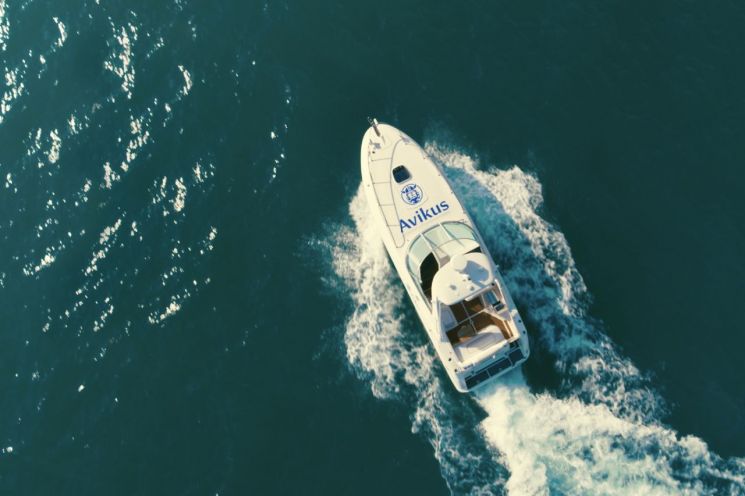
According to the Ministry of Oceans and Fisheries, the market size of autonomous ships, which was $54.4 billion (approximately 70 trillion KRW) in 2015, is expected to expand exponentially to $254.1 billion (approximately 330 trillion KRW) by 2030.
In December last year, South Korea established a legal basis for supporting autonomous ships as the Act on the Development and Commercialization Promotion of Autonomous Ships (Autonomous Ship Act), jointly promoted by the Ministry of Trade, Industry and Energy and the Ministry of Oceans and Fisheries, passed the National Assembly. This law will take effect on January 3rd next year.
Before the enforcement of the Autonomous Ship Act, the Ministry of Trade, Industry and Energy confirmed the promotion of a regulatory sandbox for planned regulations in the autonomous ship sector at the Industrial Convergence Regulatory Special Committee held on the 29th of last month. They also plan to apply special exemptions to regulations related to autonomous ships, including the Ship Safety Act, Ship Crew Act, and Location Information Act.
The companies attending the meeting highly evaluated the government's efforts and expressed hope that these efforts will ultimately lead to the improvement of related systems so that South Korea can dominate the global autonomous ship market.
Park Dong-il, Director of Manufacturing Industry Policy, stated, "It is significant that we are all on the same boat heading toward the 'world's first commercialization of autonomous ships,' and wisdom of simultaneous effort from both public and private sectors is needed so that autonomous ships can become a key export item for our country in the future." He added, "We plan to actively support international discussions such as those at the International Maritime Organization (IMO) Maritime Safety Committee (MSC) to ensure that our companies' technologies become global standards."
Meanwhile, Abicus first commercialized the Level 2 autonomous navigation system in the world by signing a contract in August 2022 for 'Hynas 2.0,' an autonomous navigation solution for large vessels, with two domestic shipping companies, SK Shipping and Janggeum Shipping. Samsung Heavy Industries is promoting the commercialization of its independently developed autonomous navigation system called 'Samsung Autonomous Ship (SAS).' Hanwha Ocean has developed a smart ship platform called 'HS4' and plans to secure Level 4 smart ship technology by 2030.
The Ministry of Trade, Industry and Energy has been promoting the autonomous ship technology development project with a total budget of 160.3 billion KRW from 2020 to 2050, working with companies to develop autonomous intelligent systems and integrated platforms for autonomous navigation and engine room control.
The IMO defines autonomous ships in four stages. Level 1 supports crew decision-making; Level 2 remotely controls the ship with crew onboard who can immediately intervene in emergency operations; Level 3 involves full remote control without crew onboard, with automated fault prediction and diagnosis; and Level 4 refers to fully autonomous navigation.
© The Asia Business Daily(www.asiae.co.kr). All rights reserved.
![Clutching a Stolen Dior Bag, Saying "I Hate Being Poor but Real"... The Grotesque Con of a "Human Knockoff" [Slate]](https://cwcontent.asiae.co.kr/asiaresize/183/2026021902243444107_1771435474.jpg)
















