A pilot project will be implemented to provide business owners who employ vulnerable groups such as marriage immigrants, youth preparing for independence, and North Korean defectors with employment incentives of up to 7.2 million KRW per worker, depending on the local situation.
The Ministry of Employment and Labor announced on the 31st that starting from the 1st of next month, the 'Regionally Customized Employment Promotion Incentive' pilot project will begin at five employment centers in Gwangju, Anyang, Jeonju, Seoul Southern, and Cheongju.
The employment promotion incentive is paid to business owners who newly employ vulnerable job seekers who have difficulty finding employment. Currently, the support targets include persons with severe disabilities, female heads of households, and those who have completed the National Employment Support System.
The government has decided to additionally identify and support vulnerable employment groups suited to the local situation in certain regions.
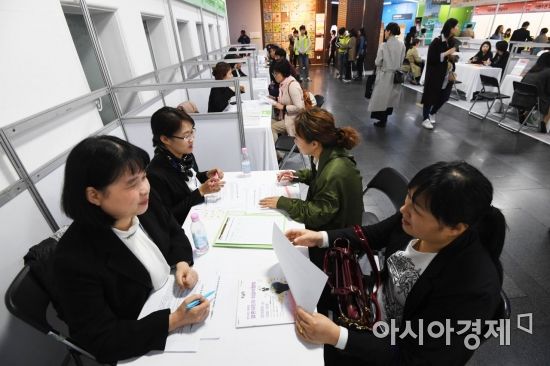 On the 6th, marriage immigrants visiting the '9th Seoul Marriage Immigrant Employment Fair' held at the Citizen Hall in the basement of the Seoul City Hall main building received employment mentoring. At the fair, 14 companies including YBM NET and the United Nations High Commissioner for Refugees (UNHCR) conducted one-on-one on-site interviews, and 45 companies planned to provide job information. The city deployed interpreters for marriage immigrants speaking Chinese, Vietnamese, Russian, Uzbek, and other languages on-site to assist those who have difficulty with interviews due to poor Korean skills. Photo by Moon Honam munonam@
The Gwangju Employment Center supports workers who have retired from the home appliance manufacturing industry, which is facing a crisis due to the Daewoo Winia court management situation, and the construction industry, which continues to experience sluggish business conditions. In collaboration with local governments, it plans to support corporate crisis management and promptly provide employment support services when retirements occur.
The Anyang Employment Center in Gyeonggi Province provides special support for youth preparing for independence, youth with extended protection, and youth entering or leaving youth welfare facilities.
The Jeonju Employment Center, which oversees Jeonbuk Jeonju, Wanju, and Jinan areas, helps marriage immigrants who wish to find employment by linking with seven local family centers to provide language and workplace culture education alongside employment assistance.
The Seoul Southern Employment Center (covering Yangcheon-gu, Gangseo-gu, and Yeongdeungpo-gu) collaborates with the South-North Hana Foundation to support the employment of North Korean defectors, while the Cheongju Employment Center in Chungbuk works with the Middle-aged Tomorrow Center and others to focus on reemployment in the food industry for long-term unemployed recipients of unemployment benefits aged 50 and over.
About 30% of North Korean defectors living in Seoul reside mainly in rental apartments in Yangcheon-gu and Gangseo-gu, and in the Cheongju area, long-term unemployment benefit recipients aged 50 and over account for half of all recipients, while there is a severe labor shortage in local food companies. These factors were taken into consideration.
If companies in these five regions newly hire these vulnerable employment groups and maintain employment for more than six months, they will receive support of 600,000 KRW per worker per month (300,000 KRW per month for large-scale enterprises) for up to 12 months.
Lee Jeong-han, Director of Employment Policy at the Ministry of Labor, stated, "Since employment situations vary by region, support tailored to local characteristics may be more effective than uniform nationwide support," and added that the results of the year-end pilot project will be evaluated for potential expansion.
© The Asia Business Daily(www.asiae.co.kr). All rights reserved.
![Clutching a Stolen Dior Bag, Saying "I Hate Being Poor but Real"... The Grotesque Con of a "Human Knockoff" [Slate]](https://cwcontent.asiae.co.kr/asiaresize/183/2026021902243444107_1771435474.jpg)















