Labor Institute Surveys 100 Major Companies
Last Year, Proportion of Irregular and Regular Hiring Nearly Twice That of Open Recruitment
Among the five major conglomerates conducting open recruitment, one plans to maintain it only until this year.
Large companies are continuing the trend of reducing regular open recruitment for new employees while increasing irregular/continuous recruitment and hiring experienced professionals.
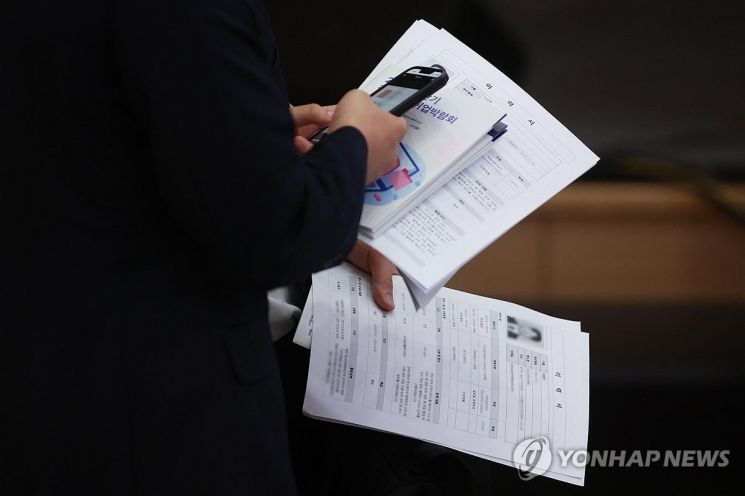 On the 1st, job seekers holding resumes are waiting for consultations at the 2023 Second Half Information Security Job Fair held at the Science and Technology Convention Center in Gangnam-gu, Seoul.
 [Photo by Yonhap News]
According to the report "The End of Open Recruitment and Changes in the Labor Market" by the Korea Labor Institute on the 31st, a survey was conducted in August last year targeting HR managers from a sample of 100 large companies with over 500 employees and annual sales exceeding 1 trillion won, revealing these findings.
When asked about future plans to maintain the open recruitment system among companies currently maintaining it (86 companies), 72.1% responded that they have no plans to abolish it, but 19.8% said they would maintain open recruitment only until this year.
Among companies already operating irregular recruitment alongside open recruitment (86 companies), 33.7% said they plan to completely abolish regular open recruitment within three years and proceed only with irregular recruitment.
Open recruitment is a method where all qualified candidates are given the opportunity to apply during a set period and are hired through open competition. Irregular recruitment refers to posting job openings immediately when demand arises without a fixed period, while continuous recruitment means keeping application channels open and accepting applications at all times.
Looking at the annual recruitment methods of the surveyed companies, the proportion of regular open recruitment in total hiring was 39.9% in 2019, decreasing to 37.9% in 2022 and 35.8% in 2023. In contrast, the proportion of irregular recruitment was 45.6%, 46.4%, and 48.3% during the same period. Continuous recruitment also showed an upward trend, rising from 14.6% to 15.7% and 15.9%.
Last year, the combined share of irregular and continuous recruitment (64.2%) was 1.8 times that of open recruitment, with the increase in irregular recruitment being more pronounced in non-manufacturing industries than in manufacturing.
The Proportion of Experienced Hires Surpassed New Hires Since 2022
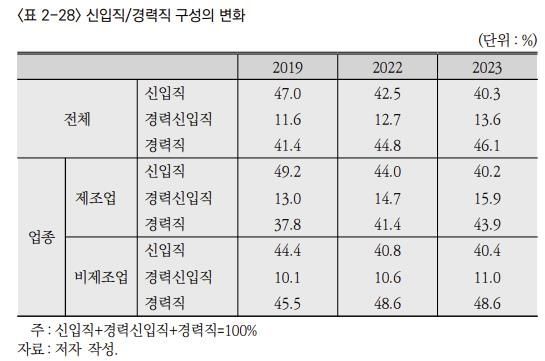
There was also a trend of decreasing new hires and increasing experienced hires.
In 2019, 47% of new hires were fresh graduates, 11.6% were re-employed as new hires after leaving within 1-2 years (experienced new hires), and 41.4% were experienced hires. However, last year, the proportion of fresh graduates decreased to 40.3%, while experienced new hires and experienced hires increased to 13.6% and 46.1%, respectively. Since 2022, the proportion of experienced hires has exceeded that of fresh graduates.
The report analyzed, "Companies prefer experienced hires over fresh graduates and increasingly favor so-called ‘used new hires,’ who are experienced new hires with a few years of organizational experience."
However, it also pointed out, "When conducting irregular recruitment, diversity in terms of region, school, and gender among successful candidates tends to decline," and emphasized the need to review whether changes in recruitment methods emphasizing irregular recruitment and the preference for experienced talent can guarantee diversity and fairness in hiring.
These changes were also felt by job seekers, particularly young people in their 20s and 30s. In a survey conducted last year with 1,010 men and women aged 18 to 39, 77.3% agreed that "it is difficult for inexperienced fresh graduates to get jobs." They perceived that the number of companies holding regular open recruitment, the frequency, and the number of hires are all decreasing.
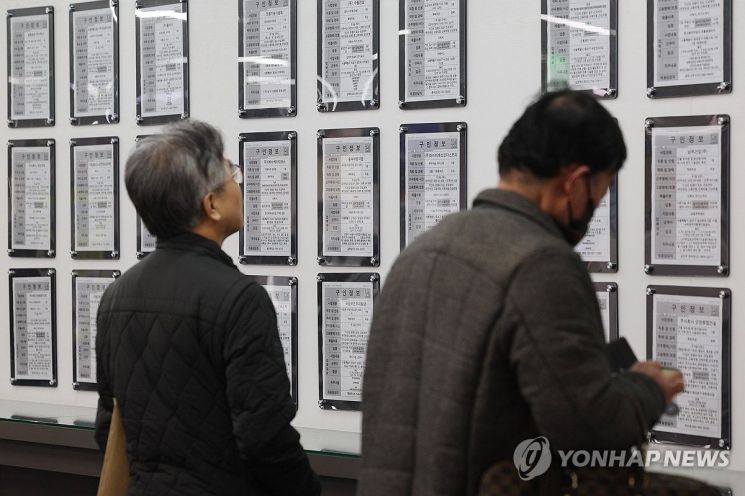
Meanwhile, although the total number of employed persons increased last year, the number of employed people in their 40s decreased. According to the Korea Employers Federation's (KEF) report "Employment Trends and Implications for the New Vulnerable Employment Group in Their 40s," the number of employed people in their 40s decreased by 54,000 compared to 2022, while the total number of employed persons increased by 327,000.
© The Asia Business Daily(www.asiae.co.kr). All rights reserved.



















