Seoul Apartment Jeonse Rents Rise for 5 Consecutive Weeks
Sales Mainly Quick Sales, Stable for 2 Consecutive Weeks
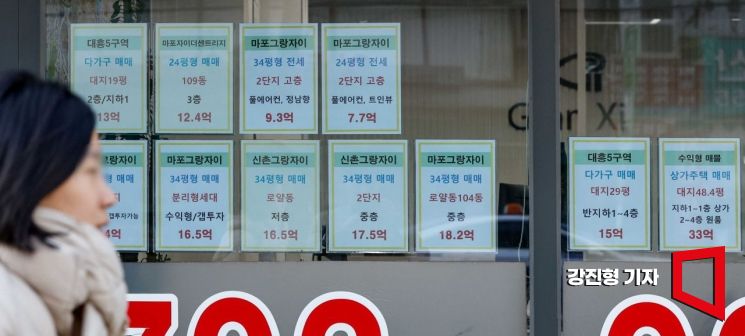 As the government announced that it will freeze the actualization rate of publicly announced real estate prices at the 2020 level, on the 21st, sale and jeonse prices are posted at an apartment complex in Seoul. Photo by Jinhyung Kang aymsdream@
Real Estate R114 announced on the 30th that the Seoul apartment jeonse prices rose by 0.01% in the fourth week of March, marking the fifth consecutive week of increase. The sales market remained steady for two consecutive weeks, with transactions mainly focused on quick sales.
An official from Real Estate R115 explained, "Although the jeonse and sales markets are gradually synchronizing, the atmosphere is still one of individual survival," adding, "Jeonse prices have shown a steady upward trend since the second half of last year, and most on-site opinions indicate a shortage of available properties."
On the other hand, "Sales prices, which had been moving at a slightly weak level, are facing a shortage of demand amid an accumulation of properties due to insufficient transaction volume," and "As a result, jeonse prices are being traded at higher prices than before, while sales prices are mainly focused on quick sales at prices lower than market value," they added.
However, "Since the sales and rental markets are interconnected, from April onward, the market is expected to tilt more strongly in whichever direction shows stronger movement," they said.
In the fourth week of March, Seoul apartment sales prices remained steady (0.00%) for two consecutive weeks. Both redevelopment and general apartments showed limited movement at a steady level. New towns also remained steady (0.00%), and Gyeonggi and Incheon showed no price movement for ten consecutive weeks.
In Seoul's individual districts, prices fell in the order of Songpa (-0.03%), Gwanak (-0.01%), Yangcheon (-0.01%), and Yeongdeungpo (-0.01%), while Gangseo rose by 0.01%.
Among new towns, Sanbon fell by 0.01%, while other areas remained steady (0.00%). In Gyeonggi and Incheon, prices dropped in Osan (-0.04%), Goyang (-0.01%), Uijeongbu (-0.01%), and Icheon (-0.01%), but Suwon rose by 0.01%.
 View of apartments in Ichon-dong, eastern Seoul, from the 63 Building observatory. Photo by Hyunmin Kim kimhyun81@
Due to the overlapping effects of the spring moving season in March, Seoul's jeonse prices rose for five consecutive weeks, increasing by 0.01% this week. Gyeonggi, Incheon, and new towns remained steady (0.00%) this week.
In Seoul's individual districts, prices rose in Mapo (0.04%), Gwanak (0.04%), Yangcheon (0.03%), Yeongdeungpo (0.02%), Seodaemun (0.02%), Guro (0.02%), and Gangseo (0.02%), while Geumcheon-gu was the only area to fall by 0.04%. Among new towns, Paju Unjeong rose by 0.03%, while other areas remained steady (0.00%).
In Gyeonggi and Incheon, prices rose in Ansan (0.04%) and Hwaseong (0.01%), while falling in Incheon (-0.01%), Goyang (-0.01%), Uijeongbu (-0.01%), and Paju (-0.01%).
An official from Real Estate R114 stated, "On the 28th, the government announced the ‘Construction Industry Recovery Support Plan,’ which mainly includes reflecting appropriate construction costs, minimizing delays in large-scale projects, and resolving private sector difficulties," adding, "It is necessary to assess the market impact of the part reflecting construction cost increases."
They continued, "Since the government has promised to realize construction unit prices in public projects and appropriately reflect inflation, public housing prices are also expected to be rationalized in the future."
They also noted, "Recently, conflicts over construction costs between associations and construction companies have intensified, especially in major redevelopment and reconstruction projects in Seoul," and "Since this is an issue related to cost-sharing by project entities, significant difficulties are expected during the negotiation process."
However, "One certainty is that as labor and material costs rise, new construction prices will continue to increase," and "The rise in new construction prices will, with a time lag, affect transaction volumes and price fluctuations in existing buildings," they concluded.
© The Asia Business Daily(www.asiae.co.kr). All rights reserved.
![Clutching a Stolen Dior Bag, Saying "I Hate Being Poor but Real"... The Grotesque Con of a "Human Knockoff" [Slate]](https://cwcontent.asiae.co.kr/asiaresize/183/2026021902243444107_1771435474.jpg)

















