'2024 Government Innovation Comprehensive Plan' Confirmed and Announced
Four Key Principles: Field, Collaboration, Action, and Resolution Revealed
Government Focused on Problem Solving, Digitalization, and Future Preparedness
Starting from July, crime victims will be able to receive support for legal, economic, employment, and financial matters all at once at the 'One-Stop Solution Center' without having to visit multiple agencies. Additionally, public officials will receive assistance from artificial intelligence (AI Administrative Assistant) when performing tasks such as information search, document summarization, and drafting reports or civil complaint responses.
On the 29th, the government held the first 'Government Innovation Council' and announced the '2024 Government Innovation Comprehensive Plan' containing these details. The meeting, chaired by Minister of the Interior and Safety Lee Sang-min, was attended by innovation officers from 46 central government ministries and deputy heads from 17 metropolitan and provincial governments.
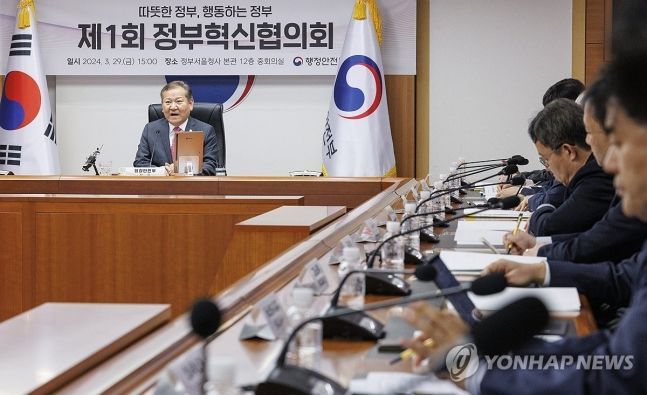 Minister of the Interior and Safety Lee Sang-min is speaking about the government's innovation direction at the 1st Government Innovation Council held at the Government Seoul Office in Jongno-gu, Seoul, on the afternoon of the 29th.
 [Photo by Yonhap News]
The comprehensive plan includes the vision of a "Warm Government, Action-Oriented Government" and four core principles: field, collaboration, action, and resolution. It also features three major strategies?▲a government that solves problems well, ▲a government that works digitally, and ▲a government that prepares for the future?along with eight key tasks and a total of 110 detailed tasks to achieve these goals.
The first strategy is a "government that solves problems well." To this end, the government will actively promote solving livelihood issues through field-centered communication. It will actively listen to citizens’ difficulties and promptly resolve them through agency-specific livelihood forums and sector-specific communication channels. In particular, it will address issues directly related to citizens’ daily lives, such as Neulbom School, vacant house maintenance, and child safety. It will also actively support revitalizing the livelihood economy by reducing interest burdens on small business owners and providing tailored information to small and medium enterprises.
The government will also eliminate administrative blind spots to ensure that everyone can use public services stably. It will strongly protect socially vulnerable groups by expanding jobs for the elderly, strengthening health management support, proactively identifying households in crisis, and expanding support for low-income patients with rare diseases. Inconveniences faced by foreign residents and overseas Koreans will be improved through measures such as the introduction of mobile foreigner registration cards.
To accelerate policy implementation, the government will actively promote the removal of silos and cooperation. It plans to expand personnel exchanges by more than 10% across sectors and eliminate inter-agency barriers through task-focused collaborative organizational staffing. Inter-ministerial collaboration will be strengthened in areas such as narcotics control and support for crime victims, and cooperation with private companies will be actively pursued to improve disaster response and public services.
To enhance administrative efficiency, the government will also improve working methods. It will hold education and workshops to improve organizational culture and provide a standard survey template that agencies can use autonomously to diagnose their organizational culture, striving to establish a rational organizational culture.
The government will also reform administrative services to become a "government that works digitally." It will gradually implement zero-document requirements through data sharing by 2026 and provide benefit notification services where the government proactively informs citizens. Additionally, digital technologies will be applied in the fields of finance, legislation, real estate, and food safety to make it easier for citizens to find the information they need in daily life.
Data and AI technologies will be actively utilized in working methods as well. Data analysis will be actively used to address urgent issues and social problems such as crowd density analysis, and an AI administrative assistant model supporting information search, document summarization, and drafting of reports and civil complaint responses will be developed and piloted.
The "government preparing for the future" is also a strategic task. Representative policies include tailored measures for future generations such as youth, supporting youth asset formation by improving tax exemption requirements for the Youth Leap Account, and increasing preferred jobs for youth through services like career development roadmaps and expanded military-linked employment support. Efforts will also be made to respond to normalized crises and risks such as population decline and climate change. The government will review future-oriented local administrative system reforms, support region-specific development by announcing local living populations, and establish mid- to long-term development strategies for remote islands on the outskirts of the national territory.
The Ministry of the Interior and Safety plans to support innovation activities of each agency through innovation education, consulting, and networking to ensure the comprehensive plan is implemented without setbacks. Minister Lee Sang-min stated, "To become a 'Warm Government, Action-Oriented Government' that solves livelihood issues, we must visit the field, communicate with citizens, and collaborate closely beyond silos. We will do our best as ministries, local governments, and public institutions united to ensure that the public clearly feels the results of government innovation and to solve problems."
© The Asia Business Daily(www.asiae.co.kr). All rights reserved.
![Clutching a Stolen Dior Bag, Saying "I Hate Being Poor but Real"... The Grotesque Con of a "Human Knockoff" [Slate]](https://cwcontent.asiae.co.kr/asiaresize/183/2026021902243444107_1771435474.jpg)
















