Statistics Korea Industrial Activity Trends
Facility Investment Increase Hits Largest Scale in 9 Years and 3 Months
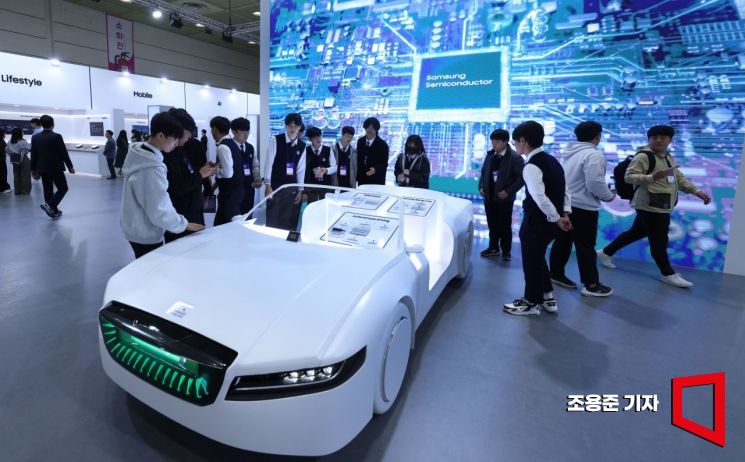 The 'Semiconductor Exhibition (SEDEX) 2023,' where domestic and international system semiconductor companies including Samsung Electronics and SK Hynix showcased a large number of new technologies and cutting-edge products, opened on the 25th at COEX in Samseong-dong, Seoul. Visitors at the exhibition hall on the day are viewing various semiconductor and component equipment booths. Photo by Yongjun Cho jun21@
In February this year, industrial production continued its upward trend for the fourth consecutive month, supported by a rebound in semiconductors. Facility investment recorded its largest increase in 9 years and 3 months.
According to the 'February 2024 Industrial Activity Trends' released by Statistics Korea on the 29th, total industrial production in February increased by 1.3% compared to the previous month. This marks the fourth consecutive month of growth following November 2023 (0.3%), December 2023 (0.4%), and January 2024 (0.4%).
By sector, production rose in mining and manufacturing, including manufacturing (3.1%), and services (0.7%). Within mining and manufacturing, production decreased in areas such as telecommunications and broadcasting equipment (-10.2%), but significantly increased in semiconductors (4.8%) and machinery equipment (10.3%).
Manufacturing inventories increased by 1.4% compared to the previous month, and the average operating rate rose by 2.5 percentage points to 74.6%.
Retail sales, which indicate consumer trends, decreased by 3.1% compared to the previous month. Sales of semi-durable goods such as clothing increased by 2.4%, but sales of non-durable goods such as food and beverages fell by 4.8%. Sales of durable goods such as telecommunications devices and computers also declined by 3.2%.
Facility investment increased by 10.3% compared to the previous month, with investments rising in transportation equipment such as ships (23.8%) and machinery including special industrial machinery (6.0%). This marks the largest increase in facility investment in 9 years and 3 months.
Gong Mi-sook, Director of Economic Trend Statistics at Statistics Korea, explained the background of the facility investment increase: "Investment in transportation equipment such as ships was influenced by the expansion of cargo volume, and investments in manufacturing machinery and special machinery increased significantly due to improvements in the semiconductor industry."
Construction performance decreased by 1.9% compared to the previous month, with declines in both building construction (-1.8%) and civil engineering (-2.2%).
Domestic machinery orders increased in both public (139.7%) and private (11.1%) sectors. Construction orders (current) rose in civil engineering such as land development (16.2%) but declined in building construction such as factories and warehouses (-33.1%).
The coincident index of economic indicators, which reflects the current economic situation, rose by 0.2 points from the previous month to 99.9. The leading index of economic indicators, which forecasts future economic conditions, increased by 0.1 points from the previous month to 100.4.
© The Asia Business Daily(www.asiae.co.kr). All rights reserved.

















