The number of unsold houses nationwide has increased for three consecutive months. The so-called "post-completion unsold houses," considered to be malignant unsold properties, also exceeded 10,000 units, showing an increasing trend for seven consecutive months. Although the leading indicators of housing supply, such as permits and construction starts, seemed to improve, they have worsened again. However, housing transaction volumes continued to show favorable results for two consecutive months.
Seoul's Post-Completion Unsold Houses Exceed 500 Units
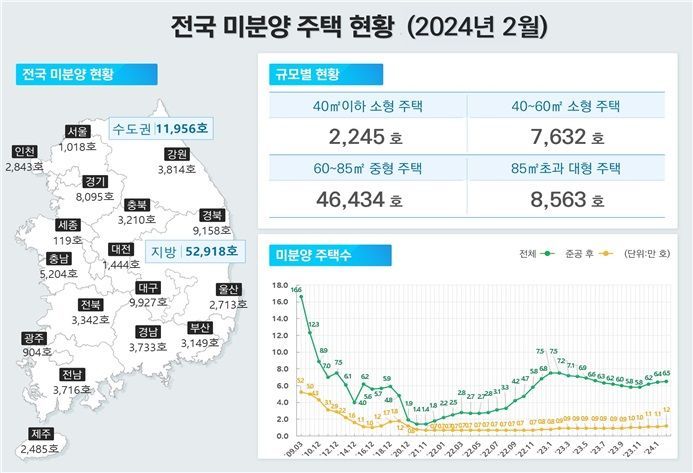 February Nationwide Unsold Housing Status / Provided by Ministry of Land, Infrastructure and Transport
According to the "February Housing Statistics" announced by the Ministry of Land, Infrastructure and Transport on the 30th, the number of unsold houses nationwide last month was 64,874 units, an increase of 1.8% (1,119 units) from the previous month (63,755 units). This marks the third consecutive month of increase since December last year.
Unsold houses in the metropolitan area numbered 11,956 units, up 17.7% (1,796 units) from the previous month. Gyeonggi Province saw a 33.4% increase (from 6,069 units to 8,095 units). During the same period, the provinces decreased by 1.3% (677 units), but the total was 52,918 units, accounting for 81.6% of all unsold houses. Daejeon showed a notable increase of 29.9% (from 1,112 units to 1,444 units). Daegu still had the highest number of unsold houses nationwide at 9,927 units, but it decreased by 197 units in one month.
The number of post-completion unsold houses nationwide last month was 11,867 units, an increase of 4.4% (504 units) from the previous month. This marks seven consecutive months of increase since August last year. In particular, Seoul's post-completion unsold houses reached 503 units, surpassing 500 units for the first time in 9 years and 6 months since August 2014 (504 units). The provinces also increased by 5.1% (467 units), from 9,115 units to 9,582 units.
The Ministry of Land, Infrastructure and Transport announced a measure the day before to revive corporate restructuring (CR) REITs for the first time in 10 years to purchase unsold houses in the provinces. Tax benefits such as acquisition tax reductions and exclusion from comprehensive real estate tax aggregation will be applied.
Housing Construction Starts Halved Compared to Previous Month
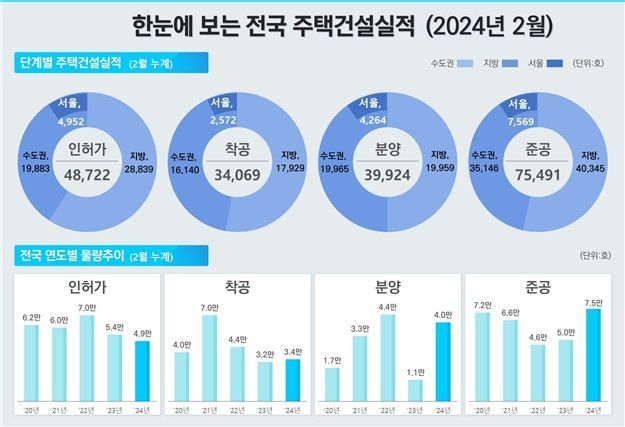 Housing Construction Performance Nationwide in February / Provided by the Ministry of Land, Infrastructure and Transport
All leading indicators of housing supply have declined. According to the Ministry of Land, Infrastructure and Transport, housing permits last month were 22,912 units, down 11.2% from the previous month. The metropolitan area (8,916 units) and provinces (13,996 units) decreased by 18.7% and 5.7%, respectively.
Housing construction starts last month were 11,094 units, halving compared to the previous month (22,975 units). The metropolitan area decreased by 72.2% to 3,510 units, and the provinces decreased by 26.7% to 7,584 units.
Trailing indicators such as completions and sales increased. Completions in February were 38,729 units, up 5.4% from the previous month. The cumulative total for January to February this year was 75,491 units, a 49.5% increase compared to the same period last year. Sales approvals (26,094 units) also increased by 88.7% from the previous month. The increase was larger in the provinces (136.9%) than in the metropolitan area (52.5%). On a cumulative basis, it surged 264.8% to 39,924 units compared to the same period last year.
Housing Transaction Volume Increases Mainly in the Metropolitan Area
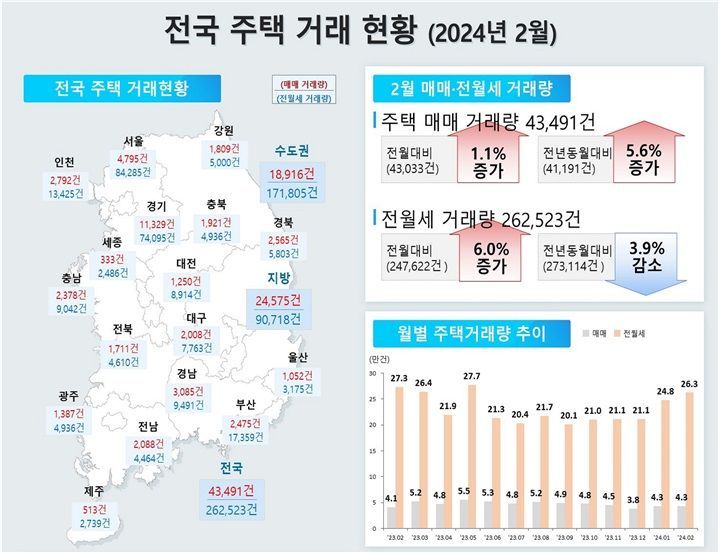 February Nationwide Housing Transaction Status / Provided by Ministry of Land, Infrastructure and Transport
Housing transaction volume increased for two consecutive months. The number of housing sales transactions in February (based on the reporting date) was 43,491, up 1.1% from the previous month. After continuously decreasing from about 51,000 cases in August last year to about 38,000 cases in December, it turned to an increase in January this year for the first time in five months. Accordingly, the cumulative transaction volume for January to February (86,524 units) also increased by 29.2% compared to the same period last year.
By region, the metropolitan area (18,916 cases) increased by 7.4% from the previous month, while the provinces (24,575 cases) decreased by 3.3%. During this period, Seoul's transaction volume was 4,795 cases, up 2.0%. By type, apartments (33,333 cases) increased by 3.8% compared to the previous month, but non-apartment houses (10,158 cases) decreased by 7.0%.
Last month's jeonse and wolse (long-term lease and monthly rent) transaction volume was 262,523 cases, up 6.0% from the previous month but down 3.9% compared to the same month last year. Jeonse transactions (107,811 cases) decreased by 10.8% compared to the same month last year, while wolse transactions (154,712 cases) increased by 1.6%. In the cumulative total for January to February this year, the share of wolse was 57.5%, 2.3 percentage points higher than the same period last year.
© The Asia Business Daily(www.asiae.co.kr). All rights reserved.
![Clutching a Stolen Dior Bag, Saying "I Hate Being Poor but Real"... The Grotesque Con of a "Human Knockoff" [Slate]](https://cwcontent.asiae.co.kr/asiaresize/183/2026021902243444107_1771435474.jpg)


















