Extension of 'Temporary Health Insurance Fund Injection' Amid Prolonged Medical Service Gaps
Government Expects Reduced Claims from Fewer Consultations to Offset Spending
Calls for Premium Rate Hike Due to Health Insurance Fund Deterioration
Government States "Essential Medical Funding Possible Without Rate Increase"
The government decided to inject an additional 188.2 billion KRW into the health insurance fund next month, following the allocation of the same amount earlier this month to address the medical service gap. The government is also releasing various policies almost daily to persuade the medical community to raise fees and support funds. Consequently, concerns about the deterioration of health insurance soundness and the possibility of increased insurance premiums for health insurance subscribers have been raised.
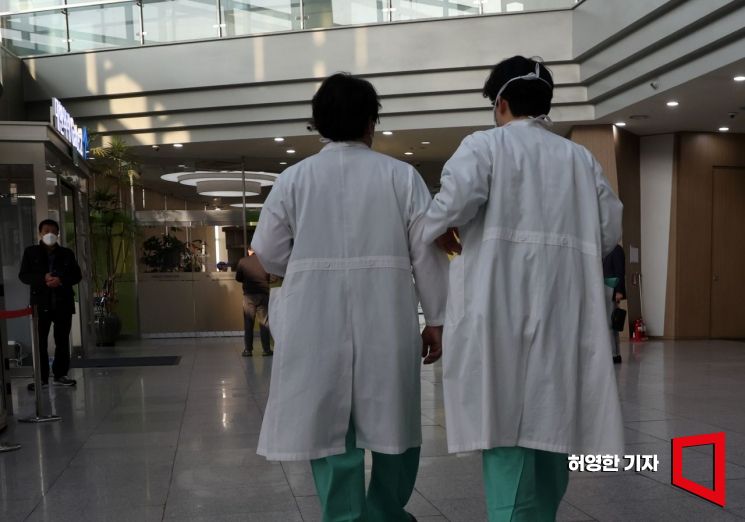 On the 15th, medical staff are entering the treatment area at a university hospital in Seoul, where the Emergency Response Committee of medical school professors from 19 universities is expected to decide on resignation. Photo by Huh Younghan younghan@
Another 188.2 billion KRW to be injected from health insurance in April... Health insurance expenditure to reach 100 trillion KRW next year
The Ministry of Health and Welfare resolved at the '7th Health Insurance Policy Deliberation Committee (HIPDC) in 2024' held the day before to extend and support the 'Emergency Medical Service Health Insurance Support Plan' worth 188.2 billion KRW per month to prevent medical service gaps caused by prolonged emergency medical care. Accordingly, following the support of 188.2 billion KRW from the health insurance fund since the 11th for frontline medical staff and additional personnel support, as well as enhanced compensation for emergency and severe inpatient care, a second expenditure of 188.2 billion KRW from the health insurance fund will occur next month. At that time, the government announced the health insurance fund support of 188.2 billion KRW per month along with a contingency fund of 128.5 billion KRW to activate the emergency medical system, expressing hope for a swift resolution of the situation, but no end date for the health insurance fund injection was set. However, the HIPDC was informed that 'if the medical service gap situation does not end, the financial injection may be extended.' The government, which aimed to prevent the situation from prolonging, ultimately decided to inject the health insurance fund for the second time.
With this additional injection, health insurance expenditure this year is expected to increase from 96.2553 trillion KRW to 96.6317 trillion KRW, assuming this additional injection is the last.
Meanwhile, the Ministry of Health and Welfare announced last month that it will invest '10 trillion KRW + α' from the health insurance fund into essential medical packages. More than 5 trillion KRW will be invested in surgical avoidance fields and severe internal medicine diseases, and over 3 trillion KRW in pediatrics and childbirth-related fields. A 2 trillion KRW network compensation will be strengthened in areas requiring cooperation between medical institutions. Reflecting this, health insurance expenditure is expected to exceed 100 trillion KRW from next year.
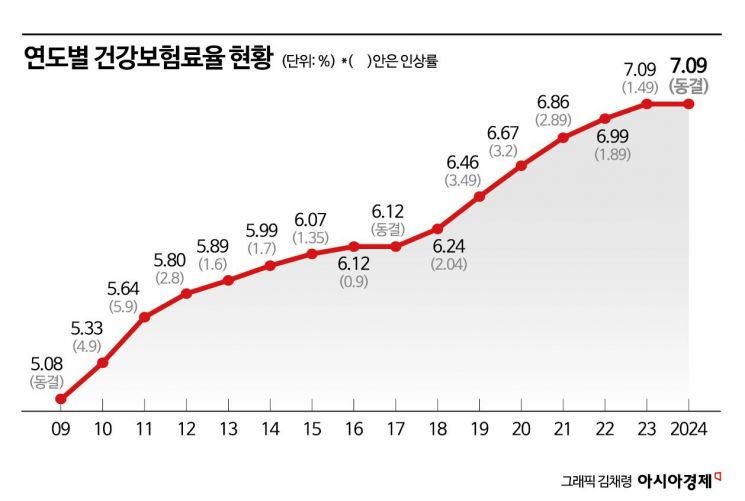
The government also forecasts health insurance revenue to exceed 100 trillion KRW. However, this revenue projection assumes a 1.49% increase in the insurance premium rate next year (the increase rate in 2023). This year, the insurance premium rate was frozen at 7.09% compared to the previous year, but the government's '2nd Comprehensive National Health Insurance Plan' leaves open the possibility of an increase from next year. The 1.49% increase rate is also variable. A Ministry of Health and Welfare official said, "It is a standard set for estimation purposes" and "it can change."
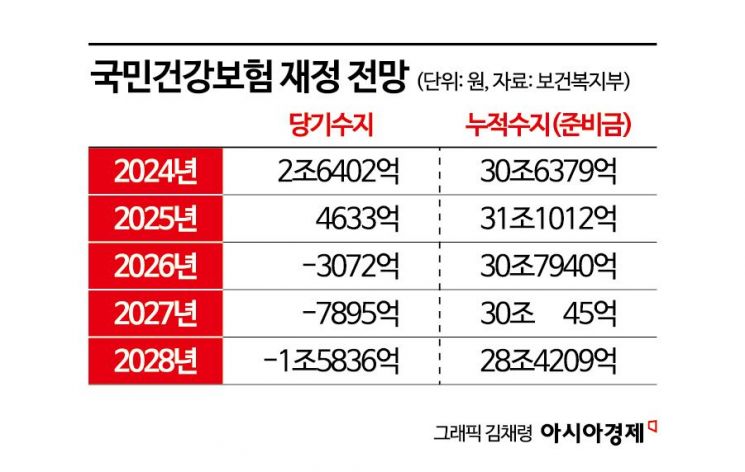
Assuming a 1.49% increase in premium rates, revenue rises but deficits begin in 2026
Assuming the insurance premium rate increases by 1.49% annually from 2025, health insurance revenue is calculated to rise from 104.5611 trillion KRW in 2025 to 125.2201 trillion KRW in 2028. Even with a 1.49% increase in premium rates, the current balance will turn into a deficit starting in 2026 due to expenditures exceeding revenue.
Health insurance premiums can be levied up to 8% of monthly salary or income according to the National Health Insurance Act. The rate was 5.08% in 2009 but has steadily increased to 7.09% this year, nearly reaching the ceiling after 15 years. The government announced earlier this year that it would initiate social discussions on adjusting the legal ceiling to ensure stable operation of health insurance. It also stated, "We do not expect a situation requiring discussion of the ceiling during the five-year plan," which can be interpreted as meaning the ceiling may be adjusted after 2028, if not before.
According to the National Assembly Budget Office's 2023?2032 health insurance financial forecast, if the health insurance premium rate increases by an average of 2.06% (the average from 2021 to 2023) starting in 2025, the premium rate is expected to reach the ceiling of 8.0% by 2030. In this case, the cumulative deficit by 2032 is projected to reach 61.6 trillion KRW. If the 8% ceiling is abolished, the cumulative deficit is expected to decrease by about 11 trillion KRW. Without the premium rate ceiling, the premium rate is projected to rise to 8.01% in 2030, 8.18% in 2031, and 8.35% in 2032.
Will the health insurance premium ceiling be adjusted after 2028? Government says "For now, no worries"
Although the possibility of health insurance premium increases to stabilize the health insurance fund continues to arise, the government currently explains that "there will be no additional increases."
Park Min-su, the 2nd Vice Minister of the Ministry of Health and Welfare, said, "Considering that the 2023 health insurance premium increase rate of 1.49% is the lowest in the past six years, we are maintaining stable health insurance finances while reducing the burden of premium rate increases. Currently, by utilizing the reserve fund of 28 trillion KRW and implementing various financial stabilization measures, we can operate finances stably without additional premium increases and make bold financial investments to revive essential medical care," he said.
Another senior government official said, "After the medical service gap incident, health insurance claims have sharply decreased, especially in tertiary general hospitals," adding, "Sales at 47 tertiary general hospitals have decreased by tens of billions of KRW. Assuming an average of 3 billion KRW per month, it amounts to about 140 billion KRW, but the actual figure is believed to be higher." He continued, "The decrease in health insurance claims will offset the 188.2 billion KRW monthly health insurance injection, and even if the medical crisis continues and 188.2 billion KRW is injected monthly, health insurance claims will decrease by a similar amount, so it is difficult to see an immediate heavy burden on the health insurance finances."
© The Asia Business Daily(www.asiae.co.kr). All rights reserved.
![Clutching a Stolen Dior Bag, Saying "I Hate Being Poor but Real"... The Grotesque Con of a "Human Knockoff" [Slate]](https://cwcontent.asiae.co.kr/asiaresize/183/2026021902243444107_1771435474.jpg)


















