Ongoing Tug-of-War Between Medical Association and Government Over Medical School Quota Increase
One Month After Resident Resignations... Professors Struggling with Heavy Workloads
Professor Shin Yongbeom of Rehabilitation Medicine Launches Solo Picket Protest
The tug-of-war between the medical community and the government over the increase in medical school quotas has been prolonged. At this point, nearly a month after residents opposing the increase announced their intention to resign, professors who are filling the vacancies left by the departing residents are suffering from overwork and expressing fatigue.
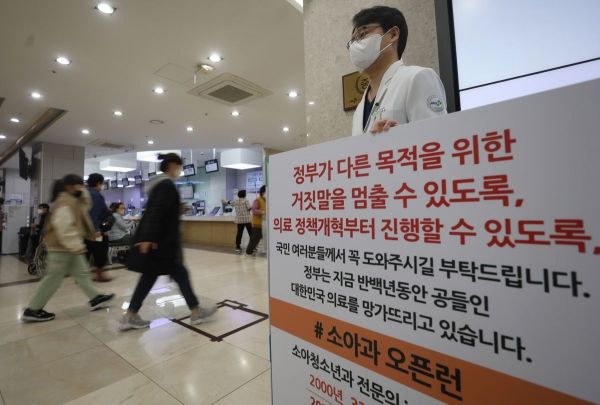 Professor Shin Yong-beom of the Department of Rehabilitation Medicine conducting a solo picket protest.
 [Photo by Yonhap News]
On the 28th, Yonhap News reported an interview with Professor Shin Yong-beom of the Department of Rehabilitation Medicine, who staged a solo picket protest at the outpatient ward of Busan National University Hospital in Seo-gu, Busan, that afternoon. Professor Shin has served as the head of the education and research office managing residents. He criticized the government's plan to increase medical school quotas by 2,000 students, stating, "I came out to the field because there are no students or residents to teach," explaining the reason for his protest.
Professor Shin said, "Recently, the remaining professors at the frontline, where residents have left, are suffering from heavy workloads," adding, "When I contacted a professor on duty in the emergency room, he said he was receiving an IV drip himself. Professors are assigned to duty shifts and also have to see outpatients, and if this situation prolongs, some will really leave the hospital or take sick leave," he warned.
He also claimed, "In places that receive many critically ill patients, professors can only go home once or twice a week," and added, "Although the number of surgeries and patients has significantly decreased, the patients remaining in university hospitals are critical, so the heavy workload remains." He continued, "Some professors at our hospital have also submitted resignation letters," but emphasized, "No one has abandoned the field."
Professor Shin revealed that new interns who were originally scheduled to start working this month have been contacting the hospital to cancel their appointments. He explained the current situation, saying, "Perhaps because there is no sign of the current situation being resolved, we frequently receive requests to completely cancel appointments so that they can enlist in active military service. Legally, once interns start their duties, they cannot enlist in active service during their training period."
He added, "There is also a tendency to think that serving 18 months in active military service is better than working 38 months as a military doctor," and argued, "If the government focuses solely on increasing quotas by 2,000 without engaging in dialogue, residents will never return to the field. For the sake of patients and the remaining medical staff, the government must initiate talks first."
Ministry of Health and Welfare urges residents to return... Interns told to "register appointments by April 2"
Meanwhile, on the same day, the Ministry of Health and Welfare urged the residents who had left to return to their training hospitals by the end of March. They warned that medical school graduates who passed as interns this year will not be able to train in the first half of the year if they do not register their appointments with the Training Environment Evaluation Committee by April 2, urging them to return to the medical field before it is too late.
On the 27th, the Presidential Office stated, "Bold financial investment in essential medical care is the cornerstone for sustaining our country's healthcare system," and announced "five major financial projects for medical reform, including appointing a national supervisor for resident training, and establishing a special account for the medical community." This aims to revive essential and regional medical care through the establishment of a national supervisor for resident training and a regional medical development fund. However, since they reiterated that there is no possibility of adjustment or compromise regarding the increase in medical school quotas, the medical gap caused by the residents' strike is unlikely to be resolved easily.
© The Asia Business Daily(www.asiae.co.kr). All rights reserved.
![Clutching a Stolen Dior Bag, Saying "I Hate Being Poor but Real"... The Grotesque Con of a "Human Knockoff" [Slate]](https://cwcontent.asiae.co.kr/asiaresize/183/2026021902243444107_1771435474.jpg)

















