Summary of BOJ Monetary Policy Meeting Released
At the March Monetary Policy Meeting where the Bank of Japan (BOJ) ended its negative interest rate policy for the first time in 17 years, it made clear that this rate hike does not signify a shift to a tightening regime. The BOJ also expressed a cautious stance on further rate increases. However, the record depreciation of the yen is expected to be a variable.
The summary of the March Monetary Policy Meeting released by the BOJ on the 28th confirmed the background behind the rate hike and the lifting of large-scale easing measures. Regarding the BOJ's decision on the 19th to raise Japan's short-term policy rate from -0.1% to 0?0.1%, it explained that "the wage negotiations in spring (Chuntu) produced better-than-expected results, bringing the goal of achieving a 2% inflation rate within sight."
Most members also expressed the opinion that "interest rate formation should be left as much as possible to market autonomy" and that "policies that have adversely affected market functions should be reviewed to allow the market to function autonomously." However, they stated that "purchases of Japanese Government Bonds (JGBs) will continue at the current level," indicating a policy to support market liquidity recovery without affecting market interest rate formation.
On the other hand, there were opinions expressing concern about the March rate hike. One member said, "If the negative interest rate policy ends, the BOJ should maintain a cautious stance," adding, "The Japanese economy is not currently in a state that requires a rapid policy rate increase." Another pointed out that most of the recent record wage increases were centered on large Japanese corporations and said, "We need sufficient time to examine whether small and medium-sized enterprises have the conditions to pass on wage increases to product prices."
It is interpreted that the BOJ reached the conclusion at the March meeting to implement the rate hike while ensuring that the market does not have excessive expectations for further easing. One member said, "It is important to clearly communicate through various means that the policy stance change presented at this monetary policy meeting does not represent a 'shift to a tightening regime.'" BOJ Governor Kazuo Ueda also reiterated in a recent parliamentary speech that "easing financial conditions are expected to continue for the time being."
Japan's economic outlook also supports this cautious view. Bloomberg News reported, "The Japanese economy is expected to show growth this quarter," but added, "Some economists predict the economy will contract again after three consecutive quarters of decline in Japanese consumer spending." This weakness in consumer spending is seen as a burden on the BOJ's further rate hikes.
However, the record depreciation of the yen is considered a variable. Even after ending the negative interest rate policy, the yen-dollar exchange rate rose intraday to 151.97 yen, marking the lowest yen value in 34 years. According to a Bloomberg survey last week, about 54% of BOJ experts expect the BOJ to raise rates further to defend the yen's value.
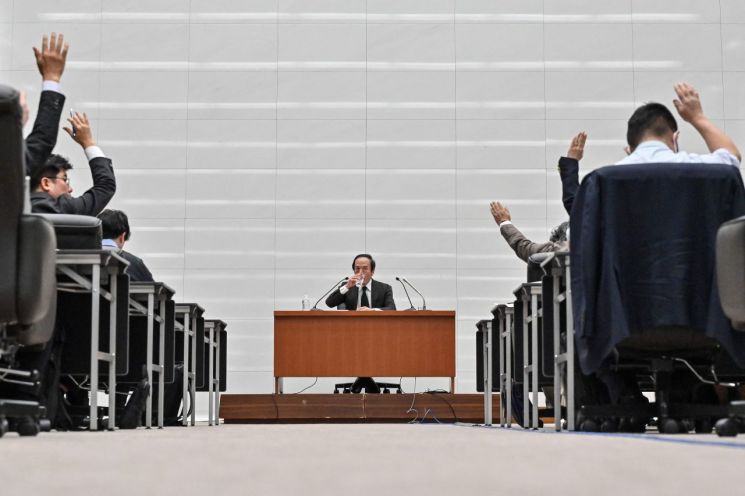
Meanwhile, at the March BOJ meeting, it was reported that two of the nine policy members, Toyoaki Nakamura and Asahi Noguchi, opposed the rate hike ending the negative interest rate policy. The BOJ's monetary policy decisions are made by majority vote among nine members, including the Governor, Deputy Governor, and policy board members, each holding one vote.
© The Asia Business Daily(www.asiae.co.kr). All rights reserved.
![Clutching a Stolen Dior Bag, Saying "I Hate Being Poor but Real"... The Grotesque Con of a "Human Knockoff" [Slate]](https://cwcontent.asiae.co.kr/asiaresize/183/2026021902243444107_1771435474.jpg)
















