2025 College Scholastic Ability Test on November 14
Plan to Remove Ultra-High Difficulty Questions to Maintain Appropriate Discrimination
EBS Linked Indirect Method...Wide Use of Textbook Materials
'Fairness Enhancement Plan' to Eradicate Private Education Cartel
In the 2025 College Scholastic Ability Test (CSAT) scheduled for November 14 this year, so-called 'killer questions' will be thoroughly excluded. The linkage between EBS CSAT textbooks and lectures and the CSAT questions will be conducted indirectly, and materials included in the linked textbooks will be widely utilized. In particular, the government has decided to promote measures focusing on strengthening the management of question setters to eradicate the private education cartel.To prevent questions similar to those in private education companies' mock exams from appearing, mock exams published during the question setters' training camp just before the CSAT will also be verified.
On the 28th, the Korea Institute for Curriculum and Evaluation (KICE) announced the '2025 College Scholastic Ability Test Implementation Basic Plan' containing these details in the morning. This year's CSAT will be composed of questions with appropriate difficulty so that students can solve problems by faithfully receiving school education within the scope of public education and supplementing it with EBS linked textbooks and lectures.
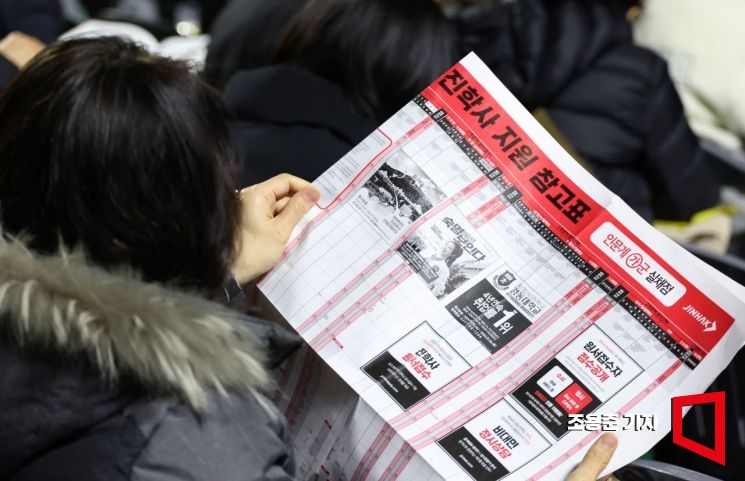 On the 14th, a parent attending the '2024 Academic Year Regular Admission Strategy Briefing' held at Jamsil Student Gymnasium in Seoul is attentively examining an analysis chart containing strategies for regular admission success. Photo by Jo Yongjun jun21@
Eliminating Killer Questions and Expanding EBS Utilization... Linkage Rate at 50%
First, according to the government's private education reduction measures, 'killer questions,' which are ultra-high difficulty problems, will be removed to maintain appropriate discrimination. The linkage between EBS CSAT textbooks and lectures and the CSAT questions will be conducted indirectly, and the linkage perception will be enhanced through the use of materials such as charts, illustrations, and passages included in the linked textbooks. The linkage rate is about 50% based on the number of questions per area and subject.
To ensure stable question setting and implementation of the CSAT, two mock evaluations (in June and September) will also be conducted to provide examinees with opportunities to adapt. The Korean History section, which is designated as mandatory, will assess basic knowledge of Korean history that high school graduates should have, rather than discrimination.
Killer questions will be excluded starting from the June mock evaluation to maintain appropriate discrimination. The test areas are divided into Korean, Mathematics, English, Korean History, Inquiry (Social Studies, Science, Vocational), and Second Foreign Language/Chinese Characters, with the Korean History section mandatory for all examinees. Following last year and the '2025 College Scholastic Ability Test Basic Plan' announced by the Ministry of Education in 2022, the Korean, Mathematics, and Vocational Inquiry areas will maintain a 'common subject + elective subject' structure, while English, Korean History, and Second Foreign Language/Chinese Characters areas will reflect absolute evaluation.
According to the test system introduced from the 2022 CSAT, the Korean, Mathematics, and Vocational Inquiry areas apply the 'common subject + elective subject' structure. The Social and Science Inquiry areas allow examinees to select up to two subjects from 17 elective subjects without distinction between social and science. This year, as in the previous year, English, Korean History, and Second Foreign Language/Chinese Characters areas will be conducted with absolute evaluation, and in the Korean History and Inquiry sections, answer sheets for Korean History and Inquiry will be separately provided to examinees. To aid understanding, three types of 2025 CSAT guidance materials will be provided on the KICE CSAT website and distributed to high schools nationwide by the end of March.
Cracking Down on CSAT and Private Education Cartel... Strengthening Question Setter Management
The Ministry of Education will implement the 'CSAT Question Setting Fairness Enhancement Plan,' including ▲systematizing the management of question setter pools ▲strengthening fairness in selecting question setters ▲systematizing similarity verification during question setting ▲and supplementing objection review procedures.
First, the CSAT question setter pool will be expanded, and verification and management will be systematized. With cooperation from education offices, universities, and related institutions, new personnel qualified as question setters will undergo prior verification and be registered in the pool on a regular basis. Additionally, monitoring and complaint reception regarding private education companies will be strengthened, and if it is found that a question setter has promoted their question-setting participation history, they will be excluded from the pool to strengthen management.
Following the September mock evaluation and last year's CSAT, this year's CSAT question setter selection will also completely exclude those engaged in profit-making activities related to private education through income-related verification. The selection process will be computerized to randomly select question setters from the verified pool, ensuring fairness.
Similarity verification between CSAT questions and private education questions during the question setting process will also be systematized. Previously, the criteria for purchasing materials used for similarity verification were unclear, resulting in some materials such as mock exams published by private education companies after admission being omitted from verification. To improve this, official requests will be made to private education companies to submit market question papers and major private education companies' mock exams, and plans for future publications will also be obtained for official purchase.
Through this, materials published both before and after admission to the CSAT question setting headquarters will be used for similarity verification between CSAT and private education questions. The 'CSAT Question Setting Review Committee,' composed of active teachers, will also be utilized to verify similarity between ongoing CSAT questions and private education materials.
Furthermore, 'private education relevance' will be added to the objection review criteria to supplement the objection review process. Previously, objections were only reviewed for question errors, but from the June 2025 CSAT mock evaluation, the relevance to private education will also be included in the review criteria. For questions suspected of similarity to private education questions, the 'CSAT Evaluation Advisory Committee,' composed of active teachers, will comprehensively consider the similarity between private education and CSAT questions and the influence of the private education questions to advise on whether the fairness of the exam is compromised.
Mock Evaluation for Main Exam on June 4... Measure to Identify Appropriate Difficulty
The College Scholastic Ability Test mock evaluation will be held on June 4. This measure aims to diagnose examinees' academic ability and provide an opportunity to adapt to new question types. It is also intended to maintain appropriate difficulty by understanding the academic level of prospective CSAT candidates this year.
The test areas are divided into Korean, Mathematics, English, Korean History, Inquiry (Social Studies, Science, Vocational), and Second Foreign Language/Chinese Characters, with the Korean History section mandatory for all examinees. Other areas can be chosen in whole or in part.
Following last year and the '2025 College Scholastic Ability Test Basic Plan' announced by the Ministry of Education in 2022, the Korean, Mathematics, and Vocational Inquiry areas maintain the 'common subject + elective subject' structure, and English, Korean History, and Second Foreign Language/Chinese Characters areas maintain absolute evaluation.
In the Korean and Mathematics areas, according to the 'common subject + elective subject' structure, the common subject is taken by all, and one elective subject can be chosen per area. Korean elective subjects include ▲Speech and Writing ▲Language and Media; Mathematics elective subjects include ▲Probability and Statistics ▲Calculus ▲Geometry. The English area consists of 45 questions, including 17 listening questions conducted within 25 minutes. The Inquiry area consists of Social Studies, Science, and Vocational Inquiry. Social and Science Inquiry areas can be freely selected, but to take the Vocational Inquiry area, students must have completed at least 86 credits of the industry-demand customized and specialized high school professional curriculum II (for those graduating before March 1, 2020, the vocational specialized curriculum; 80 credits for those graduating before March 1, 2016). In the Social and Science Inquiry areas, up to two subjects can be selected from 17 subjects without distinction. In the Vocational Inquiry area, up to two subjects can be selected from six subjects, and if two subjects are chosen, the professional common subject 'Successful Vocational Life' must be taken.
The June mock evaluation will also be based on the 2015 revised curriculum across all areas. As announced in the CSAT Implementation Basic Plan, the linkage between EBS CSAT textbooks and lectures and the mock evaluation questions will be conducted indirectly. In particular, the use of charts, illustrations, and passages included in the linked textbooks will enhance the perception of linkage. The linkage rate will be maintained at about 50% based on the number of questions per area and subject. Lee Ju-ho, Deputy Prime Minister and Minister of Education, stated, "We will eradicate the cartel between CSAT question setters and private education through system improvements," and added, "This year, we will maintain the principle of 'fair CSAT' by securing discrimination while excluding killer questions that are not covered in the public education curriculum to restore trust in the CSAT."
© The Asia Business Daily(www.asiae.co.kr). All rights reserved.
![Clutching a Stolen Dior Bag, Saying "I Hate Being Poor but Real"... The Grotesque Con of a "Human Knockoff" [Slate]](https://cwcontent.asiae.co.kr/asiaresize/183/2026021902243444107_1771435474.jpg)

















