Final Adjustment Ends in Failure on 27th
Seoul City Activates Emergency Transport Measures
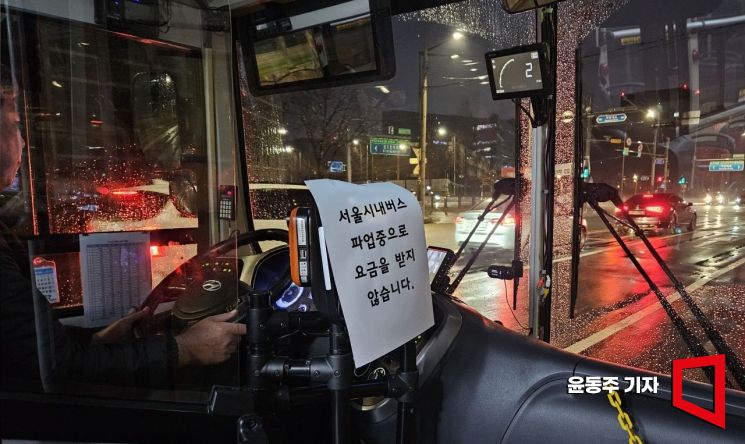 On the 28th, when the Seoul city bus union went on a general strike for the first time in 12 years, a notice saying "Seoul city buses are on strike, fares are not collected" was attached to the fare tag on buses operating in Seoul. Photo by Dongju Yoon doso7@
The Seoul city bus union went on strike starting at 4 a.m. on the 28th. This is the first time in 12 years that Seoul buses have stopped running, raising concerns about inconvenience for commuters.
The Seoul City Bus Labor Union declared the breakdown of negotiations with the employer, the Seoul City Bus Transportation Business Association, at around 2:20 a.m. that day. The labor and management entered final mediation at the Seoul Regional Labor Relations Commission from around 3 p.m. the previous day, but despite more than 11 hours of negotiations, they failed to reach an agreement. After the mediation deadline passed at midnight, both sides applied for an extension and continued talks, but ultimately failed to narrow their differences.
The union had been demanding a 12.7% hourly wage increase to prevent workforce migration to neighboring areas. However, the employer argued that the union’s demand was excessive compared to the inflation rate and civil servant wage increases over the past five years, proposing a 2.5% raise. The Regional Labor Relations Commission, acting as mediator, proposed a 6.1% increase, but no consensus was reached.
With the final negotiations failing, the union commenced a full strike as scheduled at 4 a.m. that day. However, it is reported that behind-the-scenes talks between working-level officials have continued even after the strike began.
Due to the union’s strike, 7,210 buses, accounting for 97.6% of the total 7,382 Seoul city buses, stopped operating from the first run. This is the first time since 2012 that Seoul buses have come to a halt due to a strike.
To minimize inconvenience to citizens caused by the union strike, the Seoul Metropolitan Government activated emergency transportation measures. The subway will operate 202 additional runs per day to alleviate rush hour congestion and ease inconvenience. The last train time will be extended from 1 a.m. to 2 a.m. the following day at terminal stations. To facilitate quick transfers for commuting via subway, free shuttle buses are also operating in 25 districts of Seoul. A total of 119 routes and 480 buses are deployed, running 4,959 times per day.
The city also sent out text messages advising, "Inconvenience in commuting and school attendance is expected due to the city bus strike. Please use other transportation options such as urban rail, free shuttle buses, and taxis."
Yoon Jong-jang, Director of the Seoul City Urban Transportation Office, stated, "We will make every effort to reach a smooth labor-management agreement as soon as possible," and added, "We will mobilize all available transportation means to minimize inconvenience to citizens."
© The Asia Business Daily(www.asiae.co.kr). All rights reserved.

















