Janet Yellen, U.S. Treasury Secretary
"To Discuss Overproduction Issues with China Next Month"
Janet Yellen, the U.S. Treasury Secretary, who will visit China next month, warned that China's overproduction capacity in the solar power and electric vehicle sectors is distorting the global economy. She pressured China by stating that the Chinese government’s use of massive subsidies to nurture domestic companies and its low-price offensive undermining the competitiveness of companies in other countries is problematic.
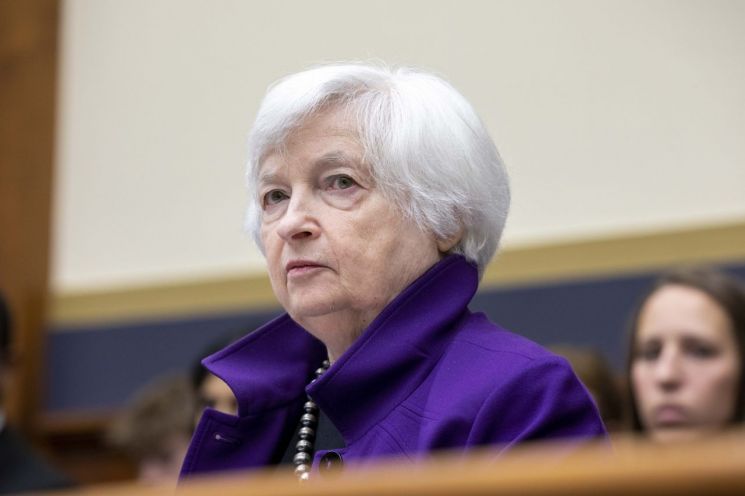
On the 27th (local time), ahead of her visit to a solar power company located in Norcross, Georgia, Secretary Yellen said in a released statement, "China's overproduction is distorting global prices and production methods, harming not only the United States but also companies and workers worldwide."
She added, "We have previously raised issues related to overproduction in talks with China, and I plan to focus on discussing this issue during my visit to China next month."
The facility Secretary Yellen visited that day is a solar power company production plant that was closed in 2017 and later reopened. Chinese companies have dominated the global solar power market for years, supported by government policies.
Secretary Yellen pointed out, "China made significant overinvestments in the steel and aluminum industries in the past. While this promoted production and employment, it also weakened industries in other countries worldwide." She continued, "We are now witnessing overproduction in new industries such as solar power, electric vehicles, and lithium-ion batteries."
The Chinese government’s support for domestic companies in green technologies like solar power and electric vehicle batteries is a warning that, similar to the past steel industry development, it could undermine fair market competition and the competitiveness of other countries. According to the People’s Bank of China, new loans in the manufacturing sector surged 28% year-on-year as of December last year. Regarding this, Secretary Yellen previously stated in an interview with MSNBC, "China has lowered solar panel prices to a level where U.S. companies cannot realistically compete. Companies have gone bankrupt, and we cannot allow this to happen again."
Secretary Yellen noted, "The difficulties faced by individual companies can lead to supply chain concentration, which will negatively impact global economic resilience." She emphasized, "It is important for U.S. companies and workers to compete on a level playing field, and we will pressure our Chinese counterparts to take the necessary measures to address this issue."
Secretary Yellen is expected to meet with He Lifeng, Vice Premier of the State Council responsible for China’s economic policy, and Lan Foan, Minister of Finance, among others, during her visit next month to focus on this issue.
China pursues a strategy of nurturing industries through government subsidies. Chinese companies, backed by active government support, have expanded their market share through low-price offensives and strengthened their dominance by gaining an advantage over competitors. In response, the U.S. has also revived industrial policies by introducing the Inflation Reduction Act (IRA) and the CHIPS and Science Act (CSA), providing massive subsidies. China has filed a complaint with the World Trade Organization (WTO), arguing that the IRA’s exclusion of subsidies for electric vehicles equipped with Chinese-made parts is discriminatory.
© The Asia Business Daily(www.asiae.co.kr). All rights reserved.

















