Low Increase Scale and Manageable Delinquency Rate
Prompt Implementation of Market Stabilization Program
Manage Soundness of Savings Banks, etc.
Regarding Lee Jae-myung's Pledge to Pay 250,000 Won per Person
Presidential Office Official: "Not Aligned with Sound Fiscal Policy"
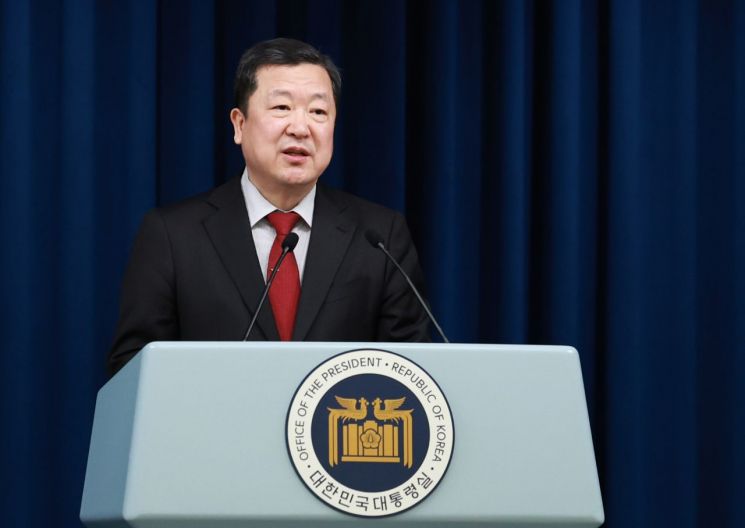
Park Chun-seop, the Chief Economic Secretary to the President, on the 27th refuted concerns about instability in the real estate project financing (PF) market and rumors of an April crisis, stating, "The government is closely monitoring the real estate PF situation, and the so-called 'April crisis' is completely baseless rumor."
At a briefing at the Yongsan Presidential Office that afternoon, Park said, "The financial sector's PF exposure (amount exposed to potential risk) stood at 135.6 trillion won as of the end of last year. Although the scale has somewhat increased, the growth is small, and the delinquency rate is at a manageable level of 2.7%."
Regarding the government's response direction, he said, "Under the consistent goal of an orderly soft landing, we are continuing to supply sufficient liquidity to viable projects while pursuing restructuring or liquidation of projects with poor feasibility," adding that the market stabilization program (85 trillion won + α) will be promptly executed.
On operating losses and asset quality deterioration in small financial sectors such as mutual finance cooperatives and savings banks, he assessed, "Although short-term net profits are decreasing and delinquency rates are rising, their loss absorption capacity is sufficient."
The delinquency rate of mutual finance cooperatives is below 3%, and the savings banks' delinquency rate was relatively low at 6.55% as of the end of last year, compared to 20.3% during past crisis periods. Park emphasized, "Both savings banks and mutual finance sectors have capital ratios significantly exceeding regulatory requirements," and explained, "We will continue to enhance loss absorption capacity through additional provisioning for bad debts and capital expansion, while managing asset quality by resolving delinquencies through PF restructuring and debt rescheduling."
Earlier, President Yoon Suk-yeol announced at the emergency economic and livelihood meeting held that day that the management of real estate PF risks and the guarantees by the Korea Housing Finance Corporation and the Housing and Urban Guarantee Corporation will be expanded by 5 trillion won to a total of 30 trillion won.
Regarding corporate value-up policies to resolve the Korea discount, Park explained, "The KOSPI index has surpassed the 2700 mark, and the overall price-to-book ratio (PBR) of KOSPI has risen to around 1.0," adding, "We plan to continuously discover and implement policies so that the capital market can become a ladder of opportunity with global competitiveness and contribute to national asset formation."
Park further noted that a second seminar will be held at the end of next month or early May to disclose value-up disclosure guidelines. In particular, plans to reduce corporate tax and dividend income tax for value-up companies and to improve corporate governance for shareholder rights protection will be concretized and announced.
Regarding budget formulation guidelines, four key investment areas will be focused on: fostering an innovation ecosystem, improving future readiness, welfare for the vulnerable, and health insurance stability.
Specifically, for the research and development (R&D) sector, he emphasized, "We will allocate an expanded budget compared to 2023. Not only increasing the budget size but also continuing visible achievements from last year's plans, we will significantly expand challenging and innovative R&D areas and expedite visible results through exemption from preliminary feasibility studies." Additionally, fostering essential medical fields and expanding the public nature of regional base hospitals are included as key points in this budget formulation guideline.
Meanwhile, regarding Lee Jae-myung, leader of the Democratic Party of Korea, proposing to provide 250,000 won per person, a senior official from the Presidential Office pointed out, "The 250,000 won per person support does not align with our sound fiscal policy stance."
On the abolition of the movie theater admission fee surcharge and school site surcharge, the official responded, "We expect the movie ticket price to decrease by about 500 won," and "The government will manage the school site surcharge so that the sale price can be lowered accordingly during development."
Regarding concerns that the abolition of the movie theater admission fee surcharge might cut production support funds for arts and independent films previously paid through the Film Development Fund, he explained, "The film industry can be sufficiently supported by transferring funds from the general account to the Film Development Fund," adding, "The government plans to provide support exceeding the amount lost due to the abolition of the movie theater admission fee surcharge."
© The Asia Business Daily(www.asiae.co.kr). All rights reserved.
![Clutching a Stolen Dior Bag, Saying "I Hate Being Poor but Real"... The Grotesque Con of a "Human Knockoff" [Slate]](https://cwcontent.asiae.co.kr/asiaresize/183/2026021902243444107_1771435474.jpg)
















