Hansol and Moorim Highlight Eco-Friendliness at Shareholders' Meetings
Expanding Scope with Nanocellulose-Based New Materials
The paper industry, which has been struggling with poor performance due to the overwhelming trend of digital transformation, is now seeking new opportunities in another major trend: the move away from plastics. While traditional paper usage has declined, companies are attempting to turn things around by expanding into eco-friendly businesses that replace plastics, such as paper containers.
According to the paper industry on March 28, the two leading companies-Hansol Paper and the Moorim Group-have each set their business direction for this year on expanding their eco-friendly operations to broaden their business scope.
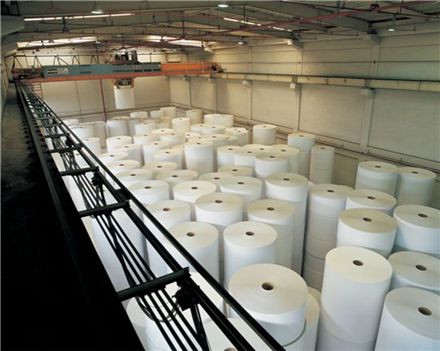 Hansol Paper factory view. (Photo by Hansol Paper)
Hansol and Moorim... "Expanding into the Eco-Friendly Market"
Hansol Paper CEO Han Chulgyu stated at the shareholders' meeting held on March 20, "We will continuously seek to enter new businesses that are promising and can create synergy with our paper business." The promising field he referred to is the eco-friendly sector. He added, "In the environmental business segment, we will leverage government-led eco-friendly policies and stricter regulations as opportunities to develop domestic biogas projects and related businesses. We will also strengthen our capabilities and expand our presence in eco-friendly paper materials and food packaging businesses to lead the market in the mid-to-long term."
Lee Dokyun, CEO of Moorim Paper, also emphasized eco-friendliness. At the shareholders' meeting on March 26, he said, "We will expand the development of various eco-friendly new material products that can be used not only in paper but also in various industries, so that we become a company sought out by consumers first. We will also focus on strengthening our business competitiveness to establish a profit-generating structure and advance our Quality Management System (QMS) to improve productivity."
Both Hansol Paper and Moorim are in urgent need of new growth engines. Hansol Paper's operating profit last year was 47.2 billion won, a 64% decrease compared to the previous year. Moorim Paper's operating profit last year was 67.7 billion won, down 30% from the previous year. The business environment remains challenging this year as well, due to factors such as the global economic downturn and the decline in demand for printing and specialty paper resulting from digital transformation.
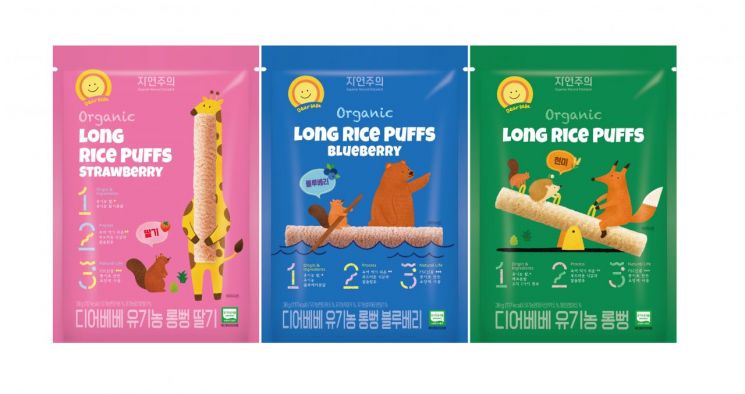 Image of Emart infant snack 'Longppong' with Hansol Paper's eco-friendly packaging Protecoga applied. (Photo by Hansol Paper)
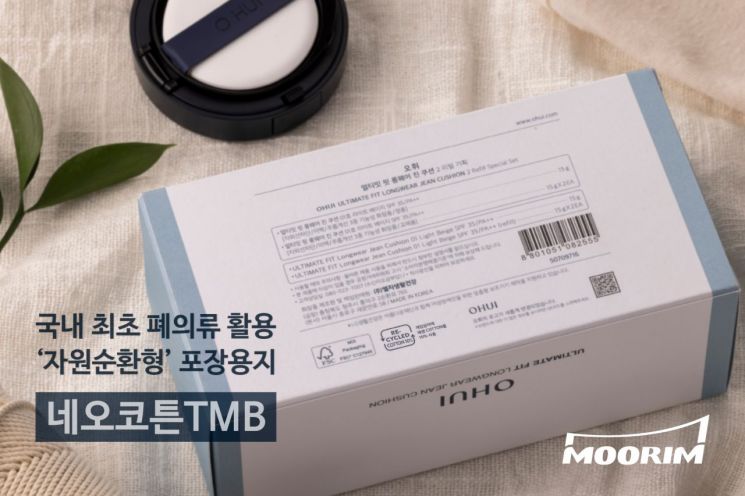
Focus on Developing Eco-Friendly New Materials
The fact that Hansol Paper and Moorim have chosen eco-friendliness as the direction for their business expansion is also evident in their recent research activities, which have focused on developing eco-friendly materials. Both companies have recently concentrated on developing nanocellulose new material application technologies. Nanocellulose is a type of bioplastic made by breaking down plant fibers to the nano level. As an advanced eco-friendly material that is biodegradable in nature, it is attracting attention in a variety of fields, including beauty, healthcare, and sports. The industry expects the related market to grow at an average annual rate of 19% by 2030.
Hansol Paper has collaborated with a matte polyurethane coating manufacturer to apply its products to automotive interiors and furniture, and is now seeking new business opportunities in areas such as secondary batteries, cosmetics, and automotive materials. Some products have already been commercialized. Notable examples include 'Protego', an eco-friendly paper packaging material that can replace plastic or vinyl packaging, and the 'Paper Sealing Tray', which reduces plastic use by more than 85% compared to conventional plastic trays.
Moorim is investing in the development of low-cost, mass-production technology for eco-friendly fiber materials. These fiber materials can be used for high-strength, heat-resistant automotive interior parts. The company also plans to complete the development of additives for highly transparent, biodegradable oxygen and moisture barrier films with a biomass content of over 90% by the end of this year. Recently, Moorim developed 'Neocotton TMB', a packaging paper made from discarded clothing, and began using it as packaging for cosmetics. Neocotton TMB is produced by separating cotton fibers from old clothes, grinding them into small pieces, and mixing them with natural pulp. This packaging material has been applied to LG Household & Health Care's 'Ohui' brand.
© The Asia Business Daily(www.asiae.co.kr). All rights reserved.
![Clutching a Stolen Dior Bag, Saying "I Hate Being Poor but Real"... The Grotesque Con of a "Human Knockoff" [Slate]](https://cwcontent.asiae.co.kr/asiaresize/183/2026021902243444107_1771435474.jpg)












