Long Judgments
One Cause of Trial Delays
Young Judges Increasing 'Footnote' Judgments
40,000 Appeals Filed Annually
To address the ‘resolution of trial delays’ that Chief Justice Cho Hee-dae’s court is driving, an active judge proposed a plan to ‘activate the Supreme Court’s remand panel.’ Inside and outside the judiciary, there is a growing atmosphere of reconsidering previously suggested measures such as ‘simplifying judgments’ and ‘improving the appellate system’ from scratch.
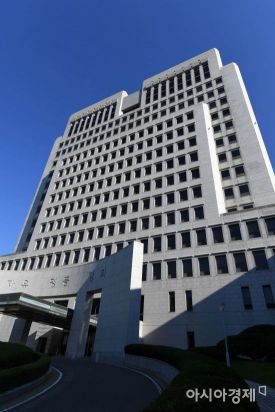 Supreme Court.
At the frontline, the ‘court president trial,’ where the court president presides directly, is gaining momentum. Meanwhile, as various available measures to improve trial delays are actively discussed, evaluations suggest that judicial restoration involving all judges, top to bottom, is underway.
“Aging Judges... Need for ‘Simplified Judgments’”
According to Legal News reporting, the Court Administration Office is also reviewing the simplification of judgments as one of the key tasks to resolve trial delays. As cases become increasingly complex, writing lengthy judgments like the current practice is considered one of the causes of trial delays. Recently, there has been a growing trend, especially among younger judges, to include footnotes commonly used in theses or research books in their judgments.
At a press briefing in February, Chief Justice Cho said, “The reason I have emphasized writing judgments in a simple and easy-to-understand manner since becoming Chief Justice is not only to make it easier for the public to understand but also to respect the fact that, unlike before, judges cannot work late into the night on weekends anymore.”
He also mentioned the roles of judges in civil law and common law systems and explained about judgments in the United States. Chief Justice Cho said, “In the U.S., there is basically no panel trial in the first instance. The judge only presides, and all conclusions are left to the people, who decide through jury trials. We may have a 3,200-page acquittal judgment, but in the U.S., if there is an acquittal, there is no judgment itself.”
The need to introduce simplified judgments is gaining more momentum in conjunction with the implementation of ‘unified legal profession,’ which requires legal professionals with a certain level of experience to become judges. The Judicial Policy Research Institute published a report in December last year titled ‘Improvement Measures for First Instance Judgment Writing Suitable for the Era of Unified Legal Profession.’ The report argues that with the start of unified legal profession, the average age of new and overall judges is increasing, and if a requirement of 7 to 10 years or more of legal experience is imposed in the future, judge aging will accelerate further, thus calling for improvements toward simplifying judgments.
Renewed Discussions on Improving the Appellate System
Meanwhile, the necessity of ‘improving the appellate system,’ a long-standing issue of the judiciary, is also emerging. To improve the appellate system, which has reached its limit due to a flood of cases, the former Yang Seung-tae court attempted to introduce an appellate court, but the plan was scrapped amid allegations of abuse of judicial administrative power during the process.
Still, more than 40,000 appellate cases flood into the Supreme Court every year. A chief judge at a metropolitan court said, “If the appellate system is not promptly improved in a situation where all cases reach the Supreme Court, the public’s right to trial will inevitably be infringed. Most countries have introduced a leave-to-appeal system, and measures such as leave-to-appeal or establishing appellate divisions in high courts could be practical improvements.”
According to the Judicial Policy Research Institute, the U.S. Supreme Court operates a certiorari system, a selective review procedure, and among thousands of leave-to-appeal applications received annually, only about 1-2% of cases are selected for substantive review.
Park Su-yeon, Legal News Reporter
※This article is based on content supplied by Law Times.
© The Asia Business Daily(www.asiae.co.kr). All rights reserved.
![Clutching a Stolen Dior Bag, Saying "I Hate Being Poor but Real"... The Grotesque Con of a "Human Knockoff" [Slate]](https://cwcontent.asiae.co.kr/asiaresize/183/2026021902243444107_1771435474.jpg)















