The government is implementing a ‘temporary regulatory relaxation’ for the first time in eight years. Previously, regulatory suspensions or relaxations were only enacted twice, in 2009 and 2016. The government expects this measure to generate economic benefits exceeding 4 trillion won.
On the 27th, Bang Gi-seon from the Office for Government Policy Coordination reported the first phase of the temporary regulatory suspension plan at the ‘23rd Emergency Economic and Livelihood Meeting’ presided over by President Yoon Seok-yeol.
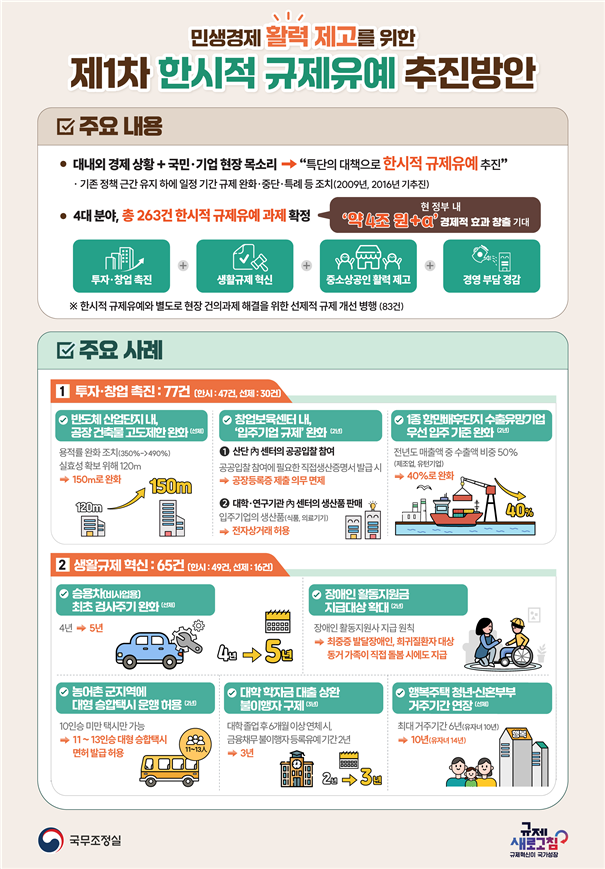
Temporary regulatory suspension is a measure that loosens regulations for a certain period while maintaining the foundation of existing policies. It is implemented by completely relaxing or suspending regulations or granting exceptions. Unlike the regulatory sandbox, which benefits only specific companies, this applies equally to all companies and citizens as long as they meet the requirements.
This measure was prepared after the government accepted demands from economic organizations raised at the ‘Killer Regulation TF Meeting’ in December last year. At that time, organizations such as the Korea Chamber of Commerce and Industry requested the implementation of temporary regulatory suspension considering the urgency of the current economic situation. Subsequently, the government selected regulations expected to have significant suspension effects from over 500 proposals submitted.
The regulatory suspension will be carried out in four major areas: investment and startups, daily life, revitalization of small and medium-sized enterprises, and reduction of management burdens. A total of 263 regulations are targeted. Compared to previous temporary regulatory suspensions in 2009 (145 cases) and 2016 (54 cases), this is the largest scale ever. Once implemented, it is expected to create economic effects exceeding 4 trillion won, including burden reduction (2.3 trillion won), investment creation (700 billion won), and sales increase (400 billion won).
Under this measure, height restrictions in semiconductor industrial complexes will be eased. Despite the relaxation of floor area ratio in March last year, the complexes faced difficulties in expansion due to a height limit of 120 meters. The government plans to relax this to 150 meters to promote the expansion of semiconductor production facilities and maximize process efficiency. It will also allow tenant companies in startup incubation centers within the complexes to participate in public procurement and relax priority occupancy criteria for first-class port hinterland complexes to encourage the expansion of promising companies.
Additionally, the initial inspection cycle for passenger cars (non-commercial use) will be extended from 4 years to 5 years to reduce the burden on citizens. Disability activity support payments will be provided during family care, and operation of large passenger taxis in rural fishing villages will be permitted. The registration deferral period for financial delinquency due to university student loan defaults will be extended from 2 years to 3 years. The residence period for youth and newlywed couples in Happy Housing will be extended from 6 years to 10 years.
Considerations to enhance the sense of impact on the ground were also included. The suspended regulations were mainly selected from those under enforcement ordinances or lower-level regulations that can be promptly addressed within the government. In addition, 83 tasks that can be immediately addressed, such as official interpretations or guideline issuance, were identified separately from the suspended regulations. Necessary measures, including ordinance amendments, are planned to be completed within the first half of this year.
The standard duration for the temporary regulatory suspension is two years. However, it will be flexibly set and implemented considering the characteristics of each task. After the suspension period ends, the effects will be reviewed to decide whether to extend, further improve, or terminate the suspension.
© The Asia Business Daily(www.asiae.co.kr). All rights reserved.
![Clutching a Stolen Dior Bag, Saying "I Hate Being Poor but Real"... The Grotesque Con of a "Human Knockoff" [Slate]](https://cwcontent.asiae.co.kr/asiaresize/183/2026021902243444107_1771435474.jpg)
















