2023 Korean Social Indicators
Dual-Income Household Share Hits Record High
Last year, South Korea's total fertility rate dropped to 0.72, marking the lowest level since statistics began in 1970. Due to the increase in single-person households, the average household size decreased to 2.2 members.
According to the "2023 Korean Social Indicators" released by Statistics Korea on the 26th, last year's total fertility rate was 0.72, down 0.06 from the previous year (0.78). This is the lowest record since statistics began in 1970. The total fertility rate refers to the average number of children a woman is expected to have during her lifetime.
The number of births has declined from 640,000 in 2000 to the 400,000 range from 2002 to 2016, the 300,000 range from 2017 to 2019, and the 200,000 range since 2020. Last year, the number of births was 230,000, which is about half of the 485,000 recorded in 2012.
The total number of households and the proportion of single-person households are on the rise. The total number of households was 22.38 million (as of 2022), an increase of 360,000 households from the previous year (22.02 million). During the same period, the average household size decreased by 0.1 to 2.2 persons from 2.3 persons the previous year.
By household size, single-person households accounted for 34.5%, and two-person households 28.8%, both showing an overall increasing trend, while three-person households (19.2%) and households with four or more members (17.6%) showed a decreasing trend.
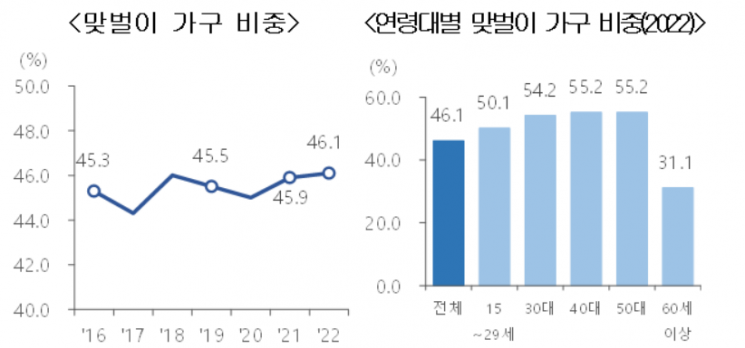
The proportion of dual-income households was 46.1% (as of the end of 2022), up 0.2 percentage points from 45.9% the previous year. This is the highest level since related statistics began in 2011. The proportion of dual-income households was highest among those in their 50s (55.2%), 40s (55.2%), 30s (54.2%), and 15-29 age group (50.1%), while the 60 and older age group had the lowest at 31.1%.
The ages at first marriage and remarriage are gradually increasing. Last year, the number of marriages per 1,000 people was 3.8, and divorces were 1.8, both similar to the previous year. The number of marriages last year was 193,657, slightly up from 191,690 the previous year, while divorces were 92,394, slightly down from 93,232 the previous year.
Statistics Korea explained, "The average age at first marriage and remarriage has steadily increased since 1990, and although the average age at divorce is higher than in 2010, it was similar to that in 2022."
© The Asia Business Daily(www.asiae.co.kr). All rights reserved.
![Clutching a Stolen Dior Bag, Saying "I Hate Being Poor but Real"... The Grotesque Con of a "Human Knockoff" [Slate]](https://cwcontent.asiae.co.kr/asiaresize/183/2026021902243444107_1771435474.jpg)











