Rapid Increase in 'Chulgeun Look' Posts on SNS
NYT: "Expressing Self-Deprecation with the Whole Body"
Among China's younger generation, a culture of going to work dressed in ridiculous outfits, such as layering multiple character pajamas, is reportedly trending. In particular, they say they will stick to such attire, stating, "Wearing nice clothes doesn't get you a higher salary, so we will dress plainly."
On the 24th (local time), foreign media including the US New York Times (NYT) and the UK Guardian focused on the phenomenon of young Chinese people posting photos of themselves going to work in pajamas on social networking services (SNS). On Xiaohongshu, known as China's Instagram, photos showing people wearing fuzzy pajama pants, slippers, and sleep socks with the caption "commuting look" are being uploaded one after another.
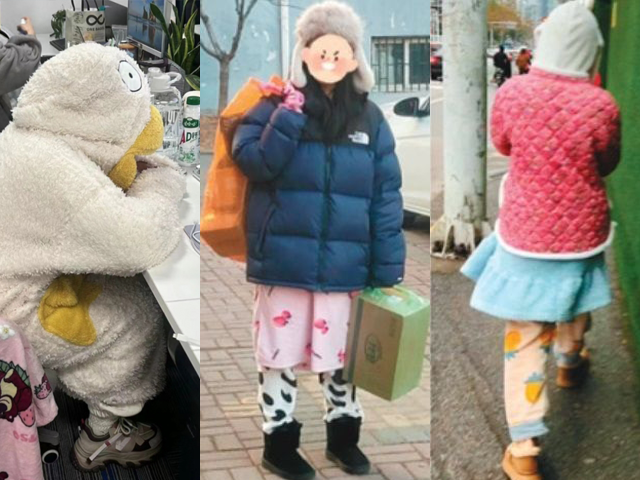 On Xiaohongshu, known as the Instagram of China, photos are continuously uploaded showing people wearing pajama fleece pants, slippers, and sleep socks with the description "commuting look."
 [Photo by Xiaohongshu]
The NYT explained, "The commuting attire of young Chinese office workers is surprisingly casual," adding, "Most look like they just got out of bed." Luo (30), who works as an interior designer in Wuhan, Hubei Province, told the NYT, "I just wear what I want," and said, "Since I only have to sit, I don't think it's worth spending money on clothes for commuting." She also added that she wears comfortable pajamas to work and rarely coordinates tops and bottoms.
"Low salary and no time, so when would I care about my commuting look?"
The Guardian introduced that the trend of "disgusting outfits" among young Chinese office workers started when a woman using the username Kendou S on Douyin, China's TikTok, posted a "commuting look" video wearing slippers, pajama bottoms, a brown sweater dress, and holey wool gloves.
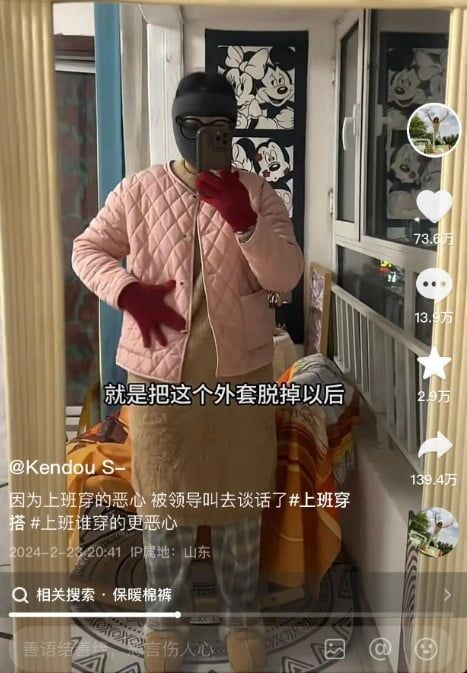 Kendos S posted a video saying that although his boss nagged him, saying his outfit was "terrible" and that he should "be mindful of the company's image and get a grip," he does not care.
 [Photo by Douyin]
At the time, Kendou S said, "My boss told me my outfit was 'terrible' and that I should 'care about the company's image and get my act together,'" but she ignored it and posted a commuting look video wearing slippers, pajama bottoms, a brown sweater dress, and holey wool gloves. Chinese netizens responded enthusiastically to this video, commenting, "There’s a lot of work and little pay, so when would we care about our outfits?"
Furthermore, the video of this outfit quickly spread across other platforms such as SNS and online communities. Since then, thousands of young office workers have been going to work in pajamas, showing rebellion and rejection of traditional "commuting attire." Although some criticize that "pajamas have really crossed the line," China's younger generation remains unfazed by such criticism and continues to maintain their disgusting commuting looks.
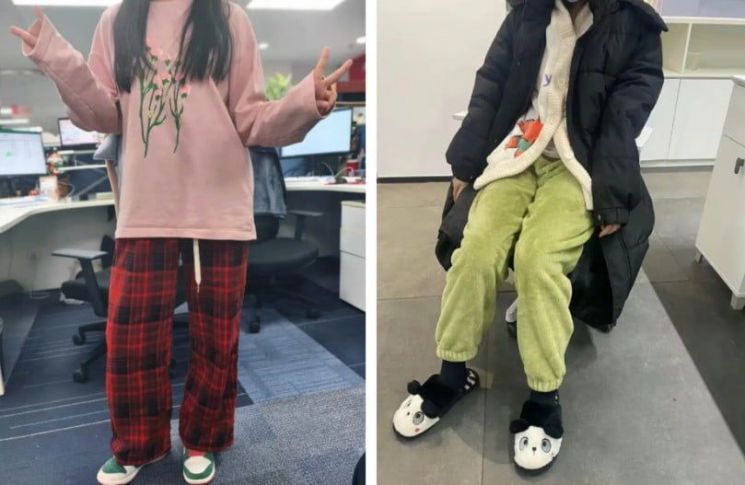 Amid this, some have also pointed out, "Isn't wearing pajamas crossing the line?" However, the NYT analyzed that a sense of 'loss' contributes to Chinese young people wearing pajamas to work.
 [Photo by Xiaohongshu]
The NYT analyzed that the background behind this commuting look trend in China is a sense of "loss" among young people. Young office workers, caught in a sense of loss due to the country's slowing growth and disappearing opportunities, believe that reality will not change no matter how hard they try, and are quietly protesting. Above all, it is interpreted as young Chinese rejecting a life of desperately striving for success or promotion and expressing their self-deprecation about their situation with their whole body.
© The Asia Business Daily(www.asiae.co.kr). All rights reserved.



















