4th Public-Private Joint Export Expansion Strategy Meeting
Historic Maximum of 90 Trillion Invested in Small and Medium Export Enterprises
The government has decided to provide trade insurance worth 136 trillion won to key industries such as semiconductors and secondary batteries to achieve $700 billion in exports this year.
On the 25th, the Ministry of Trade, Industry and Energy held the '4th Public-Private Joint Export Expansion Measures Meeting' chaired by Minister An Deok-geun at the Korea Chamber of Commerce and Industry, where they discussed plans to expand trade insurance support in 2024, strategies to strengthen the overseas competitiveness of small e-mobility, and support measures for export companies to respond to trade technical barriers (TBT).
The agenda items were follow-up measures to the '2024 Pan-Government Export Expansion Strategy' prepared in February to achieve the record-high export target of $700 billion this year, and for the first time, trade insurance supply targets by industry were presented.
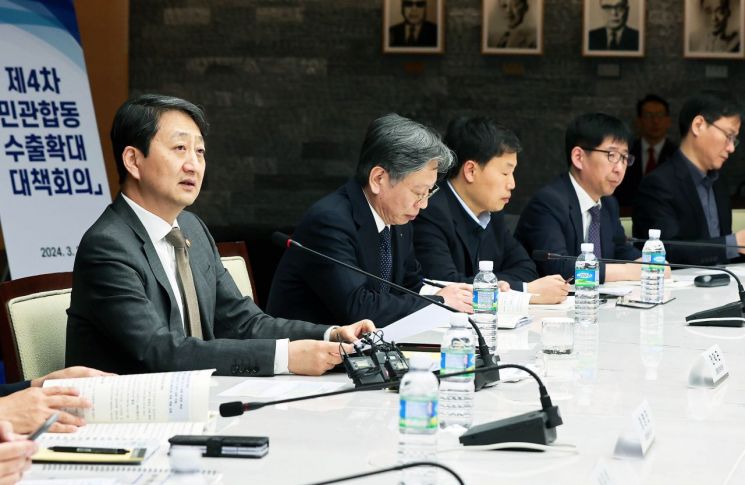 Minister Andeok Geun of the Ministry of Trade, Industry and Energy is presiding over the "4th Public-Private Joint Export Expansion Measures Meeting" on the 25th at the Chamber Lounge of the Korea Chamber of Commerce and Industry in Jung-gu, Seoul.
◆Record-high Trade Insurance of 255 Trillion Won... Industry-specific Supply Targets Presented
First, the government plans to supply a record-high 255 trillion won in trade insurance this year and significantly improve the scope and methods of support. Proactive support will be provided to industries where demand for trade finance is surging due to business recovery. By product category, a total of 136 trillion won will be supplied to key export sectors: 33 trillion won for automobiles and secondary batteries, 13 trillion won for machinery and ships, 40 trillion won for petrochemicals and steel, and 50 trillion won for IT. To support the increased likelihood of winning large projects, a total of 26 trillion won will be provided to sectors such as defense (7 trillion won), plant and energy (15 trillion won), and nuclear power (4 trillion won). In promising consumer goods sectors where exports are increasing due to the recent expansion of the Korean Wave, such as agricultural and marine products (5 trillion won) and cosmetics (1 trillion won), 18 trillion won will be supplied. Additionally, to expand service exports, a new production fund support program will be introduced for global online video streaming service (OTT) companies producing K-content.
To alleviate the financial burden on small and medium-sized enterprises (SMEs) and mid-sized companies whose fundamentals have weakened due to prolonged high interest rates, a record-high total of 90 trillion won will be supported. To this end, group insurance for small export companies will be expanded from 28,000 companies last year to 35,000 companies this year, the export credit guarantee limit will be doubled, and short-term export insurance premiums will continue to be discounted by 50%.
Through cooperation between commercial banks and the Korea Trade Insurance Corporation, insurance and guarantee fees for a newly established 2.2 trillion won export package preferential financing will be waived. Special support for advance payment refund guarantees (RG) for small and medium-sized shipbuilders will be expanded (from 200 billion won to 400 billion won), and to encourage participation from commercial and regional banks, the RG coverage ratio will be increased (from 85% to over 90%).
To respond to the global supply chain restructuring, trade insurance support (1 trillion won) will be newly provided to overseas subsidiaries with high export inducement effects, and a production fund support program (export supply chain guarantee, 200 billion won) will be newly introduced for 1st to 3rd tier suppliers conducting indirect exports through large companies.
To reduce risk burdens when entering emerging markets, the scale of export insurance support for countries such as the Global South will be expanded (to 10 trillion won), and preferential export insurance measures such as doubling limits and an additional 20% premium discount will be promoted for Gulf Cooperation Council (GCC) countries, with which a free trade agreement (FTA) was concluded at the end of last year.
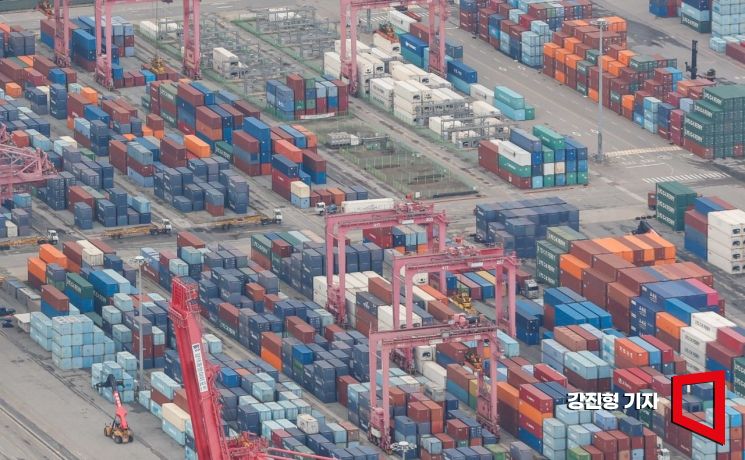 On the 27th, cargo containers are stacked at Pyeongtaek Port as seen from the air. [Aerial photography cooperation=Seoul Metropolitan Police Agency Aviation Unit, Pilots: Inspector Shin Seung-ho - Inspector Park Ji-hwan, Crew: Inspector Park Sang-jin] Photo by Kang Jin-hyung aymsdream@
◆Strengthening Overseas Competitiveness of Rapidly Growing Small e-Mobility
According to the Ministry of Trade, Industry and Energy, the small e-mobility market, including ultra-compact electric vehicles and electric two-wheelers, is expected to grow rapidly to over $120 billion by 2030 (from $78.2 billion in 2022). Accordingly, the government has established region-specific tailored strategies and competitiveness enhancement plans targeting markets such as India and Southeast Asia, where the e-mobility penetration rate is low (around 5%) and competition with major countries like China is intense.
First, through joint ventures with local companies in the Philippines and Vietnam, the government plans to enter the market with a package approach covering production, sales, infrastructure, and after-sales service (AS). It will also promote pilot distribution and establish e-mobility cooperation centers using official development assistance (ODA) projects (Indonesia). Demonstration projects such as delivery services linked with local distribution networks like BBQ and Kmart will be carried out. Additionally, at the ASEAN e-mobility exhibition to be held in Jakarta, Indonesia, this May, local buyer demand will be identified, and overseas consultation meetings will be held to support matching with domestic companies. Production fund loan guarantees and export insurance will be preferentially supported (1.5 times the limit, 30% discount on insurance and guarantee fees) to ensure stable contract fulfillment and payment collection.
To strengthen the domestic industrial ecosystem, three regional clusters in Jeonnam, Gangwon, and Gyeongbuk will be linked and developed into core export hubs, and a shared e-mobility platform for operation, charging, and after-sales services will be established by next year. Institutional improvements will also be actively pursued from a market creation perspective, including establishing safety standards and national standards and including electric two-wheelers in eco-friendly vehicles.
◆Systematic Support for Export Companies to Respond to Trade Technical Barriers
Trade technical barriers exceeded 4,000 cases for the first time last year, with more than 10 new cases emerging daily recently. To ensure that the increasingly complex and rapidly growing trade technical barriers do not become a burden to our export companies, the government plans to expand the focus monitoring countries for technical regulations and certifications (from 20 countries to 25, including Canada and Egypt), increase the provision of unnotified hidden regulation information (over 2,000 cases), promote the enactment of the 'Trade Technical Barriers Response Act,' and hold corporate meetings (once every six months) and regional briefing sessions (once a month) to provide one-stop support by visiting industrial sites directly to resolve difficulties.
Minister An said, "Despite challenging conditions such as the prolonged global high interest rate environment, supply chain restructuring due to US-China conflicts, geopolitical crises like the Russia-Ukraine war, and uncertainties from major country elections, our exports are showing a positive trend. We expect exports to continue to grow for six consecutive months and maintain a trade surplus for ten consecutive months as of March." He added, "It is time for the public and private sectors to unite as one team and launch an all-out export campaign to fully activate the export engine, which is showing a definite rebound among the three main engines of our economy, to bring forward a new spring for our economy."
© The Asia Business Daily(www.asiae.co.kr). All rights reserved.
![Clutching a Stolen Dior Bag, Saying "I Hate Being Poor but Real"... The Grotesque Con of a "Human Knockoff" [Slate]](https://cwcontent.asiae.co.kr/asiaresize/183/2026021902243444107_1771435474.jpg)

















