Deputy Prime Minister for Economy and Minister of Agriculture, Food and Rural Affairs Review Food Price Trends
Prices of agricultural products, including apples and green onions, have been showing a downward trend. The government attributes this to the effects of support for delivery prices, expanded discount support, and discounted supply of directly imported fruits by the Korea Agro-Fisheries & Food Trade Corporation (aT).
On the morning of the 25th, Deputy Prime Minister and Minister of Economy and Finance Choi Sang-mok and Minister of Agriculture, Food and Rural Affairs Song Mi-ryeong visited the Hanaro Mart Seongnam branch to review price trends of agricultural, livestock, and fishery products and to check the implementation status of price stabilization measures.
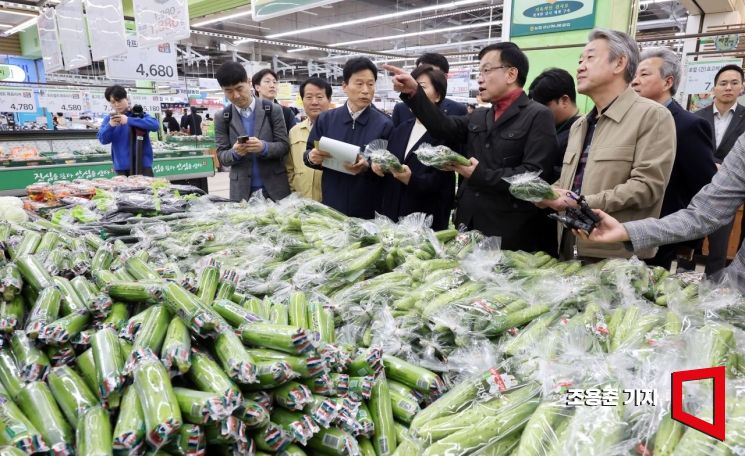 Choi Sang-mok, Deputy Prime Minister for Economic Affairs and Minister of Economy and Finance, visited the Nonghyup Hanaro Mart Seongnam branch in Seongnam, Gyeonggi Province on the 25th to check prices, inspecting price trends of major items such as fruits and vegetables. Attending the on-site price inspection were Song Mi-ryeong, Minister of Agriculture, Food and Rural Affairs, and Kang Ho-dong, Chairman of Nonghyup. Seongnam ? Photo by Jo Yong-jun jun21@
In response to recent price instability in food items such as fruits and vegetables, the government began providing 150 billion KRW worth of 'Emergency Agricultural, Livestock, and Fishery Price Stabilization Funds' starting last week and is implementing the price stabilization measures for agricultural, livestock, and fishery products announced at the Livelihood Economy Inspection Meeting on the 18th. Accordingly, Deputy Prime Minister Choi and Minister Song visited Hanaro Mart to inspect the on-site implementation of government price stabilization measures and consumer perceptions.
An official from the Ministry of Agriculture, Food and Rural Affairs explained, "Agricultural product prices rose sharply until February due to supply and demand instability caused by adverse weather conditions at the beginning of the year. However, in March, thanks to government support for delivery prices, expanded discount support, and aT's discounted supply of directly imported fruits, prices of most items have started to decline." As of the 22nd, prices of apples and pears fell by 11.6% and 13.4%, respectively, compared to the previous week. Additionally, consumer prices of tomatoes (-12.9%), paprika (-14.5%), small cucumbers (-17.9%), and green onions (-10.9%) also decreased.
Hanaro Mart stated that, in addition to the government's expanded delivery price support and increased discount rates (up to 30%), the mart itself is offering discounts, selling major agricultural, livestock, and fishery products at prices discounted by up to 40-50%.
Deputy Prime Minister Choi and Minister Song also visited the livestock and fishery product sections to check supply and price trends and the progress of discount events. A representative from the NongHyup explained, "Since the 21st, discount events using Korean beef self-support funds have been held at over 750 Hanaro Mart locations nationwide. Prices of eggs and chicken are also stabilizing downward due to delivery price support (eggs: 1,300 KRW/30 eggs, chicken: 1,500 KRW/kg)." Regarding fishery products, it was reported that supply is stable as stocks held by the government and private sector are being supplied to the market, maintaining stable prices.
The government plans to continue providing price stabilization funds until agricultural product prices stabilize and will expand the scope of delivery price and discount support to include small and medium-sized marts and online shopping malls. Furthermore, by early April, the number of fruit items subject to tariff quotas will be swiftly increased from the current 24 to 29, and direct fruit imports will be expanded from two types (banana and orange) to 11 types, including pineapple and mango, supplying consumers with affordable prices without margins.
Additionally, to prevent a recurrence of sharp price increases caused by poor apple harvests like last year, the government plans to develop a fundamental 'Fruit Industry Competitiveness Enhancement Plan' in cooperation with related ministries, covering production, distribution, and consumption stages. The plan includes significantly expanding the distribution of disaster prevention facilities against cold damage and focusing on establishing next-generation orchards with productivity more than twice that of existing orchards, especially in new cultivation areas. The contract cultivation volume of apples and pears, currently about 105,000 tons this year, will also be greatly expanded, and the Agricultural and Fishery Product Distribution Centers (APCs) will enhance sorting and storage facilities to strengthen supply and demand management.
© The Asia Business Daily(www.asiae.co.kr). All rights reserved.
![Clutching a Stolen Dior Bag, Saying "I Hate Being Poor but Real"... The Grotesque Con of a "Human Knockoff" [Slate]](https://cwcontent.asiae.co.kr/asiaresize/183/2026021902243444107_1771435474.jpg)
















