From Korea and China to German Japanese Instructors Appear
Instructor Shortage Amid Staffing Crisis
"Foreigners Teach Better Than Native Speakers," Praised
The hiring of foreign Japanese language instructors in Japan has increased significantly. Since the pandemic, the number of foreign students staying in Japan through working holidays or language study programs to learn Japanese has surged, but there is a severe shortage of instructors. At the government level, a decision was made to remove nationality from the qualification requirements for instructors, sparking mixed reactions between criticism questioning "how foreigners can teach another country's language" and support viewing it as "an opening to the diversity of the Japanese language."
On the 30th, Nihon Keizai Shimbun (Nikkei) introduced the case of Julian, a German Japanese language instructor, reporting that the number of foreign instructors who are not native Japanese speakers has greatly increased at Japanese language schools in central Tokyo. They also noted that inquiries from foreigners seeking employment as instructors at Japanese language instructor training institutions are flooding in.
Julian, who has been working at a Japanese language school in Shinjuku, Tokyo since July last year, conducts classes in the same way as other Japanese instructors by writing Japanese example sentences and having students read them aloud, then correcting their pronunciation one by one. He is highly passionate, even developing his own teaching materials. Born to a Japanese father and a German mother, he was in an environment where acquiring Japanese was somewhat easier, but he had lived in Germany continuously. At the age of 27, he moved to Japan and completed a teacher training course.
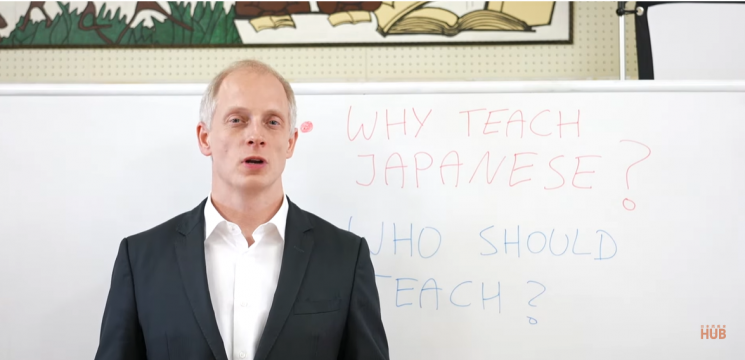 Dominic Kosik, an Australian CEO running the Japanese language school 'Akita Inaka School' in Japan, is explaining Japanese language education by foreign instructors. (Photo by Japanese Language Education HUB YouTube channel)
Despite concerns that being non-Japanese might make it difficult to gain students' trust, his fluency in Japanese, German, and English is seen as an advantage, making him more popular than other Japanese instructors. On days without classes, he spends time recruiting foreign students who want to learn Japanese directly.
At the school where Julian works, instructors from China and Uzbekistan are already conducting Japanese language classes. A school official stated, "Nationality is not a factor when it comes to Japanese language instructors. We rather look at character and ability when hiring."
At another Japanese language school in Shinjuku, instructors of Korean and Chinese nationality are active. This school, with about 1,800 students, has eight foreign instructors. A representative emphasized, "We are actively increasing non-native instructors. It is a prejudice to assume that international students naturally want to learn Japanese from Japanese people. On the contrary, foreigners who learned Japanese first can provide good motivation to students, which has many advantages."
The government is also lowering the barriers for instructors accordingly. From next month, Japanese language instructors will be classified as "Registered Japanese Language Teachers" after passing a national qualification exam. To obtain the qualification, candidates must pass a written exam and complete training. However, a groundbreaking condition has been set that the nationality of those wishing to acquire the certification will not be questioned. As long as certain qualification requirements as an instructor are met, it does not matter whether the person is foreign or Japanese.
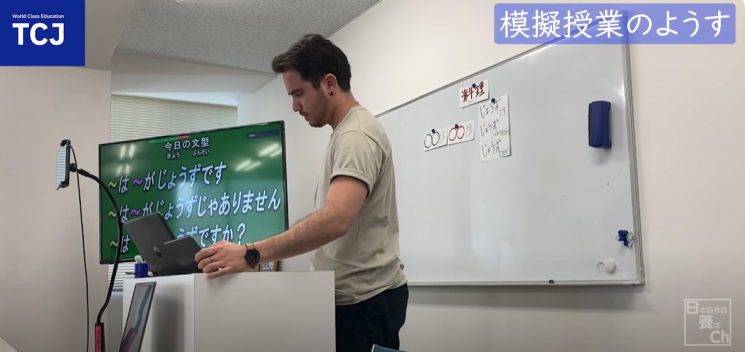 Julian during a mock class while attending a Japanese teacher training course. (Photo by TCJ YouTube channel)
The background of this phenomenon lies in the shortage of personnel. There are about 44,000 Japanese language instructors nationwide, while the number of students learning Japanese is known to reach 220,000. Additionally, most instructors are non-regular employees, and due to poor treatment such as low wages relative to work intensity, the number of new instructors is gradually decreasing. Nikkei reported, "Among Japanese language instructors, those in their 20s are a minority, and those aged 50 and above account for more than half. By gender, 80% are female."
Moreover, most instructors are concentrated in major cities such as Tokyo. According to the Agency for Cultural Affairs, as of November 2022, 44% of Japanese municipalities (basic local governments) have no Japanese language education facilities for foreign residents, creating gaps. A Japanese language school principal said, "Recently, inquiries from foreigners wishing to register for instructor training courses have increased," adding, "At six branches including the Kansai region, 16 foreign students are attending classes." It is especially known that many are from China or Vietnam.
Opinions in Japan are divided on this issue, but experts generally have a favorable view. Professor Yasuhiro Nakagawa of Chuo University said, "Opening the door to foreigners is a welcome development," emphasizing, "Because they are not native speakers, they understand the points where mistakes are likely to occur well." He added, "It is also important in terms of opening linguistic diversity. The market value will continue to rise in the future."
© The Asia Business Daily(www.asiae.co.kr). All rights reserved.


















