KAIST (President Kwang Hyung Lee) announced on the 25th that the research team led by Professor Jongcheol Ye from the AI Graduate School, including Jinho Jang, has developed an artificial intelligence technology capable of simultaneously generating and predicting molecular structures and their biochemical properties, making it widely applicable to various chemical challenges.
The newly developed AI technology demonstrated performance surpassing existing AI technologies by solving various problems simultaneously, such as chemical reaction prediction, toxicity prediction, and compound structure design. It draws attention as an AI technology capable of generating new compounds while simultaneously predicting the properties of existing compounds.
The research team proposed an AI learning model that considers the set of chemical property values itself as a data format representing molecules, learning the correlation between the molecular structural expressions and these properties together. By introducing multimodality learning techniques primarily studied in the field of computer vision, the model integrates two different data formats to generate new molecular structures that satisfy desired compound properties or predict the properties of given compounds, enabling simultaneous generation and property characterization.
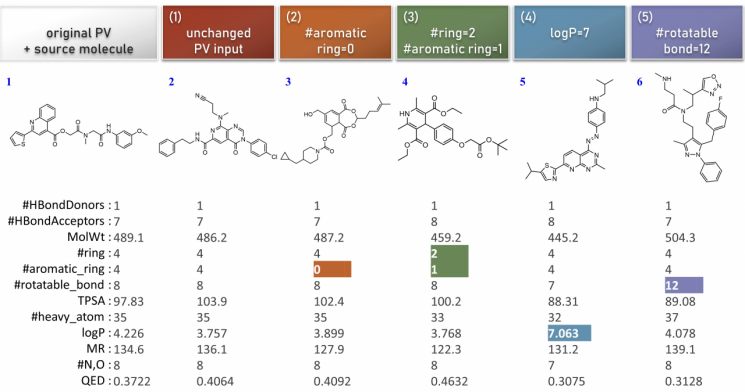 Molecular structure transformation results of input feature values using the proposed model. (Column 1) The molecular structure output by directly inputting the feature value vector (PV) of the given reference molecule, showing characteristics that match the input values. (Columns 2 to 5) The molecular structure output results when some items in the feature value vector of the reference molecule are arbitrarily changed and input, reflecting the changed input conditions while maintaining other characteristics.
The proposed model demonstrated the ability to solve tasks requiring understanding of both molecular structure and properties, such as predicting molecular structures based on more than 50 simultaneously given property inputs. Through sharing these two data types, it was confirmed that the model outperforms existing AI technologies in various problems including chemical reaction prediction and toxicity prediction.
This research is expected to be applicable to a broader and richer range of molecular forms and various biochemical fields such as polymers and proteins, including important industrial tasks like toxicity prediction and candidate material exploration.
Professor Jongcheol Ye stated, “We take pride in expanding the foundation of generative AI technology by pioneering a new generative AI technology in chemistry that integrates the generation of new compounds and the prediction of compound properties.”
The research results, with Jinho Jang, a combined master's and doctoral student in Professor Ye’s team as the first author, were published online on March 14 in the international journal Nature Communications (Paper title: Bidirectional Generation of Structure and Properties Through a Single Molecular Foundation Model).
© The Asia Business Daily(www.asiae.co.kr). All rights reserved.
![Clutching a Stolen Dior Bag, Saying "I Hate Being Poor but Real"... The Grotesque Con of a "Human Knockoff" [Slate]](https://cwcontent.asiae.co.kr/asiaresize/183/2026021902243444107_1771435474.jpg)











