Legal Provisions Are Ambiguous, Unintentional Violations Possible
Light Violations Punishable by 10 Years... Maximum Sentence Up to 14 Years
With the Hong Kong version of the National Security Law, which strengthens the punishment for anti-government acts, coming into effect on the 23rd, warnings are being raised that travelers should also be cautious.
 As the Hong Kong version of the National Security Law, which strengthens penalties for anti-government activities, comes into effect on the 23rd, warnings are being issued that travelers should also exercise caution.
 [Image source=Getty Images]
On the 23rd, major foreign media reported that on the 19th, the Hong Kong Legislative Council unanimously passed the National Security Law (Article 23 of the Basic Law), which includes 39 security crimes such as secession, subversion, terrorist activities, and collusion with foreign forces, along with their punishments. The Hong Kong government also announced on its website that this law would be enforced starting at midnight on the 23rd.
The Security Law stipulates that even relatively minor offenses, such as spreading false or misleading information, can result in up to 10 years of imprisonment, and particularly, collusion with external forces can lead to a maximum sentence of 14 years in prison. Here, external forces refer to foreign governments and political parties, international organizations, overseas institutions pursuing political objectives, and organizations and individuals connected with them. The problem lies in the fact that the wording is excessively vague, as it requires that collusion with external forces for punishment must involve 'illegal intent' and 'improper means.'
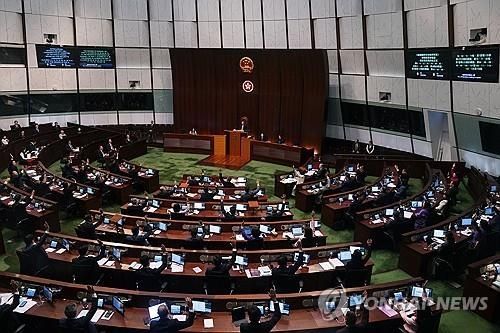 Hong Kong Legislative Council members voting on the Hong Kong National Security Law bill
 [Photo by AP Yonhap News]
Because of this, domestic and international human rights organizations and businesspeople are concerned that the Security Law will shrink business and travel within Hong Kong. Volker T?rk, the UN High Commissioner for Human Rights, stated that the broadly defined and ambiguous provisions "could criminalize a wide range of acts protected under international human rights law, such as freedom of expression, peaceful assembly, and the right to receive and impart information." Jan Zhong, Chairman of the Taiwan-Hong Kong Economic and Cultural Cooperation Promotion Council, said, "Both foreign visitors and businesses in Hong Kong will be affected."
Taiwan's intelligence agency, the National Security Bureau (FSB), also pointed out that many details are unclear and ambiguous, urging its citizens to be cautious when traveling to Hong Kong.
Taiwanese planning to travel to Hong Kong should carefully review whether they have previously been questioned upon entry to Hong Kong or have publicly criticized China's political or economic issues. Additionally, the Australian government issued a travel advisory for Hong Kong, warning that the National Security Law could be broadly interpreted, causing travelers to unintentionally violate the law.
Some companies have begun withdrawing from Hong Kong or are considering doing so. This is because the crackdown on leaks of confidential information in Hong Kong is likely to be raised to the level of the 'Anti-Espionage Law' enforced in mainland China. As the Sinicization of Hong Kong rapidly progresses, there are predictions that the freedoms of Hong Kong residents will be stripped away and that Hong Kong's status as an 'Asian financial hub' could be shaken. In fact, several companies are considering relocating their businesses to Singapore.
This law complements the Hong Kong Security Law enacted by China in 2020 in response to large-scale anti-government protests in Hong Kong. As a result, two security-related laws now exist in Hong Kong.
© The Asia Business Daily(www.asiae.co.kr). All rights reserved.
![Clutching a Stolen Dior Bag, Saying "I Hate Being Poor but Real"... The Grotesque Con of a "Human Knockoff" [Slate]](https://cwcontent.asiae.co.kr/asiaresize/183/2026021902243444107_1771435474.jpg)

















