Nominees in All Districts for People Power Party
7 Candidates Challenge in Seoul Jongno-gu
The average competition rate for constituency candidates in the 22nd general election was calculated to be 2.75 to 1.
On the 22nd, the National Election Commission announced that 699 candidates registered in 254 constituencies following the candidate registration deadline. This competition rate is lower compared to previous elections. The 18th general election in 2008 recorded a rate of 4.5 to 1, the 19th general election in 2012 was 3.6 to 1, the 20th general election in 2016 was 3.7 to 1, and the 21st general election was 4.4 to 1.
By party, the People Power Party fielded 254 candidates, presenting candidates in all constituencies. Next were the Democratic Party with 246 candidates, Reform New Party (43), New Future (28), Progressive Party (21), Green Justice Party (17), and Liberty Unification Party (11). There were 58 independent candidates not affiliated with any party.
By constituency, the highest competition rate was in Jongno-gu, Seoul. Incumbent constituency lawmaker and People Power Party candidate Choi Jae-hyung sought re-election, competing against Democratic Party candidate Kwak Sang-eon, New Future candidate Jin Ye-chan, Reform New Party candidate Geum Tae-seop, Garak Privilege Abolition Party candidate Kim Jun-su, Daehan Gukmin Party candidate Kim Jong-gap, and Minjung Democracy Party candidate Cha Eun-jung, totaling seven candidates. Next, Mokpo in Jeonnam recorded a competition rate of 6 to 1.
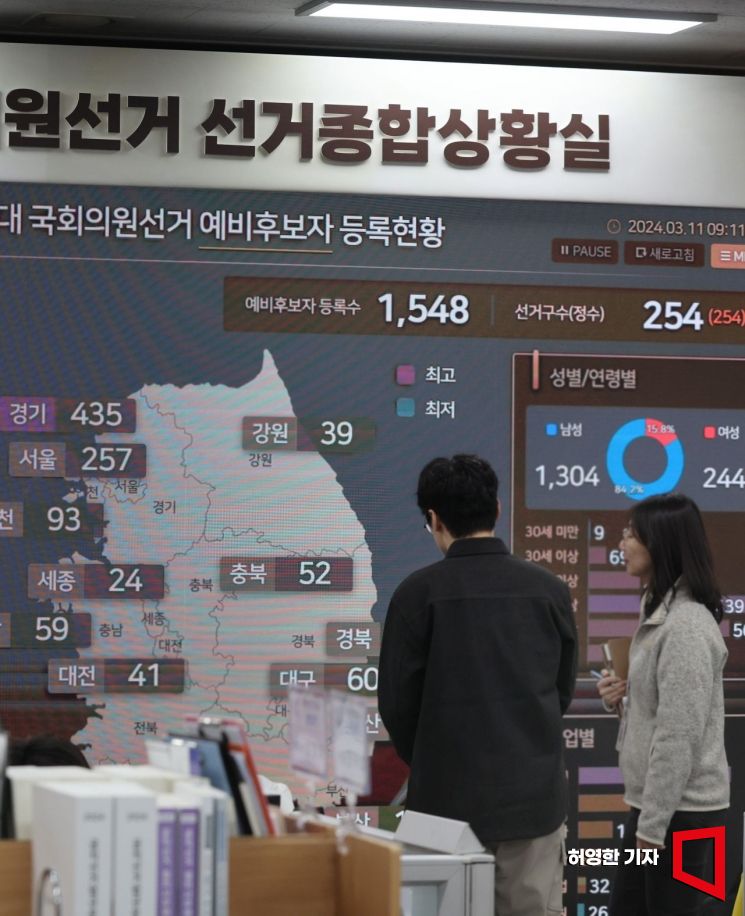 On the 11th, 30 days before the 22nd National Assembly election, the electronic display board at the Comprehensive Election Situation Room for the 22nd National Assembly Election of Gwacheon City Central Election Commission shows the constituencies and the status of preliminary candidate registrations. Photo by Younghan Heo younghan@
Looking at the metropolitan level, Gwangju, with 36 candidates in 8 constituencies, had the highest competition rate at 4.5 to 1. Following were Jong (4 to 1), Jeonnam (3.6 to 1), Jeonbuk (3.3 to 1), Daejeon (3.14 to 1), Gyeongbuk (3.07 to 1), Ulsan (3 to 1), Daegu (2.83 to 1), Incheon (2.79 to 1), Gangwon and Chungbuk (2.63 to 1), Seoul (2.6 to 1), Gyeonggi (2.47 to 1), Busan (2.39 to 1), Jeju (2.33 to 1), and Gyeongnam (2.31 to 1).
The oldest candidate was Kim Il-ryun, an independent candidate from Gyeongju, Gyeongbuk. The youngest candidate was Woo Seo-young from the Democratic Party, who ran in Miryang-si, Uiryeong-gun, Haman-gun, and Changnyeong-gun in Gyeongnam. Woo was born in 1995.
The average age of candidates was 56.8 years. There were 4 candidates in their 20s and 26 candidates aged 70 or older.
The average declared assets of candidates were 2.77704 billion KRW. The candidate who declared the highest assets was Kim Bok-deok of the People Power Party, running in Bucheon-si Gap, Gyeonggi. Kim, CEO of LED lighting manufacturer Solux, declared assets worth 144.66768 billion KRW. Next was Ahn Cheol-soo of the People Power Party, running in Seongnam Bundang-gu Gap, Gyeonggi, who declared 140.13548 billion KRW, the second highest.
Conversely, the candidate with the least assets was Jin Sun-mi of the Democratic Party, running in Gangdong-gu Gap, Seoul, who currently has debts of 894.6 million KRW. Following was Lee Seong-sim of the People Power Party, running in Gwanak-gu Eul, Seoul, who declared debts of 583.94 million KRW.
Among the candidates, 242 had criminal records, accounting for 34.2% of all candidates. Among those with records, there were even 11 repeat offenders.
Among all candidates, 85.8% were male, and only 14.2% were female. Of the 600 male candidates, 14.2% (99 candidates) were recorded as not having completed military service.
However, the National Election Commission did not announce the proportional representation candidate list because the registration review completion time for proportional representation candidates at the city/county level could not be predicted by 10 PM on the 22nd through media notices.
© The Asia Business Daily(www.asiae.co.kr). All rights reserved.
![Clutching a Stolen Dior Bag, Saying "I Hate Being Poor but Real"... The Grotesque Con of a "Human Knockoff" [Slate]](https://cwcontent.asiae.co.kr/asiaresize/183/2026021902243444107_1771435474.jpg)
















