Japanese Textbooks for 2025... Numerous Historical Distortions
"Dokdo is Japan's inherent territory, illegally occupied by Korea"
South Korean Government "Cannot Accept Japan's Claims," Summons Ambassador to Japan to Protest
Next year's Japanese middle school textbooks include content stating that 'Dokdo is Japan's inherent territory' and are written in a way that obscures the history of Japanese colonial aggression. In response, the South Korean government strongly protested, stating that it cannot accept Japan's claims.
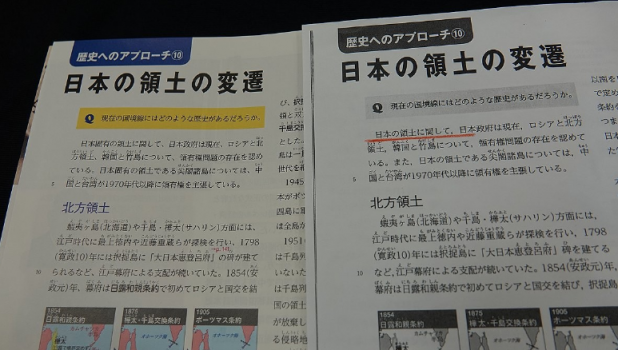 (Left) Social studies textbook to be used in Japanese middle schools from 2025, (Right) Previously written social studies textbook. It can be seen that "Japanese territory" has been changed to "Japan's inherent territory."
 [Photo by Yonhap News]
On the 22nd, Yonhap News reported that an analysis of the Japanese Ministry of Education, Culture, Sports, Science and Technology-approved middle school textbooks (8 social studies and history books, 6 civics books, and 4 geography books) revealed that 15 out of 18 textbooks (83.3%) contained expressions stating that Dokdo was 'illegally occupied' by Korea. This is an increase compared to the previous approval in 2020, where 14 out of 17 history, civics, and geography textbooks (82.4%) used such expressions.
The claim that 'Dokdo is Japan's inherent territory' was included in 16 out of 18 textbooks (88.9%), which is a significant increase compared to 14 out of 17 textbooks (82.4%) in the previous approval.
The assertion of 'Korea's illegal occupation' appeared in both civics and geography textbooks and was also included in five history textbooks. Specifically, geography textbooks contained expressions such as, "(Dokdo) is illegally occupied by Korea, so Japan continues to protest" (publisher: Tokyo Shoseki), and "Generally, boundaries are set in international waters, with maritime police and lighthouses established, but it is illegally occupied" (publisher: Teikoku Shoin).
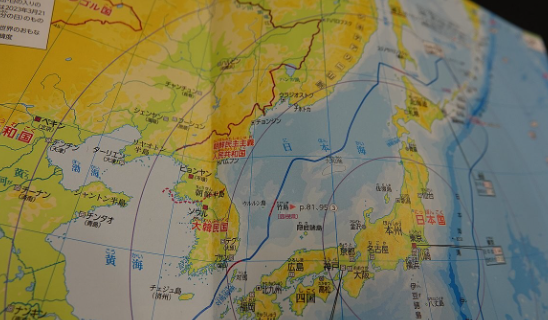 A Japanese middle school textbook that includes Dokdo within Japan's exclusive economic zone.
 [Photo by Yonhap News]
Civics textbooks described it as "The Japanese government's position is that Dokdo is Japan's inherent territory based on historical and international law" (Ky?iku Shuppan), and "It is clearly Japan's inherent territory, but Korea is illegally occupying it" (Ikuhosha). In both geography and civics textbooks, maps, photos, and illustrations supporting Japan's claim to Dokdo were consistently included, with captions under photos stating '竹島 (Takeshima - the name Japan claims for Dokdo)'.
History textbooks contained distorted claims such as "In January 1905, the Japanese government decided at the Cabinet meeting to incorporate Dokdo into Japanese territory" (publisher: Manabisha), and "Korea, established in 1948, set a new maritime boundary in 1952, including Takeshima as Korean territory" (publisher: Yamakawa). Notably, Jiyusha's history textbook included a map titled 'The Tragedy of the Syngman Rhee Line,' reflecting the claim that the Syngman Rhee Line was unilaterally established by Korea in violation of international law. The Syngman Rhee Line is a maritime sovereignty line declared by former President Syngman Rhee in 1952 over adjacent waters, including Dokdo as Korean territory.
Originally, this section contained a photo of the Japan-Soviet Joint Declaration of 1965 and a chart summarizing Japan's postwar compensation amounts after the Pacific War. However, the newly written textbooks included content related to the Syngman Rhee Line, with explanations stating, "The capture of Japanese fishing boats and detention of fishermen continued until the announcement of the 1965 Korea-Japan Fisheries Agreement. A total of 327 captured vessels and 3,911 crew members were detained and mistreated. During captures, 29 people died due to shootings and collisions, and material damages amounted to 7 billion yen at the time. The suffering of families who lost their breadwinners due to captures was so severe that there were suicides."
South Korean Government Expresses Regret... "Strong Protest Against Japan's Claims"
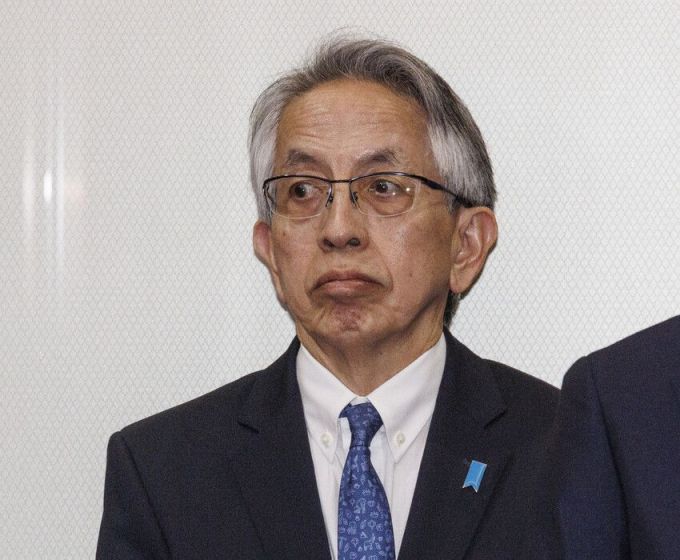 Aiboshi Koichi, the Japanese Ambassador to Korea, is seen entering the Ministry of Foreign Affairs building in Jongno-gu, Seoul.
 [Photo by Yonhap News]
As Japanese middle school students lose the opportunity to learn about Korea's basis for sovereignty over Dokdo, the South Korean government expressed deep regret and immediately protested. On the afternoon of the same day, Kim Hong-kyun, First Vice Minister of Foreign Affairs, summoned Koichi Aiboshi, the Japanese Ambassador to South Korea, to the Ministry of Foreign Affairs building to convey the protest stance.
The Ministry of Foreign Affairs stated, "We express deep regret that the Japanese government approved middle school textbooks containing unjust claims about Dokdo and descriptions based on assertions that do not align with historical facts. We strongly protest the Japanese government's repeated approval of textbooks containing unjust claims about Dokdo, which is clearly our inherent territory historically, geographically, and under international law, and we make it clear that we cannot accept any claims by Japan regarding Dokdo."
The Ministry of Education also joined the protest. The Ministry said, "Middle school social studies textbooks contain unjust claims about Dokdo, our inherent territory, and also downplay and conceal historical facts such as the forced mobilization of Koreans. Although corrections were requested when the textbooks first passed the screening in 2020, these were not reflected in the current approval results," urging for corrections.
© The Asia Business Daily(www.asiae.co.kr). All rights reserved.
![User Who Sold Erroneously Deposited Bitcoins to Repay Debt and Fund Entertainment... What Did the Supreme Court Decide in 2021? [Legal Issue Check]](https://cwcontent.asiae.co.kr/asiaresize/183/2026020910431234020_1770601391.png)

















