Declining Birthrate and Sharp Drop in School-Age Population
Education Sector Says "No Students to Fill"
Universities Reducing Quotas Due to Population Decline
Other Departments Expected to Accelerate Restructuring
As the government has confirmed an increase of 2,000 medical school admissions, concerns are emerging in the education sector that it will be difficult to meet student demand in the long term due to the declining school-age population. In particular, with universities undergoing departmental restructuring amid the low birthrate impact, it is pointed out that other departments' quotas will inevitably have to be reduced except for the expanded medical schools.
Song Ki-chang, Professor Emeritus of the Department of Education at Sookmyung Women’s University, said in a phone interview with Asia Economy on the 22nd, "Currently, the number of applicants to universities is decreasing, making it difficult to fill the freshman enrollment rate to 100%," adding, "Universities are already trending toward reducing their quotas." Lim Sung-ho, CEO of Jongro Academy, also criticized, "It’s like building apartments when there are no buyers," and said, "Even if there is a shortage of doctors, the school-age population will fall below 4 million in just 10 years, so I don’t know how they plan to fill the spots."
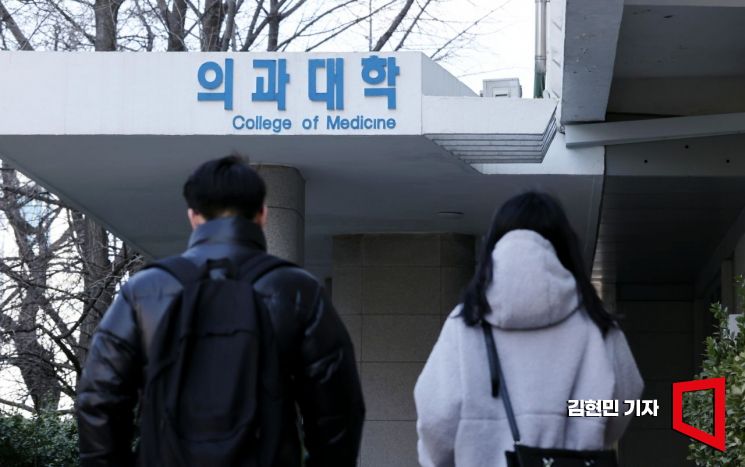 Students are entering a medical school in Seoul on the 20th, when the results of the allocation of increased medical school admission quotas, which sparked conflicts between the medical community and the government, are being announced. Photo by Hyunmin Kim kimhyun81@
In fact, the number of test takers for the College Scholastic Ability Test (CSAT) has been decreasing every year. Starting from 668,991 in 2011, the number dropped to a record low of 504,588 last year. Compared to 2013, ten years ago, the number has decreased by about 120,000. Looking at the number of general university admissions, it also fell from 370,000 in 2013 to 330,000 last year, a decrease of about 40,000.
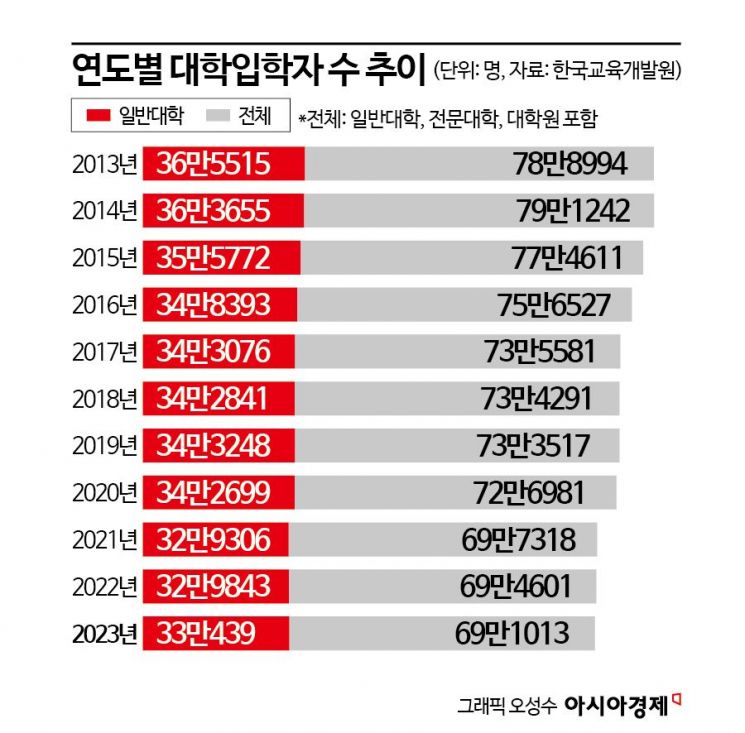
Considering the declining trend of the school-age population aged 6 to 21, the number of university admissions is expected to decrease further in the future. The school-age population was 7,259,000 last year, accounting for 14.1% of the total population, with its proportion decreasing by 0.4 percentage points compared to the previous year. According to Statistics Korea’s estimates, the school-age population, which was 7,888,000 in 2020, will decrease to 6,940,000 in 2025. It is estimated to fall to the 4 million range by 2035, eleven years later.

According to the ‘2023 Basic Education Statistics Survey’ by the Ministry of Education and the Korea Educational Development Institute, the nationwide university freshman enrollment rate increased by 0.5 percentage points from the previous year. This was the result of reducing the university recruitment quota (685,519) by 1.9% (13,346) compared to the previous year. Universities have already started restructuring by abolishing or downsizing unpopular departments and recruiting at the faculty level. These changes are especially actively taking place in non-metropolitan universities.
Professor Song predicted, "Although the medical school quota will increase in the short term, restructuring will have to proceed concurrently," adding, "Restructuring will likely be carried out by adjusting the quotas of other majors or departments except for science and engineering."
© The Asia Business Daily(www.asiae.co.kr). All rights reserved.
![Clutching a Stolen Dior Bag, Saying "I Hate Being Poor but Real"... The Grotesque Con of a "Human Knockoff" [Slate]](https://cwcontent.asiae.co.kr/asiaresize/183/2026021902243444107_1771435474.jpg)


















