Lung Cancer, Leading Cause of Cancer Deaths in Both Men and Women
Incidence Continues to Rise Among Non-Smoking Women
Most Diagnosed at Stage 4 Due to Lack of Symptoms
82% Survive More Than 5 Years When Diagnosed Early
"Is lung cancer only for smokers?" This is one of the biggest misconceptions people have about lung cancer, which ranks first in cancer mortality. Moreover, in South Korea, where the perception of female smoking is negative, such misunderstandings often lead to incorrect views about female lung cancer patients. To break away from these misconceptions, a campaign was held to raise awareness about the risks and importance of female lung cancer.
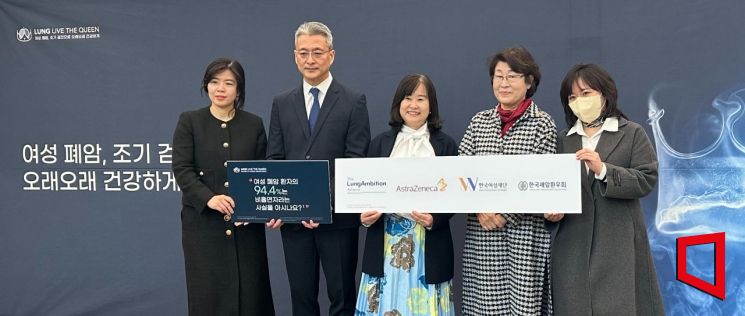 On the 21st, at COEX in Samseong-dong, Seoul, officials are taking a commemorative photo at the launch ceremony of the women's lung cancer early screening campaign, "Lung Live the Queen." Yang Mi-seon, Executive Director of Oncology Business at AstraZeneca Korea; Jeon Se-hwan, CEO of AstraZeneca Korea; Bang Hye-ryeon, Executive Director of External Cooperation at AstraZeneca Korea; Jang Pil-hwa, Chairperson of the Korea Women's Foundation; Lee Hee-jung, Director of the Korea Lung Cancer Patients Association.
 [Photo by Lee Chun-hee]
On March 21, Korean AstraZeneca, in collaboration with the Korea Lung Cancer Patients Association and the Korea Women's Foundation, held a female lung cancer early screening campaign called "Lung Live the Queen" at COEX in Gangnam-gu, Seoul, to mark "Cancer Prevention Day." The campaign aimed to raise awareness about the risks of female lung cancer and the importance of early screening.
Jeon Se-hwan, CEO of Korean AstraZeneca, who introduced the campaign, emphasized, "While early detection rates for female cancers such as ovarian and breast cancer are close to 90%, lung cancer early detection is only about 30%. The most important factor in lung cancer is survival through early diagnosis."
In Korea, lung cancer is generally perceived as a cancer that affects men with a history of smoking. However, according to the National Cancer Information Center, lung cancer is not only the most common cancer among men but also ranks fourth in incidence among women. In terms of cancer mortality, it ranks first for both men (26.8%) and women (15.1%). This high mortality rate is attributed to the fact that patients rarely notice symptoms, and the cancer is often detected only after it has significantly progressed. In fact, it is known that 4 out of 10 lung cancer patients are diagnosed at stage 4 with distant metastasis, and while the 5-year survival rate for early-diagnosed lung cancer patients is about 82%, it drops to 10% for stage 4 patients.
To highlight the importance of early diagnosis, CEO Jeon shared his personal pain. His wife passed away from lung cancer last year. He said, "My wife was a non-smoker under 45 years old who had never even caught a cold. Despite annual X-rays, her cancer was not detected until she was diagnosed at stage 4, and she did not survive beyond three years."
This is why Jeon strongly stressed, "Low-dose chest computed tomography (CT) must be performed." Although chest X-rays are included in the national health screening, many cancers are not detected, so low-dose CT is necessary. He added, "If only X-rays are to be taken, at least X-rays with artificial intelligence (AI) should be used for screening, as it doubles the likelihood of detecting cancer."
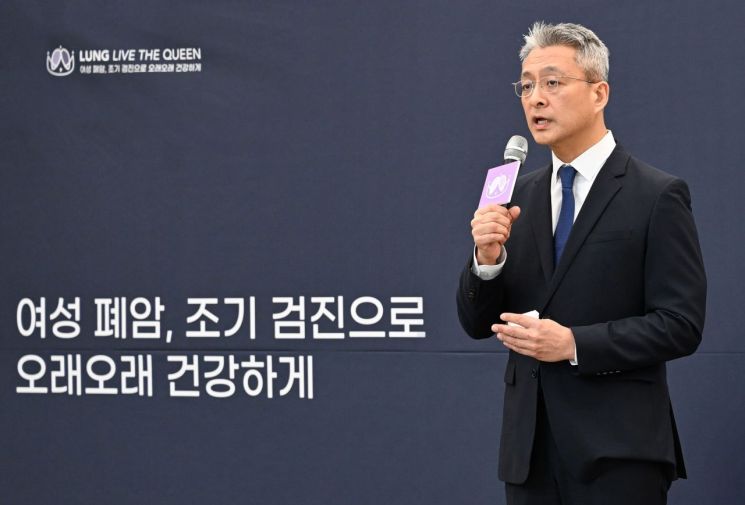 On the 21st, at COEX in Samseong-dong, Seoul, Jeon Se-hwan, CEO of AstraZeneca Korea, introduced the 'Lung Live the Queen' campaign for early detection of lung cancer in women at the campaign launch ceremony.
 [Photo by AstraZeneca Korea]
The government also includes low-dose CT for lung cancer screening in the national cancer screening program. However, it is only for individuals aged 54 to 74 with a smoking history of 30 pack-years or more. A pack-year is a unit measuring smoking exposure, defined as smoking one pack per day for one year. This still considers only long-term smokers as high-risk groups. However, recent reports indicate that fine dust generated during cooking processes, such as "cooking fumes," has been recognized as an occupational disease cause for a school meal worker diagnosed with lung cancer. This is cited as a reason for the rapid increase in non-smoking female lung cancer patients, especially in Asian countries like Korea, where women often take on household chores.
Jang Pil-hwa, director of the Korea Women's Foundation, expressed concern, saying, "Negative perceptions of smoking are more severe for women. Many women do not disclose their illness for fear of stigma." She added, "Many diagnoses and treatments are based on male standards, often overlooking physiological differences in women. Through this campaign, we hope to better inform about the risks of female lung cancer and encourage many women to take action for early screening."
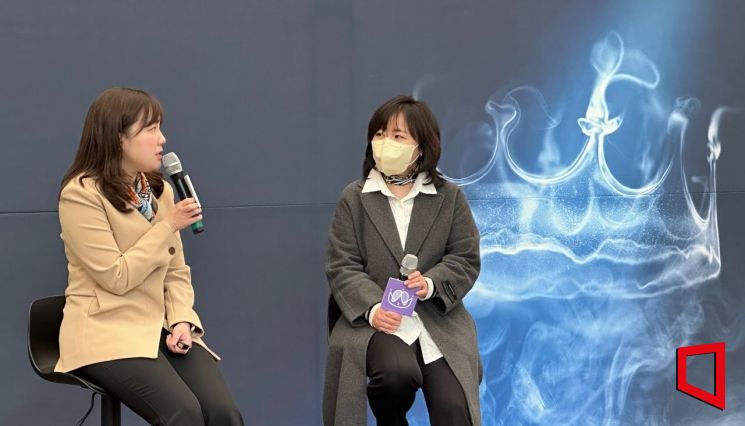 At the launch ceremony of the women's lung cancer early screening campaign 'Lung Live the Queen' held on the 21st at COEX in Samseong-dong, Seoul, Lee Hee-jung, director of the Korea Lung Cancer Patient Association (right), is sharing her lung cancer diagnosis and treatment story with Lee Sang-ah, manager at Korea AstraZeneca.
 [Photo by Lee Chun-hee]
Following this, Lee Hee-jung, director of the Korea Lung Cancer Patients Association and a stage 4 lung cancer patient herself, revealed her battle with the disease and emphasized the importance of early diagnosis. Lee said, "I thought lung cancer was unrelated to me as a non-smoking woman. Early screening can detect lung cancer at stages 1 or 2." She continued, "Once diagnosed with lung cancer, one cannot escape the fear of death, but with recent medical advances and many effective drugs, it is a cancer worth challenging. I hope people have more hope."
Korean AstraZeneca plans to continue various awareness-raising activities through this campaign to highlight the seriousness of female lung cancer and urge early screening.
© The Asia Business Daily(www.asiae.co.kr). All rights reserved.



















