"Religious Cultural Heritage Path, Hoping to Become a Case of Regional Revitalization"
"To attract people to the region, installing tourism infrastructure is important, but having programs and content is even more crucial. I hope the Religious Cultural Heritage Trail will serve as an important case in rediscovering Gongju and exploring ways to revitalize the region."
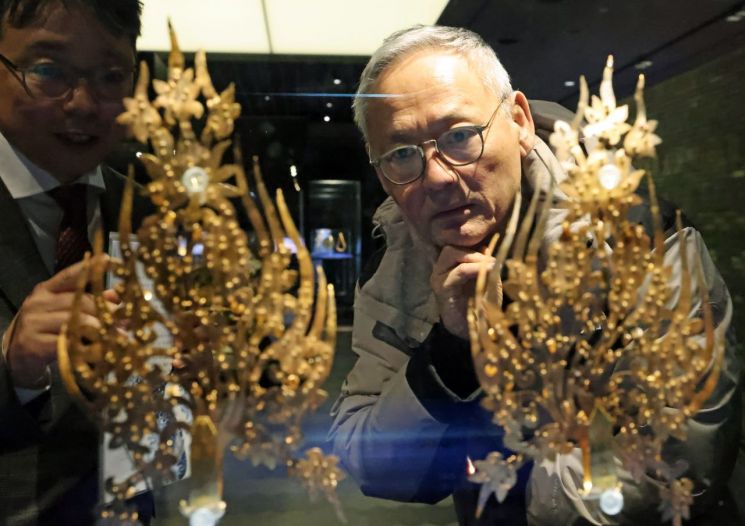 Yoo In-chon, Minister of Culture, Sports and Tourism, visited Gongju City, Chungnam Province on the 20th and toured the exhibition hall of the National Gongju Museum.
 [Photo by Ministry of Culture, Sports and Tourism]
Yoo In-chon, Minister of Culture, Sports and Tourism, visited Gongju, the ancient capital of Baekje and a UNESCO World Cultural Heritage site, and announced his commitment to actively support key projects including religious cultural heritage.
According to the Ministry of Culture, Sports and Tourism, Minister Yoo visited Gongju, Chungnam Province, on the 20th and 21st to inspect cultural infrastructure linking themes such as religion, patriotism, and history with Gongju’s religious cultural heritage, history, and cultural assets, as well as to check the sites of the Western Inland Area Wide-area Tourism Development Project.
Earlier on the 20th, he visited the National Gongju Museum to review the operation of the Chungcheong region storage facility, a model case for the utilization of state-owned cultural heritage, and urged officials to actively utilize Baekje’s national cultural heritage to expand cultural enjoyment rights for local communities and the entire nation. The National Gongju Museum’s Chungcheong region storage facility operates a "visible storage" and various experiential events, presenting a new direction for the utilization of national cultural heritage.
Following this, Minister Yoo visited the site for the establishment of the Baekje History and Culture Hub within the Gongju Cultural Tourism Area and heard about the city’s plans for cultural tourism infrastructure projects. He also visited Gongju’s representative cultural tourism sites, including the Tomb of King Muryeong and Gongsanseong Fortress.
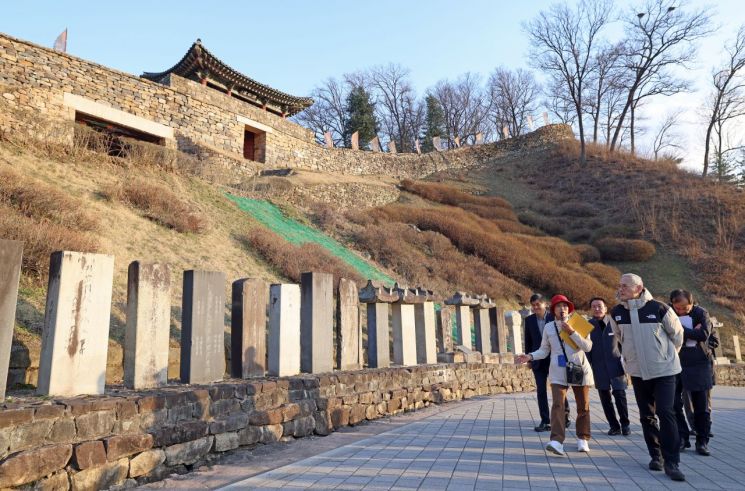 Minister Yoo In-chon of the Ministry of Culture, Sports and Tourism is visiting Gongju City, Chungnam Province on the 20th and touring Gongsanseong Fortress.
 [Photo by Ministry of Culture, Sports and Tourism]
On the 21st, Minister Yoo explored Gongju’s religious cultural heritage and inspected the sites of the Western Inland Area Wide-area Tourism Development Project. Religious figures such as Monk Dogye from Magoksa Temple, Father Kim Sung-tae of the Daejeon Diocese of the Catholic Church, Pastor Yoon Ae-geun of Gongju First Church, and Gongju Mayor Choi Won-cheol accompanied the field visit.
The Western Inland Area Wide-area Tourism Development Project is a regional linked and cooperative tourism promotion project (2024?2026) combining religious culture and healing elements from Chungnam, Sejong, and Jeonbuk. Planned initiatives include developing healing pilgrimage products, the Bidangaram Bicycle Path, and healing trail lunchboxes.
First, Minister Yoo walked the "Baekbeom Meditation Trail" at Magoksa Temple, where Baekbeom Kim Gu was ordained, then moved to Gongju to explore the "Religious Cultural Heritage Trail," which is being developed as a pilot project, for about two hours.
The "Religious Cultural Heritage Trail" is a walking route connecting ▲ Hwangsaebawi Martyrdom Site, a Catholic martyrdom site ▲ Gongju Hyanggyo, where Confucian scholar Oh Gang-pyo committed suicide in protest of the 1910 Japan-Korea Annexation Treaty ▲ Gongju Jungdong Catholic Church, the first Catholic church established in Gongju in 1897 ▲ Yeongmyeong Middle and High School, where independence activist Yu Gwan-sun studied and led the Gongju area’s March 1st Movement ▲ the former Gongju First Church, where Pastor Shin Hong-sik, one of the 33 national representatives, served ▲ and Daetongsa Temple site, founded by Baekje King Seong in 527 but now only marked by the Dangganjiju (flagpole supports).
Minister Yoo In-chon expressed his gratitude to Gongju city officials who are striving to create an attractive cultural city, saying, "I hope the key projects Gongju is promoting will be successfully realized, and the Ministry of Culture, Sports and Tourism will review ways to take a keen interest and provide active support."
© The Asia Business Daily(www.asiae.co.kr). All rights reserved.


















