Emergency Macroeconomic and Financial Meeting
Discussion on US 5 Consecutive Rate Holds
Risk Management for Secondary Financial Sector and Real Estate PF
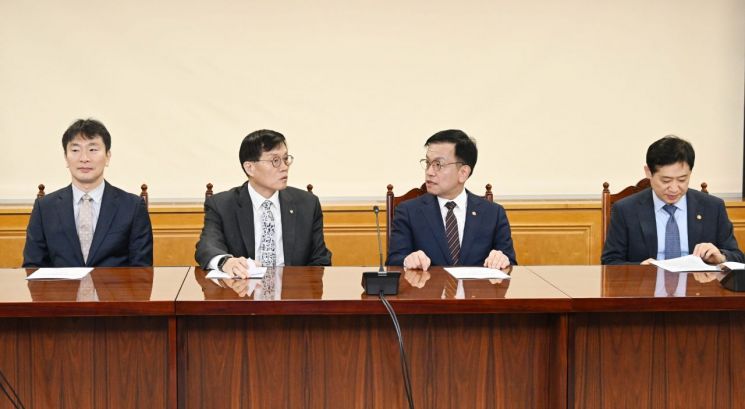 Choi Sang-mok, Deputy Prime Minister for Economic Affairs and Minister of Economy and Finance (second from right), is conversing with attendees at the joint 'Emergency Macroeconomic and Financial Meeting' of related agencies held on the 21st at the Seoul Federation of Banks building.
Choi Sang-mok, Deputy Prime Minister for Economy and Minister of Strategy and Finance, emphasized on the 21st that he would respond with caution to the possibility of increased volatility amid the visible differentiation in monetary policies among major countries such as the United States and Japan.
On the same day, Deputy Prime Minister Choi held a joint "Emergency Macroeconomic and Financial Meeting" with related agencies at the Korea Federation of Banks building in Seoul to assess the impact of the U.S. Federal Open Market Committee (FOMC)'s decision to keep interest rates unchanged on domestic and international financial and foreign exchange markets and to discuss response strategies.
The U.S. Federal Reserve Board (Fed) announced in the early morning (Korean time) at the FOMC that it would keep the benchmark interest rate steady at 5.25?5.5% and proceed with three planned rate cuts this year. The Fed has maintained the benchmark rate unchanged for five consecutive times since September, November, and December of last year, and January of this year. As a result, the interest rate gap between the U.S. and South Korea (3.50% per annum) remains at a maximum of 2 percentage points.
The market had anticipated the Fed would keep the benchmark interest rate unchanged at this FOMC meeting. When Jerome Powell, Fed Chair, stated at the press conference that the interest rate had reached its peak level and reaffirmed the intention to pivot (change direction) within the year, major global stock indices rose, while interest rates and the dollar index fell, prompting market cheers.
Deputy Prime Minister Choi and other attendees evaluated that this FOMC decision would contribute to maintaining stability in the international financial market. However, given the visible differentiation in monetary policies among major countries such as the Bank of Japan, which recently raised its benchmark interest rate for the first time in 17 years, and the Fed, they agreed that the possibility of increased volatility cannot be ruled out, and decided to closely cooperate among related agencies to respond accordingly.
They further assessed that the domestic stock market has generally improved, supported by foreign stock capital inflows due to efforts to support corporate value, and that the exchange rate has maintained a trend similar to major countries, while corporate bonds and short-term interest rates have remained stable, indicating a favorable situation.
They shared the view that potential risks in the secondary financial sector and real estate project financing (PF) are also sufficiently manageable.
Regarding the secondary financial sector such as savings banks, although delinquency rates have slightly increased due to the impact of interest rate hikes, they remain below historical averages, and capital ratios significantly exceed regulatory requirements, demonstrating sound loss absorption capacity.
In the case of real estate PF, although loan delinquency rates have slightly risen, liquidity is being supplied timely to normal projects, and restructuring is being encouraged for projects lacking viability, facilitating a soft landing. They recognized that since the financial sector can sufficiently absorb these risks internally, the possibility of risk transmission to other sectors is extremely limited.
Finally, they agreed to proactively prepare necessary measures to facilitate an orderly soft landing. To this end, they promised to expand the scale of PF loan guarantees, broaden the support targets of the PF project normalization support fund to alleviate funding difficulties on the ground, and support market-driven restructuring by revising business viability evaluation criteria and amending creditor agreements.
© The Asia Business Daily(www.asiae.co.kr). All rights reserved.
![Clutching a Stolen Dior Bag, Saying "I Hate Being Poor but Real"... The Grotesque Con of a "Human Knockoff" [Slate]](https://cwcontent.asiae.co.kr/asiaresize/183/2026021902243444107_1771435474.jpg)
















