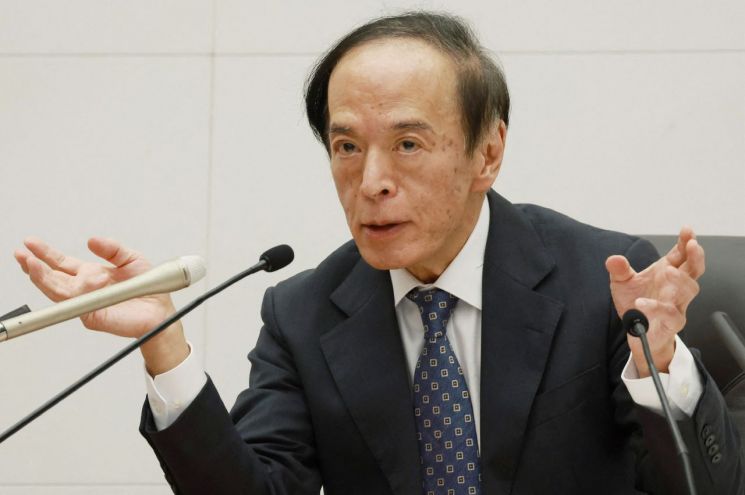
Kazuo Ueda, Governor of the Bank of Japan (BOJ), Japan's central bank, stated on the 19th that the decision to end the negative interest rate policy was made because they "confirmed a virtuous cycle between wages and prices and judged that the 2% inflation target can be achieved continuously and stably." However, Governor Ueda plans to maintain an accommodative financial environment for the time being to prevent market disruption caused by changes in monetary policy.
At a press conference held around 3:30 p.m. following the Monetary Policy Meeting, Governor Ueda said, "The large-scale monetary easing policy so far has fulfilled its role." On the same day, the BOJ raised the short-term policy interest rate from -0.1% to 0?0.1% and decided to stop yield curve control (YCC) and exchange-traded fund (ETF) purchases. This marks the first time in eight years since February 2016 that the BOJ has ended its negative interest rate policy.
Governor Ueda explained, "The recent high wage increase rate among Japanese companies was a factor in the decision to raise interest rates." Rengo, the Japanese trade union organization, announced on the 15th in a mid-term report that the average wage increase rate was 5.28%, the highest in 33 years.
However, Governor Ueda emphasized that an accommodative financial environment will be maintained for the time being. He said, "Assuming the current economic and price outlook, I believe that an accommodative financial environment will continue for the time being." He also stated, "We will continue long-term government bond purchases at a scale similar to the current level."
© The Asia Business Daily(www.asiae.co.kr). All rights reserved.

















