"Some Doctors Fail to Uphold Their Duties, Regrettable"
"Medical Licenses Should Not Be Used as a Threat to the Public"
Presidential Medical Reform Committee to Be Formed in April
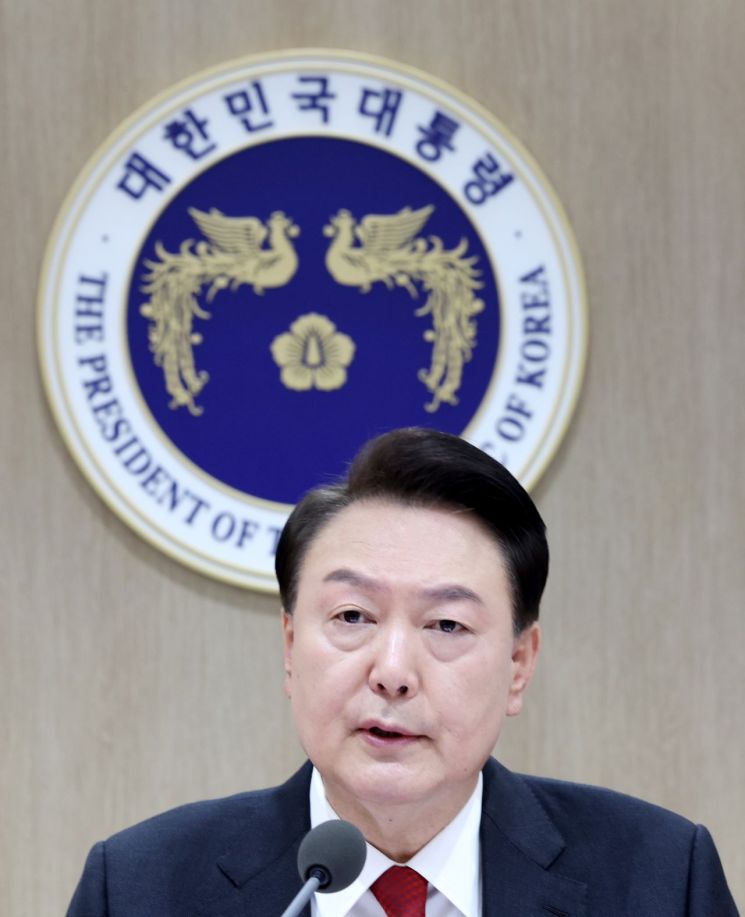 President Yoon Suk-yeol is speaking at the Cabinet meeting held on the 19th at the Yongsan Presidential Office Building in Seoul.
 [Image source=Yonhap News]
President Yoon Suk-yeol stated on the 19th, "The medical reform before us is a task for the people and a mandate from the people," adding, "The government will significantly allocate the increase of 2,000 medical school quotas next year primarily to medical schools in non-metropolitan areas to strengthen essential regional healthcare."
Despite growing concerns over medical service gaps as resident doctors and professors have collectively resigned and private practitioners are showing signs of joining the collective action, the government appears determined to vigorously push forward medical reform centered on increasing medical school quotas and proceed with the planned allocation of these quotas.
In his opening remarks at the Cabinet meeting held at the Yongsan Presidential Office, President Yoon emphasized, "Medical licenses granted to save lives must not be used as tools to threaten or unsettle the public." While expressing deep concern over the ongoing collective resignation of resident doctors for a month, he indicated that there will be no retreat from medical reform.
President Yoon lamented, "It is truly regrettable that some doctors, who should be by patients' sides and persuading resident doctors, are betraying the public's desire for medical reform and failing to fulfill their duties as physicians and mentors." However, he stressed, "If it benefits the people, no matter how difficult or challenging, we must focus solely on the people and see it through to the end."
Yoon: "Korean Doctors Have the Highest Income Among OECD Countries"
President Yoon underscored the necessity of increasing medical school quotas by presenting specific data. Since the early 2000s, the United States has increased its medical school quotas from 16,000 to 23,000, an increase of 7,000; France from 3,850 to 10,000, an increase of 6,150; and Japan from 7,625 to 9,384, an increase of 1,759, continuously expanding quotas annually. However, South Korea has not increased its medical school quotas by a single student in 27 years.
He explained that the current number of doctors in South Korea is 112,000, which is 80,000 fewer than the average among OECD countries. He also pointed out the problem of doctors' average income in South Korea far exceeding the OECD average. President Yoon noted, "According to the health workforce survey, the average income of doctors in South Korea is the highest among OECD countries, approximately five times that of nurses, and the income gap among healthcare professionals is also the highest in the OECD."
He firmly rejected calls from some in the medical community to reconsider the increase in medical school quotas from scratch. President Yoon said, "Some in the medical community continue to demand a fundamental review of the quota increase, making claims that the public cannot accept. However, a phased approach or postponement of the increase will never accomplish the medical reform needed to save lives and prevent the collapse of regional and essential healthcare."
He added, "Because medical school quotas have been maintained at reduced levels for about 27 years, this is a story far removed from the urgent medical realities given the pace of increasing medical demand. The longer the increase is delayed, the greater the harm will ultimately be to all citizens." In this context, President Yoon raised his voice, saying, "It would be a miracle if essential healthcare does not collapse."
Accordingly, the government plans to allocate the increase of 2,000 medical school quotas next year primarily to medical schools in non-metropolitan areas to strengthen essential regional healthcare. The increased quotas will first be allocated regionally based on population, medical demand, the necessity to expand essential healthcare, and educational conditions of each university, then further distributed among medical schools within each region.
President Yoon also appealed to the medical community to halt collective actions and come to the dialogue table. He said, "Since doctors' cooperation is most needed, we must come together and discuss candidly," adding, "We will form a Presidential Medical Reform Special Committee in April, including representatives from the medical community and various sectors as well as experts, to deeply discuss medical reform tasks." He further expressed hope that "resident doctors and medical associations will participate and create concrete implementation plans for medical reform through discussion rather than protests outside hospitals."
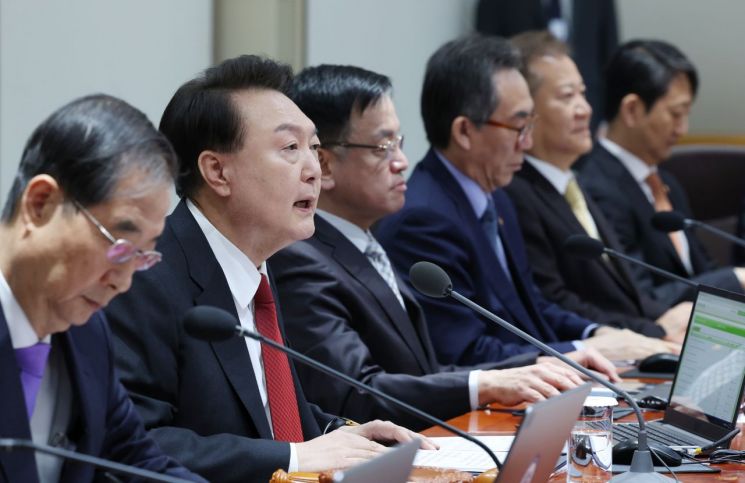 President Yoon Suk-yeol is speaking at the Cabinet meeting held on the 19th at the Yongsan Presidential Office Building in Seoul. [Image source=Yonhap News]
Order for 'Early Stabilization of Inflation at 2% Range, All Ministries to Mobilize'
Additionally, President Yoon referred to his visit to the Nonghyup Hanaro Mart Yangjae branch the previous day, where he personally checked prices of agricultural and livestock products and food, urging all ministries to be vigilant and make every effort to achieve early stabilization of inflation at the 2% range.
He pointed out, "I met many shoppers and heard that recent price increases in fruits and other groceries have made shopping more burdensome," then instructed, "Activate direct transactions for agricultural products, block collusion and unfair practices in distribution stages, and utilize all policy tools including food vouchers for vulnerable groups."
Regarding last month's inflation rate, he explained, "The inflation rate rose to 3.1% compared to the same period last year, slightly exceeding our government's target of managing inflation in the 2% range. The rise from 2% to 3% is mainly due to strong prices of international oil and agricultural products such as fruits and vegetables. Prices of fruits affected by last year's poor harvest and vegetables impacted by adverse weather in February are unlikely to fall quickly."
On the government's response, he stated, "We will directly lower prices of fruits and vegetables including apples through price discount support, swiftly increase substitute fruits via tariff quotas and government direct imports, and benchmark major countries' price stabilization measures in our policy formulation."
Earlier, at the Livelihood Economy Inspection Meeting he chaired the previous day, President Yoon announced measures including immediate injection of 150 billion won in emergency agricultural and livestock price stabilization funds, inclusion of cherries and kiwis among five fruit items with reduced tariffs, direct imports of rapidly rising price items by the Korea Agro-Fisheries & Food Trade Corporation (aT), and active response to market disruption and unfair practices.
Yoon: "Raising Children Is a Constitutional Duty of the President and Government"
Beyond inflation measures, President Yoon introduced tailored policies for all generations including children, youth, and the elderly. Regarding the newly launched Neulbom School this month, he emphasized, "Properly caring for and raising children is a constitutional duty of the President and government. For this, not only central and local governments but the entire social community must cooperate," adding, "The government will establish a platform for such cooperation and serve as a hub."
With the population aged 65 and over expected to exceed 20% next year, entering a super-aged society, the government reaffirmed its commitment to invest in elderly welfare. This year, the government raised the basic pension and expanded senior employment opportunities by the largest margin ever.
President Yoon promised, "We are supporting daily life at senior centers through meals, exercise, and digital education, while expanding visiting doctors, care services, and nursing cost support. We also conducted a full survey of unregistered senior centers in January, providing immediate safety inspections, heating costs, and grain support," pledging, "We will actively pursue policies to improve seniors' quality of life this year."
Regarding youth policies, he reiterated investments announced at a recent livelihood discussion, including expanded national scholarships, income tax deductions for sports facility fees, and tax exemptions for childbirth support. He particularly stressed, "To push reforms for the people and build the country the people desire, the energy of youth free from vested interests and interest cartels is essential," urging, "All ministries and committees should responsibly ensure that youth aides can fulfill their roles as future think tanks."
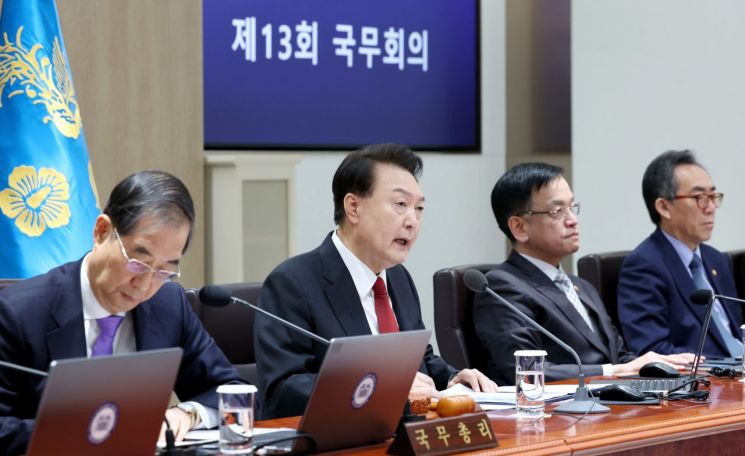 President Yoon Suk-yeol is speaking at the Cabinet meeting held on the 19th at the Yongsan Presidential Office Building in Seoul. [Image source=Yonhap News]
Yoon: "Democracy Summit a Milestone for the Spread of Democracy"
Finally, President Yoon mentioned the 'Technology, Elections, and Fake News' session of the Democracy Summit plenary meeting he chaired that day. He said, "It will be an opportunity to protect elections and democratic political systems, the core of democracy, from fake news and false propaganda, and to instill confidence in our liberal democracy among youth."
South Korea is hosting the 3rd Democracy Summit in Seoul from the previous day through the 20th, including ministerial meetings, civil society events, and virtual summits. This is the first time the Democracy Summit, first held by U.S. President Joe Biden in 2021, is being held outside the United States.
President Yoon introduced the summit, themed "Democracy for Future Generations," as a venue where heads of state and ministers from various countries exchange views and pool wisdom on challenges facing democracy today.
Regarding South Korea hosting the summit, he said, "Following our co-hosting of the 2nd summit last year, hosting the 3rd summit reflects the international community's high regard for Korea's level of democracy," and emphasized, "I will ensure that the 3rd Democracy Summit becomes a global milestone for advancing and spreading democracy until the very end."
© The Asia Business Daily(www.asiae.co.kr). All rights reserved.



















