Apple down 11.9%·Pear down 8.4%
First simultaneous decline since Seol
Effect of discount and delivery price support
The consumer prices of apples and pears, which had been soaring, have turned downward for the first time since this year's Lunar New Year holiday. This decline in retail prices is attributed to extensive discount support and delivery price assistance from the government and the distribution industry. However, since apple and pear prices are still higher than last year, the government plans to expand the emergency price stabilization fund of 150 billion KRW until price stability is achieved.
According to the Korea Agro-Fisheries & Food Trade Corporation (aT) on the 19th, the average retail price of 10 apples (Fuji, premium grade) recorded 24,148 KRW as of the 18th, down 11.9% (3,276 KRW) from the previous day. Pear retail prices also turned downward. The average consumer price of 10 pears (Shingo, premium grade) was 41,551 KRW on the 18th, down 8.4% (3,830 KRW) from the previous day.
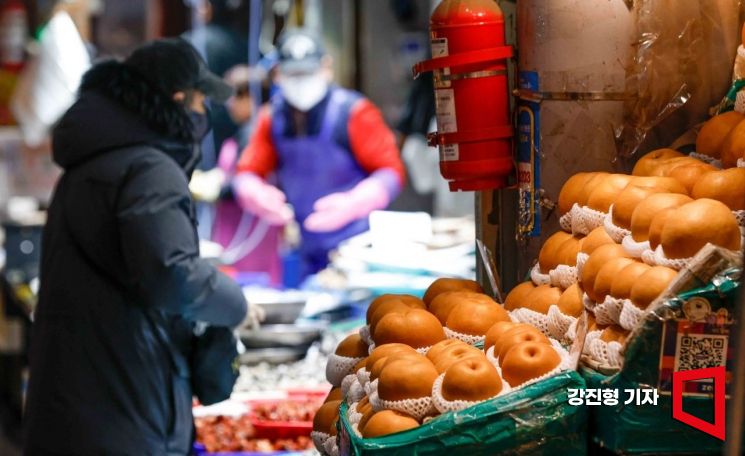 On the 18th, pears are displayed at Gyeongdong Market in Dongdaemun-gu, Seoul. Photo by Jin-Hyung Kang aymsdream@
This is the first time since this year's Lunar New Year holiday that the retail prices of apples and pears have fallen simultaneously. Apples peaked at 30,877 KRW on the 7th and have been declining since. Pear retail prices peaked at 45,381 KRW on the 15th.
An official from the Ministry of Agriculture, Food and Rural Affairs explained, "In the case of apples and pears, prices showed a downward trend ahead of this year's Lunar New Year holiday due to discount support but began to rise again after the holiday. It is analyzed that the retail prices of apples and pears turned downward yesterday as the government expanded discount support and delivery price assistance."
It is still too early to say that fruit prices have stabilized. Although apple and pear retail prices have declined, they remain higher than last year, and wholesale price increases have not yet subsided. The retail price of 10 apples is 5.6% (1,287 KRW) higher than the same period last year (22,861 KRW). Pear prices, in particular, have risen 52.0% (14,211 KRW) compared to the previous year.
Wholesale prices continue to soar. As of the 18th, the wholesale price of 10 kg of Fuji apples was 74,978 KRW, up 5.9% (4,198 KRW) from the previous day. This is a 120.5% increase compared to the same period last year. The wholesale price of 10 kg of Shingo pears shows an even steeper rise. Although it fell 5.3% (5,569 KRW) from the previous day to 99,871 KRW on the 18th, it has surged 217.8% compared to last year.
The government expects the strong prices of apples and pears to continue inevitably until the new fruit harvest. Accordingly, it plans to expand the emergency price stabilization fund of 150 billion KRW announced on the 15th until price stability is achieved and to implement thorough mid- to long-term production and distribution management. Specifically, for discount support (45 billion KRW), the discount rate will be raised from 20% to 30%, and the number of items supported for delivery price assistance (75.5 billion KRW) will increase from 13 to 21, with the support price doubled at most. For apples and pears, delivery price support of 4,000 KRW per kilogram will be provided.
An official from the Ministry of Agriculture, Food and Rural Affairs said, "Since there will be an absolute shortage of supply until this year's new apples and pears come out, it is difficult to guarantee that the current price decline will continue. We will do our utmost to ensure prices stabilize downward by continuing discount and delivery price support and expanding the supply of substitute fruits such as chamoe and watermelon, as well as imported fruits."
© The Asia Business Daily(www.asiae.co.kr). All rights reserved.
![Clutching a Stolen Dior Bag, Saying "I Hate Being Poor but Real"... The Grotesque Con of a "Human Knockoff" [Slate]](https://cwcontent.asiae.co.kr/asiaresize/183/2026021902243444107_1771435474.jpg)
















