If Employees Try to Stop Them, They Get Angry and Scolded
Daily Deployment of Vehicles and Personnel to Collect Carts
Dozens of Carts Collected Daily from Apartments Near the Mart
After shopping, residents dragging carts to subway stations, apartment entrances, and even right in front of their homes have become a headache for supermarket employees, whose grievances have been broadcasted. On the 15th, 'JTBC News' captured footage of some residents stealing shopping carts from supermarkets, causing public disapproval. The report found several abandoned carts at locations including the entrance of an apartment complex in Gangnam, Seoul, and apartment parking lots. All of these carts were left by residents who had shopped at nearby supermarkets.
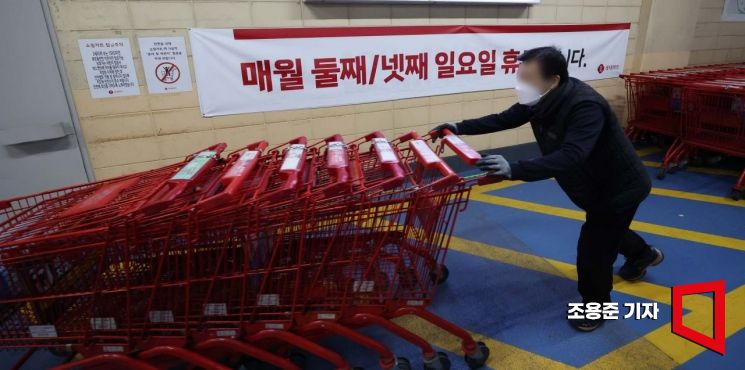 Repairs are the same. Frequent breakdowns occur in the store parking lot, excluding stolen carts. There are also cases where vehicles collide with carts left unattended in the parking lot. The photo is not related to the specific content of the article.
 Photo by Jo Yongjun jun21@
Moreover, the shopping carts were left unsightly in various places such as apartment crosswalks, parking lots, and garbage collection sites, negatively affecting the appearance around the apartment complexes. A security guard at an apartment said, "(Every day) around evening, there are about 10 to 20 carts. The parking lot corner requires cars to turn, but because of these carts, I have to go out and organize them every time," he complained. Dozens of carts are discarded daily. Due to this situation, supermarket employees sometimes have to come to apartment complexes 5 to 6 times a day to collect the carts, creating a laughable situation.
Supermarket employee A stated, "Each shopping cart costs about 100,000 won, and 100 carts disappear every year." He shared a shocking customer story, saying, "Once, when someone took a cart up the elevator, I told them to leave it here, but they retorted, 'I get paid, so why do you interfere here?'" A also revealed that there have been cases where carts were stolen and sold to scrap dealers, adding to the shock.
Supermarket Carts: One Out of Every Five Discarded Annually
According to the distribution industry, the annual discard and repair rate of carts combined is around 20%. This means that one out of every five carts becomes unusable each year. Most discarded carts are lost. Repairs are made to damaged or broken carts, but many of these cannot be reused. Including these, the discard rate of carts increases further.
Especially, stores located near urban residential areas tend to have higher rates of cart discard and repair. This is because more customers in these areas use the supermarket on foot rather than by car. The larger and heavier the purchased items, the more frequently carts are taken outside. This is because customers do not use vehicles. Additionally, if stolen carts are not recovered, the supermarket incurs financial losses.
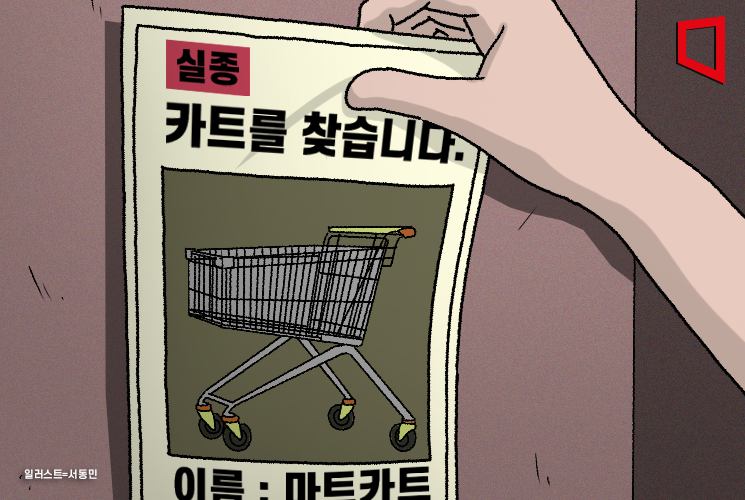
A cart costs about 150,000 won each. Therefore, supermarkets mobilize manpower and vehicles to collect them. However, stolen carts inevitably require repairs, doubling the costs. The cart wheels are damaged from traveling on asphalt and other surfaces. Cart wheels play a role in tightly fixing the cart to supermarket escalators. Using damaged wheels poses safety risks.
Repairs are similar. Aside from stolen carts, frequent breakdowns occur in store parking lots. There are cases where vehicles collide with carts left arbitrarily in parking lots. Most vehicle repair costs are the supermarket's responsibility. Even if manpower is assigned to promptly remove carts, there are limits. However, removing carts is not a solution. Carts are essential for both customers and supermarkets. Hand baskets are insufficient to encourage the purchase of multiple items. There are no stores without carts even in North America or Europe, where large supermarkets were first established.
Installing devices around stores to block cart movement is burdensome in many ways. Customers are often seen as potential 'cart thieves,' leading to frequent complaints. Additionally, it may obstruct the passage of the mobility-impaired, causing further inconvenience. The industry appeals that the only solution is for customers to use carts maturely whenever possible.
© The Asia Business Daily(www.asiae.co.kr). All rights reserved.


















