There has been a call for professional developers to participate in privately-led urban public housing complex projects (urban complex projects). To meet rapidly changing housing demands, it is argued that developers with expertise and capital should step forward to develop cultural facilities, industrial facilities, and housing in a mixed-use manner.
Lee Jin, Head of Policy Research at the Korea Real Estate Development Association, stated at the "Relay Seminar on Responding to Real Estate Market Issues" held at the Construction Hall on the 18th that developers should be allowed to participate as full project operators in private urban complex projects. Lee said, "Developers can participate in development through REITs, but if they have expertise and capital, they should be allowed to act as direct operators."
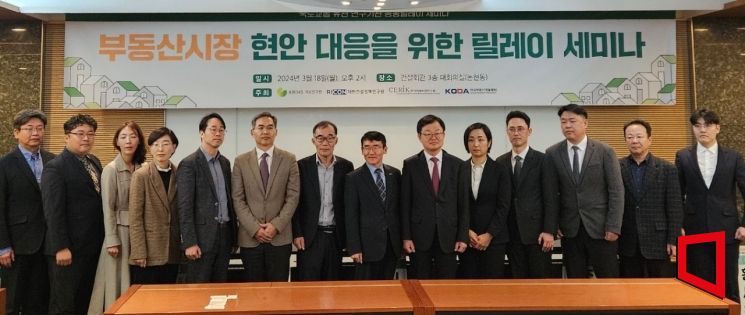 Photo of the "Relay Seminar for Responding to Current Issues in the Real Estate Market" held on the 18th at the Construction Hall by the Korea Research Institute for Human Settlements, Korea Construction Policy Research Institute, Korea Institute of Construction Industry, and Korea Real Estate Development Association. Photo by Seungwook Park
Lee also added, "Just as private loans and investment banks were utilized in Tokyo Roppongi Hills in Japan, various investors should participate domestically as well." The intention is to support rapidly changing housing demands through urban complex projects.
There were also criticisms that urban complex projects are failing to keep up with housing trends. Since the pandemic, the spread of remote work culture has expanded the function of homes as places for both rest and work. However, urban complex projects have not supported these housing needs, so it is argued that the private sector should be activated in urban complex projects with public support.
In particular, there was an opinion that the current flexible use system should be reorganized into a major classification system reflecting mixed-use and use conversion to support high-density development.
Problems with the current land use management system were also pointed out. The land use management system is divided into use districts, plans, and review permits. Unlike discretionary review permits, use districts and plans must be implemented with clearly stated laws, ordinances, and plan contents. Due to this rigid operation, there are limitations to complex development.
The Ministry of Land, Infrastructure and Transport responded that it will improve the uniformity of the current system, which does not support rapidly changing housing demands. Cho Hyun-jun, Director General of Urban Housing Supply at the Ministry, said, "Urban complex projects must be pursued jointly by the public and private sectors," adding, "We said we would focus on trusts and REITs for urban complex projects, but we are considering diversification." The intention is to attract not only trusts and REITs but also more participants to urban complex projects.
Meanwhile, the government pushed for the enactment of the "Urban Complex Development Act" in December 2022, which includes the possibility of participation by private specialized institutions such as trusts and REITs in urban complex projects. Through this, it also aimed to supply 200,000 housing units. This bill was promulgated in February and will be enforced in February next year.
In addition to the Urban Complex Development Act, the Ministry plans to discuss with the industry methods such as land in-kind contributions and equity sharing, and intends to propose related enforcement decrees and rules in the first half of this year, with guidelines to be released in the second half.
© The Asia Business Daily(www.asiae.co.kr). All rights reserved.

















