The High-ranking Officials' Crime Investigation Office (Hugo) announced that it will implement an amendment to the case handling regulations that deletes the provision requiring the submission of related documents to the Seoul Central District Prosecutors' Office when deciding not to prosecute cases without indictment authority. In response, the Ministry of Justice rebutted, stating that "the claim that cases without indictment authority can be subject to non-prosecution decisions does not conform to the criminal law system."
On the 18th, the Ministry of Justice stated, "According to the amended Hugo case handling regulations, Hugo can make non-prosecution decisions even on cases for which it does not have indictment authority. In such cases, complainants and accusers cannot file appeals or re-appeals, and under Article 29 of the Hugo Act, they can only file a petition for review with the court."
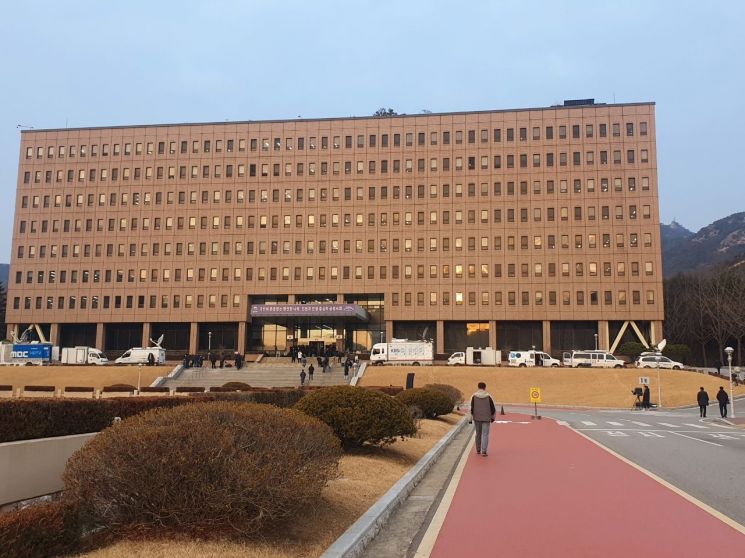
The Ministry of Justice said, "We have conveyed our opposition to the rule amendment to Hugo twice, on February 16 and this month on the 18th," adding, "First, depriving complainants and accusers of their rights to appeal and re-appeal through administrative rules without explicit legal provisions has a high risk of being unconstitutional."
It continued, "Moreover, during the National Assembly's deliberations on the Hugo Act, it was discussed that non-prosecution decisions subject to petitions for review under Article 29 of the Hugo Act are limited to cases where indictment authority exists," citing the minutes of the first subcommittee meeting of the National Assembly's Legislation and Judiciary Committee dated November 25, 2020.
Finally, the Ministry of Justice stated, "Logically, indictment authority and the right to decide non-prosecution are inseparable, like two sides of the same coin. Therefore, the claim that Hugo can only make non-prosecution decisions despite lacking indictment authority does not conform to the criminal justice system."
On the same day, Hugo announced that it plans to publish the amended case handling regulations, which reflect its existing position that "it has the authority to make non-prosecution decisions even on cases without indictment authority under the Hugo Act," in the official gazette on the 19th and implement them thereafter.
The amended case handling regulations contain two main points.
First, Article 28, Paragraph 2 of the regulations, which stipulated that when Hugo investigates cases without indictment authority and decides not to prosecute, it must send a case transfer document along with related documents and evidence to a prosecutor belonging to the Seoul Central District Prosecutors' Office, has been deleted.
Second, Article 42 (Investigation Deliberation Committee, etc.) has been amended to remove the Investigation Advisory Group and integrate it into the Investigation Deliberation Committee.
Article 3, Paragraph 1, Subparagraph 2 of the Hugo Act limits the subjects Hugo can indict to ▲ the Chief Justice and Justices of the Supreme Court ▲ the Prosecutor General ▲ police officers of rank Superintendent or higher who are currently serving or have retired from that position, for high-ranking officials' crimes and related crimes committed by themselves or their family members while in office.
Article 26 (Submission of Related Documents and Evidence by Hugo Prosecutors), Paragraph 1 of the Hugo Act stipulates that "When a Hugo prosecutor investigates high-ranking officials' crimes other than those specified in Article 3, Paragraph 1, Subparagraph 2, they must promptly submit related documents and evidence to a prosecutor belonging to the Seoul Central District Prosecutors' Office."
Given that the Hugo Act requires Hugo prosecutors to submit related documents and evidence to the Seoul Central District Prosecutors' Office after completing investigations of cases other than those specified in Article 3, Paragraph 1, Subparagraph 2, the Ministry of Justice and the Supreme Prosecutors' Office hold the position that the amended regulation, which exempts submission of related documents for cases where Hugo has decided not to prosecute, violates higher laws.
On the other hand, Hugo maintains that "the amended case handling regulations supplement deficiencies that have emerged in the operation of the system based on the Hugo Act and decisions by the Constitutional Court and courts."
Hugo cites Article 27 of the Hugo Act as the basis for its authority to make non-prosecution decisions on all investigated crimes, regardless of indictment authority.
Article 27 (Transfer of Related or Cognizant Cases) of the Hugo Act states, "When the head decides not to prosecute a high-ranking officials' crime, related crime cases discovered during the investigation must be transferred to the Supreme Prosecutors' Office."
Hugo also cites Article 29 of the Hugo Act concerning petitions for review as another basis.
Article 29 (Special Provisions on Petitions for Review), Paragraph 1 of the Hugo Act states, "When a complainant or accuser receives notification from a Hugo prosecutor that prosecution will not be initiated, they may file a petition for review on the matter with the Seoul High Court."
This provision allows complainants and accusers to file petitions for review with the court upon notification of non-prosecution by Hugo, regardless of whether Hugo has indictment authority. Hugo argues that this presupposes that Hugo retains the relevant 'non-prosecution records.'
In practice, courts dismiss petitions for review on cases where Hugo lacks indictment authority, stating reasons such as "the non-prosecution decision by the Hugo prosecutor is acceptable," which Hugo interprets as a decision made on the premise that the non-prosecution decision by the Hugo prosecutor is lawful.
Finally, Hugo points to the Constitutional Court's prior statement that "Hugo prosecutors have the same authority as prosecutors in the Prosecutors' Office" and "can perform the duties of prosecutors under Article 4 of the Prosecutors' Office Act," arguing that Hugo prosecutors naturally possess the authority to dispose of cases (including indictment and non-prosecution decisions) held by prosecutors in the Prosecutors' Office.
Given the significant differences in positions between the Ministry of Justice, the Supreme Prosecutors' Office, and Hugo, there are concerns about confusion at investigation sites due to inter-agency conflicts.
Previously, Hugo had a serious conflict with the prosecution over conditional transfer with reserved prosecution rights but abandoned its position and deleted the relevant provision through rule amendments in January 2022.
© The Asia Business Daily(www.asiae.co.kr). All rights reserved.

















