Notification of Improvement Measures to the Ministry of the Interior and Safety and the Ministry of Environment
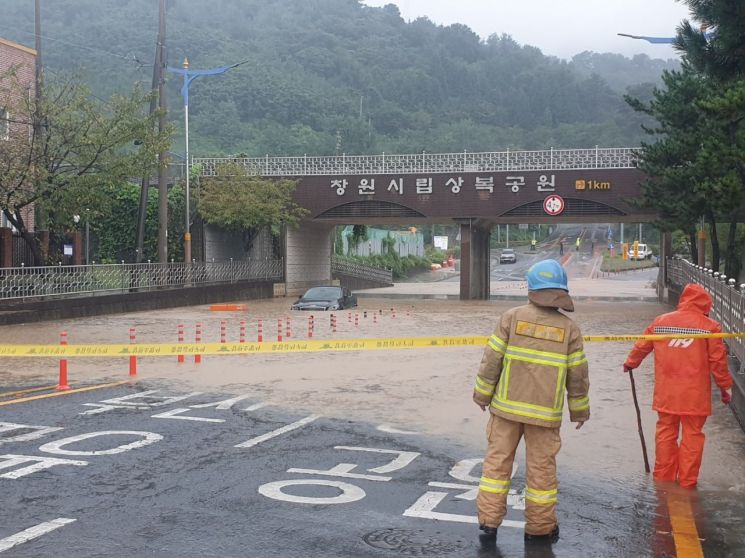
The Board of Audit and Inspection pointed out that the government has been establishing or promoting design standards and projects for social infrastructure based on past weather data without making scientific predictions or with insufficient predictions regarding future climate change, which is problematic.
On the 18th, the Board announced that applying the future climate change scenarios from the Intergovernmental Panel on Climate Change (IPCC), a UN-affiliated international climate organization, to short-, medium-, and long-term periods showed increased risks of urban flooding, dam overtopping, bridge collapse, port flooding, and railway rail buckling due to climate change. Accordingly, it notified the Ministry of the Interior and Safety and the Ministry of Environment to prepare improvement measures.
According to the Board, simulations of the stability of domestic dams revealed that among a total of 14 dams, Pyeonghwa Dam experienced overtopping in all scenarios, and nine dams including Soyanggang Dam showed overtopping or insufficient freeboard in some scenarios.
Regarding bridges, among 313 bridges in the metropolitan area, the number of bridges experiencing overtopping increased by up to 64, and those with insufficient freeboard increased by 20 compared to the existing basic river plans. Accordingly, the Board notified the Ministry of Environment to prepare measures to effectively respond to future risks such as dam overtopping by reflecting climate change factors in dam design standards and related regulations.
Urban drainage facilities are also expected to have a higher possibility of additional flooding. Simulation results showed that in the worst case, the flooded area in Siheung City, Gyeonggi Province, could increase by up to 74 square meters, and the damage cost could rise by 465.5 billion KRW. The Siheunghajung public housing district currently experiences flooding in five areas, and with future climate change applied, up to ten additional areas may be at risk of flooding.
Furthermore, during the 2022 flooding in Gangnam District, Seoul, the hourly rainfall exceeded the disaster prevention performance targets. It was confirmed that the Ministry of the Interior and Safety’s “disaster prevention performance targets,” which serve as design standards for urban drainage facilities, are insufficient to reflect future risks.
The Board requested the Ministry of the Interior and Safety to establish disaster prevention performance targets that predict rainfall increase rates in line with future climate change progress and contribute to flood prevention in vulnerable areas and public housing districts.
Port structures were also found to be exposed to the risk of sea level rise. The Board predicted that flood areas would increase in disaster-vulnerable zones within port areas such as Tongyeong Port, Masan Port, Pyeongtaek-Dangjin Port, and Nokdong New Port, as well as in Busan Marine City, and notified the Ministry of Oceans and Fisheries to make improvements.
Additionally, railways (rails) are expected to require preparation for heatwaves. Analysis showed that although there were no occurrences of atmospheric temperatures above 40°C in the past 30 years, the probability of temperatures exceeding 40°C in the future could increase up to 53.4%, and consequently, the probability of buckling in high-speed railways could rise up to 0.2%.
© The Asia Business Daily(www.asiae.co.kr). All rights reserved.
![User Who Sold Erroneously Deposited Bitcoins to Repay Debt and Fund Entertainment... What Did the Supreme Court Decide in 2021? [Legal Issue Check]](https://cwcontent.asiae.co.kr/asiaresize/183/2026020910431234020_1770601391.png)















