Government, Livelihood Economy Inspection Meeting
All Ministries United to Achieve 2% Inflation Rate
The government will urgently inject 150 billion KRW to stabilize the prices of agricultural and livestock products, which are driving inflation. In response to the soaring apple prices, high-demand imported fruits such as cherries and kiwis will be added to the tariff reduction list, and the applicable quantities will be significantly increased to expand the supply of alternative fruits.
On the 18th, the government announced these measures at the 'Livelihood Economy Inspection Meeting' chaired by President Yoon Seok-yeol. The Ministry of Economy and Finance stated, "We will immediately inject 150 billion KRW into emergency agricultural and livestock price stabilization funds this week and continue support until prices stabilize." The 150 billion KRW will be used to support price reductions for distributors of fruits and vegetables or to subsidize discounts on agricultural and livestock products.
First, the scale of support for agricultural product delivery prices will be expanded to 75.5 billion KRW. The number of supported items will increase from the existing 13 to 21, and the support price will be raised up to twice the current level. To reduce the direct burden on consumers, the discount rate for agricultural and livestock products in March and April will be increased from 20% to 30%. The tariff reduction list for imported fruits will also be expanded from the previous 24 items, including bananas, pineapples, mangoes, grapefruits, and oranges, to add high-demand items such as cherries, kiwis, and mangosteen.
The Ministry of Agriculture, Food and Rural Affairs explained, "We will expand direct imports by the Korea Agro-Fisheries & Food Trade Corporation (aT), focusing on bananas and oranges, to concentrate supply in March and April, and increase the quota and volume of tariff-rate quota items."
Additionally, to stabilize the soaring fruit prices, plans will be announced in early April to foster new apple production areas and establish specialized next-generation orchards that are high-quality, high-yield, and resistant to heat and pests, as part of mid- to long-term measures to enhance the competitiveness of the fruit industry.
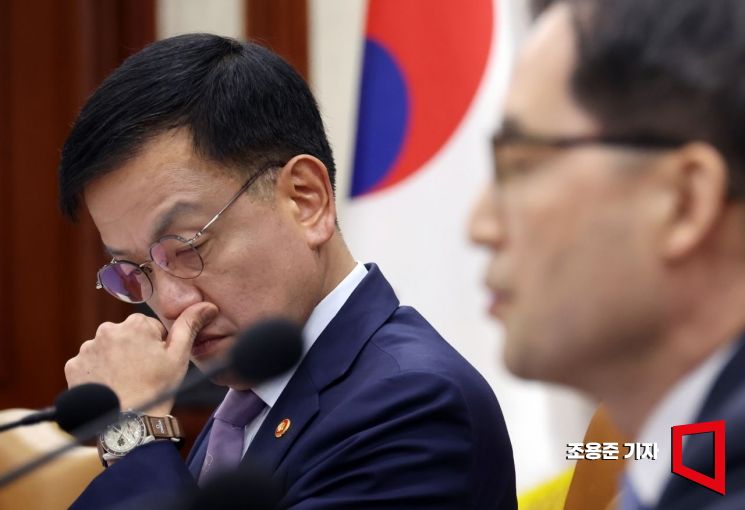 On the 13th, as the prices of fruits including apples soared, causing an emergency in the cost of food, Choi Sang-mok, Deputy Prime Minister for Economy and Minister of Strategy and Finance, attended an emergency economic ministers' meeting held at the Government Seoul Office in Jongno-gu, Seoul, and was deep in thought. Photo by Jo Yong-jun jun21@
Discount support and supply for seafood will also be increased. The Ministry of Oceans and Fisheries announced, "We will invest 50 billion KRW in discount support for seafood purchases through traditional markets, marts, online malls, and mobile gift certificates in March and April." The support scale has been increased by about 11.8 billion KRW from the original 38.2 billion KRW.
Discount events at marts and online malls will be extended by one week in March. Depending on the cooperation level of distributors in stabilizing prices, the number of items will be expanded and additional budgets will be allocated, with plans to provide incentives worth 20 billion KRW.
For squid, the government plans to quickly release a total of 600 tons?400 tons from government stockpiles and 200 tons from private holdings?until April, when supplies from distant-water fisheries begin, to maintain stability. Additionally, to disperse demand for squid, which is in short supply, 400 tons of government stockpiles of five other popular fish species?mackerel, pollock, hairtail, yellow croaker, and dried anchovies?will be supplied at a maximum 30% discount.
Furthermore, if international oil price instability continues, the government is considering extending the fuel tax reduction beyond April. Through the inter-ministerial Petroleum Market Inspection Team, excessive fuel tax increases will also be monitored and controlled.
© The Asia Business Daily(www.asiae.co.kr). All rights reserved.

















