2030 Greenhouse Gas Reduction Target Approximately 86 Million Tons
Banking Sector, KDB and KEXIM Jointly Invest in Fund
The government will supply a total of 420 trillion won in policy finance by 2030 to respond to the climate crisis. The banking sector will also invest about 10 trillion won together with policy finance institutions to create funds related to future energy and climate technology, thereby supplying venture capital.
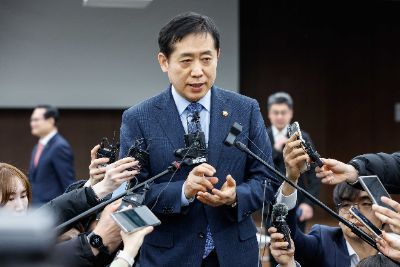 Kim Ju-hyun, Chairman of the Financial Services Commission, is answering questions from the press after the 'Rapid Credit Recovery Support Implementation Event for Low-income and Small Business Owners' held at the Bankers' Hall in Jung-gu, Seoul on the 12th. Photo by Kang Jin-hyung aymsdream@
On the morning of the 19th, Kim Joo-hyun, Chairman of the Financial Services Commission, held a meeting with heads of commercial banks and policy finance institutions at the Seoul Energy Dream Center in Mapo-gu, Seoul, attended by Kim Sang-hyup, private chairman of the 2050 Carbon Neutrality and Green Growth Committee, and Han Hwa-jin, Minister of Environment. He announced the 'Plan to Expand Financial Support for Climate Crisis Response' containing these details.
Accordingly, the financial authorities decided to increase the annual average supply of green funds by five policy finance institutions related to climate crisis response?KDB Industrial Bank, IBK Industrial Bank, Export-Import Bank, Credit Guarantee Fund, and Technology Guarantee Fund?from the average of the previous five years (36 trillion won) by 67% to 60 trillion won. The total supply amount by 2030 will reach 420 trillion won.
Of the 420 trillion won supply, 141 trillion won will be allocated to low-carbon transition, and 279 trillion won will support low-carbon facility investment, product manufacturing, and technology support. In particular, the authorities plan to adjust the policy finance supply to 48.6 trillion won this year and 74.4 trillion won in 2030, anticipating further increases in funding demand. Accordingly, the authorities expect greenhouse gas reduction by 2030 to reach about 85.97 million tons, which accounts for 29.5% of the national reduction target of 291 million tons by 2030.
They will also initiate fund supply through public-private cooperation. Of the approximately 54 trillion won in venture capital demand, 23 trillion won will be jointly borne by policy finance institutions and commercial banks. The total required funds for renewable power generation expansion by 2030 are estimated at 188 trillion won, with financial demand around 160 trillion won. However, due to the long process from loan to recovery characteristic of the industry, financing is not easy. For example, offshore wind power is estimated to take about 25 years from loan to recovery.

Accordingly, the Korea Development Bank and the five major commercial banks (KB Kookmin, Shinhan, Hana, Woori, NH Nonghyup) plan to invest 9 trillion won (1.8 trillion won from Korea Development Bank and 7.2 trillion won from the five banks) by 2030 to create a 'Future Energy Fund.' The first phase will establish a fund of 1.26 trillion won, with additional investments made as needed through a consultative body composed of the six investing banks. In this process, considering Korea Development Bank's risk absorption capacity, the risk weight will be significantly lowered from the current 400% to 100% to reduce the Basel International Settlement Bank (BIS) ratio burden on commercial banks.
Furthermore, about 9 trillion won will be supplied jointly by the public and private sectors in the climate technology field to develop future growth engines. Climate technology is a promising industry expected to grow at an average annual rate of 24.5%, but often faces difficulties in development due to initial economic feasibility issues.
Accordingly, IBK Industrial Bank and the five major commercial banks will invest a total of 1.05 trillion won to match private funds of 1.95 trillion won, creating a climate technology fund totaling 3 trillion won. The first phase will establish a fund of 360 billion won, with additional funds added as needed. Alongside this, the authorities will also foster climate technology through the Innovation Growth Fund (3 trillion won) and Growth Ladder Fund (1 trillion won).
Institutional improvements will be pursued simultaneously. The authorities plan to prepare a 'Green Loan Management Guideline (tentative name)' within the year to assist the application of the Korean Green Taxonomy to loans, and will support strengthening management related to this by holding a financial sector climate risk symposium. Additionally, the authorities will form a 'Climate Finance Consultative Body' with related ministries and agencies to guide funds to be supplied appropriately, and will identify and review long-term tasks for achieving carbon neutrality through a 'Future Response Finance Task Force (TF)' to prepare necessary financial support plans by 2050.
Regarding this, Cho Yong-byeong, Chairman of the Korea Federation of Banks, said, "It is meaningful that the banking sector is participating in preparing a sustainable future through this financial support," and added, "The banking sector will contribute to Korea's climate crisis response and future development by supplying funds to green industries."
Kang Seok-hoon, Chairman of Korea Development Bank, also said, "We will continuously expand green finance to support companies' eco-friendly and low-carbon transitions," and added, "Through the transition to clean energy and fostering climate technology, we will actively support not only responding to the climate crisis but also the cultivation and growth of green industries."
Chairman Kim expressed gratitude to the participating banks, stating, "The unprecedented climate change we face today is a problem that must be solved not only for the competitiveness of our companies but also for future generations," and added, "Today's measures represent a meaningful first step in responding to the climate crisis through collaboration among the government, policy finance institutions, and banks."
© The Asia Business Daily(www.asiae.co.kr). All rights reserved.
![User Who Sold Erroneously Deposited Bitcoins to Repay Debt and Fund Entertainment... What Did the Supreme Court Decide in 2021? [Legal Issue Check]](https://cwcontent.asiae.co.kr/asiaresize/183/2026020910431234020_1770601391.png)

















